


This play was first performed back in 2002 at the National Theatre where it won plaudits for the author, Nicholas Wright, director, Richard Eyre, and Clare Higgins, in one of the lead roles. It is hard to see why it has not been performed more in the interim, as on the strengths of this new production at the Orange Tree Theatre, Richmond, its quality still shines out as brightly as Van Gogh’s ‘Starry Night.’
The action takes place in Stockwell in 1873, something of a mystery pivot period in the artist’s life, when he spent a year in London as a trainee art salesman and lodged with a widow and her daughter, the Loyers. He left abruptly for Paris in underexplained circumstances, though his family hinted at revealed secrets that had upset his mental balance. This play sets out to fill the gaps, and Nicholas Wright does so in a way that is wholly convincing dramatically, while not doing violence to the known facts. A rare achievement.
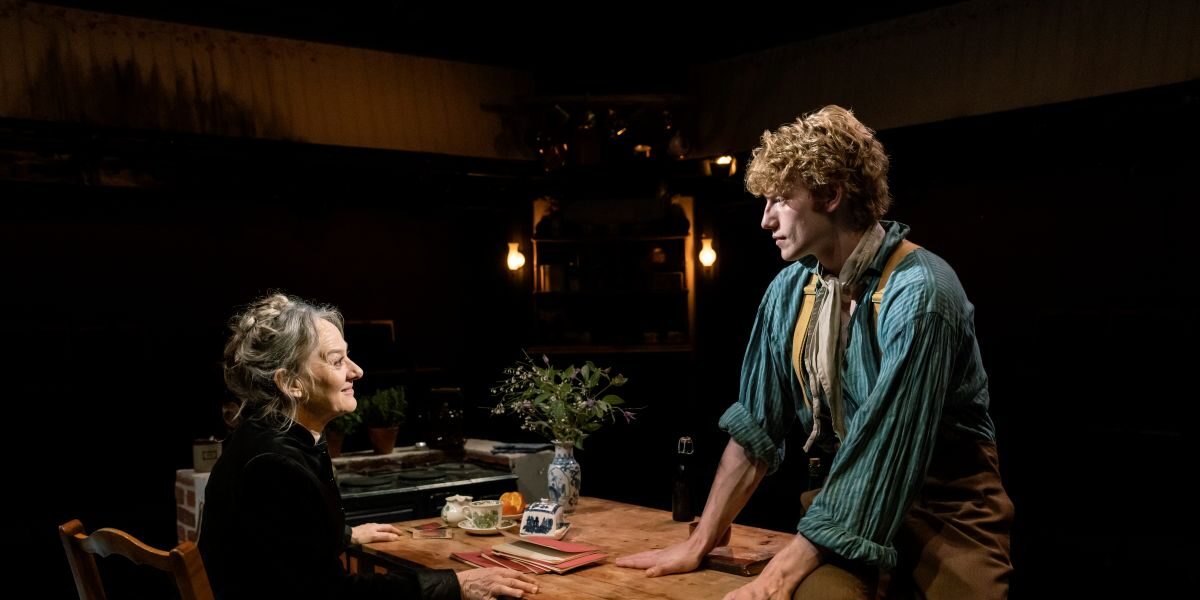
The lights go up on an immaculately recreated Victorian kitchen, with a real meal cooking on the range – yet another meticulously detailed set from this theatre that commands admiration. We first meet Ursula, very much still wearing widow’s black, and then the young Van Gogh, all physical awkwardness and abrupt unfiltered commentary, as he persuades her to take him on as a tenant. They are joined by Ursula’s daughter, Eugenie, who helps her in running a small school, and the other lodger, Sam Plowman, a decorator with artistic ambitions of his own.
In his blunt full-on way Vincent decides he is in love with the daughter, but it turns out she is already semi-secretly committed to Sam. So far, so conventional. But then something remarkable happens – Ursula and Vincent fall for each other. The second scene of the play which brings this about is a truly magnificent piece of slow-burn writing, which requires acting of great skill and finesse and this it receives in the hands of Niamh Cusack and Jeroen Frank Kales.
Their empathy starts from a shared experience of depression – ‘It starts with something small and then it becomes everything.’ – and then develops into a love that refuses to recognise boundaries, with his conviction that ‘No woman is old as long as she loves and is loved.’ and her longstanding determination to assist and lose herself in the nurturing of a rare talent. When the interval comes you feel the actors have taken you through a huge arc of emotions and yet this is only half-way.
There is a surprising and very clever change of tone when we come back. The first few minutes are dominated by the arrival of Van Gogh’s sister Anna, almost a caricature of Dutch stereotypes – blunt to the point of rudeness, determine to clean the house on arrival, and bossily put everyone’s lives in order. We hover on the edge of farcical comedy. But then the tone darkens as she discovers the truth, and all that has been elaborately achieved in the first half is rapidly unravelled and replaced by the bleak return of prosaic realities. Again it is a sign of dramatic confidence that the final scenes are a slow fade back into darkness rather than the false note of melodrama.
The acting and direction are exceptional throughout. The intimacy of the theatre allows the actors the luxury of taking the size of performances down and you register the return of Ursula’s depression in the smallest of Cusack’s gestures ofwilting hopelessness. This is a peach of a part for an older woman and she plays it with the utmost delicacy, pent-up passion and wistful refinement. Kales grows visibly through the play and embodies in his performance as Vincent the emergence of a real artistic personality as well as a more mature adult, though one clearly oddly aligned to the world. The relationship of creativity to life experience is subtly sketched out here.
The other parts are developed with real depth of characterisation. Rawaed Asde does a lot with the role of Sam – you sense his affable, sensual nature, but also, in carefully calibrated moments, his growing realisation that his talent is more for family life than the lonely sacrifice of the artist’s career. As Eugenie, Ayesha Ostle starts submissively, but finds a full presence and meaning for her role by the end; and Amber Van Der Brugge finds a fine line between broadbrush comedy and superbly incisive interventions that gives real edge and bite to the later scenes.
This is one of the very best plays and productions I have seen this year and will be a strong contender for awards, while also confirming once more the reputation of this house for breathing new and compelling life into plays that deserve to be given a voice once more.
Writer: Nicholas Wright
Director: Georgia Green
Cast: Rawaed Asde, Niamh Cusack and Jeroen Frank Kales, Ayesha Ostle, Amber Van Der Brugge
Until 18 April 2026
2 hrs 10 mins with interval
Photo Credit: Johan Persson