


I was enthralled by the original 1998 production of this play that sustained so many levels of intellectual debate within the simple framework of a three-way conversation. Starting from the pretext of discovering why German scientist Werner Heisenberg visited his old mentor Niels Bohr in Copenhagen in 1941 and what led to the severing of their friendship, the play becomes a moral investigation of the origins of the atomic bomb, an account of the development of quantum mechanics, the nature of the creative process in theoretical physics, and a meditation on the unreliability and self-decptions of memory, as each of the participants construct contradictory accounts of what really happened whether to bolster their later decisions and actions, or even to search for a meaning and justification that eluded them at the time.
I left this revival, however, with mixed feelings. There is some truly eloquent writing here, particularly in the set-piece speeches of the second half that harvest the insights of the earlier part of the evening. And the application of Heisenberg’s own principle of uncertainty to the plot and structure of the play as much as to the science still strikes me as a brilliant dramatic inspiration on the part of Michael Frayn. However, there is also a lot that has not aged well. The play is simply too long: the first half in particular drags and sags badly in places as the dramatic impetus falters and mere exposition takes over from dramatic representation. We could lose at least one of the many versions of what happened to advantage.
If the performances on press night had been in better balance we would have noticed these issues less. Just as a three-legged stool needs three fully secure legs for it function, so a tripartite cast needs all of its members to be on song. While doubtless this will mitigate through the run, on press night Richard Schiff seemed either uncertain or overly emphatic in his delivery, and that meant the key mentor-son relationship with Damien Molony’s Heisenberg did not convince. We never got the proper sense of Bohr’s grave authority as the ‘pope’ of nuclear physics, and thus the back-and-forth of the debate did not land as evenly as it should.
This problem also impacted Alex Kingston’s generally excellent performance of the role of Bohr’s wife, Margrethe. This is a key role in the play, for she acts as the moral arbiter and scientific interpreter for the audience. In order to give more momentum to the action she had to take a compensating lead more than the part really allows for, thus upsetting the balance of her own characterisation. Molony’s performance therefore dominated more than it perhaps should; but he still gave a very convincing detailed account of both Heisenberg’s scientific swagger and brashness and his moral ambiguity and naivety.
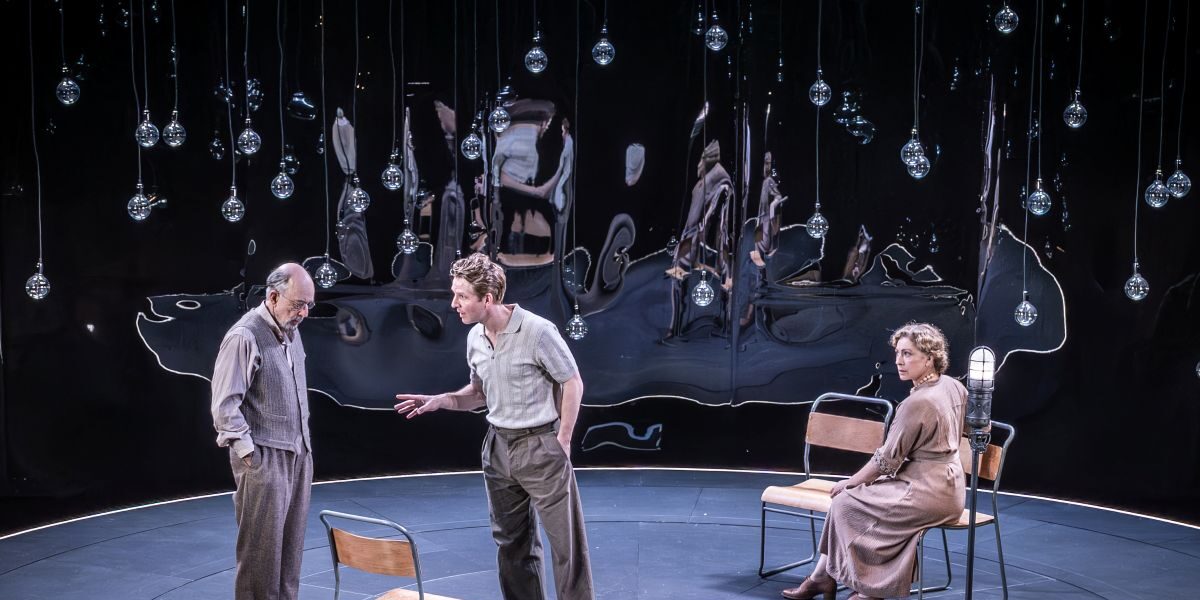
Joanna Scotcher and Neil Austin, the set and lighting designers, are perhaps the real heroes of the evening – indeed their contributions deserve to win awards for subtlety and layered depth. The set offers a circular platform containing two revolves and just three chairs. A mirrored backdrop reflects back colour from a series of hanging lights, and the whole sits in a pool of water. The integration of the setting and lighting gives a visual depiction of the structure of the atom and its orbiting particles while also pinpointing key references to water, city walks, and even in one key moment, an atomic detonation.
Michael Longhurst and this creative team therefore could not have done more to lend contextual dramatic life to this production, which perhaps needed another week of rehearsals to be where it ought to be. My advice would be to see it later in the run, if tickets are available.
Writer: Michael Frayn
Director: Michael Longhurst
Cast: Alex Kingston, Damien Molony, Richard Schiff
Until 2 May 2026
2 hrs 45 with interval
Photo Credit: Marc Brenner