


Productions of plays by George Bernard Shaw are fairly rare these days. Like Haydn in classical music, he has been labelled as box-office poison, and even if it is hard to understand why. Yes, the plays are self-consciously wordy with their punchy prose prefaces debating multiple issues passionately before the action even opens. But many of the issues raised are as salient now as they were last century, and there is no better example of that than St Joan which deals, among other themes, with the morality of war, the nature of religious inspiration, feminist self-assertion and the way the individual and community can cohere within a modern world.
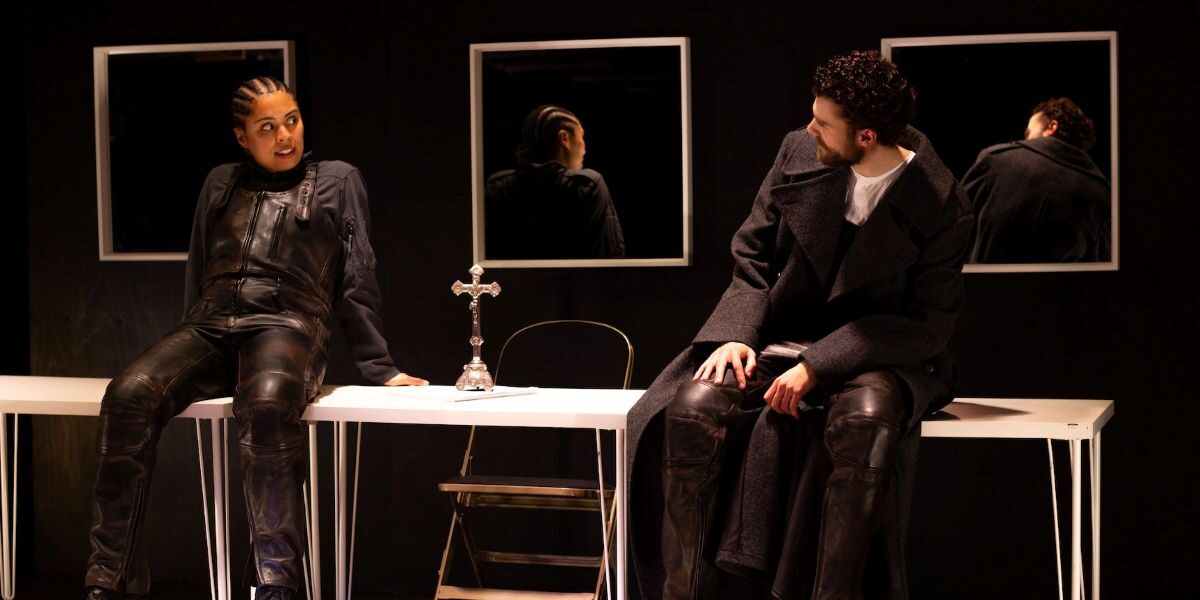
This adaptation strips the play down to an hour’s running time, with the focus very much on Joan herself, played by Ruthie Black, rather than the political or military milieu of early fifteenth-century France. Other roles are played by James Saxby, shifting from joshing fellow soldier, to the shrewdly-calculating dauphin, and onwards to Joan’s interrogator and judge. Black captures memorably many of the character’s key (and conflicting) traits: her visionary intensity, her combination of naivety and shrewd peasant pragmatism, her disdain for political calculation and faith in the common soldier. Saxby is perhaps more persuasive as Joan’s companion at arms, inspired by her example, than in depicting the more sophisticated political players. But the scene in which the inquisitor casts doubt on the reality of Joan’s visions is movingly played all round.
The setting is miminalist and none the worse for that – a black dais with reflective mirrors behind, a crucifix, a scatter of chairs and the actors wearing military leathers that suggests Game of Thrones. Locations are suggested with projected text, and a voiceover from a documentary about Joan introduces the whole.
There are some elements that do not convince. The songs add little and could be omitted to advantage; and overall the play seems too short. It is one thing to complain of Shaw’s overweening wordiness, as many contemporary critics do; but at his best, and this play is certainly is at that level, there is an intoxication about the effortless eloquence and forensic acuity in presenting viewpoints that makes the debate spell-binding. Even the most apparently unacceptable of viewpoints are given a fair hearing and the final outcome forces you to think hard for yourself, always the author’s best intention. If you strip too much of that away and make it mostly about Joan herself, the bracing challenge dissipates, the caveats fade, and the play becomes too narrowly a vehicle for heroic self-assertion instead. There is a balance to be struck between removing tiresome excrescences and sub-plots and preserving complexity. I am not sure this adaptation always hits that balance, for all the skill with which the protagonists present the material.
However, it is good to see the play taken up by a younger generation, and also to see the former Turbine Theatre back in action under new management.
G.B. Shaw adapted by Ruthie Black
Director: Peter Hinton-Davis
Cast: Ruthie Black and James Saxby
Until 12 April 2026
1 hr, no interval
Photo Credit: Haui