


It is always a challenge to produce a piece of literature two and a half millennia old, there is a temptation to introduce novelties to stress the contemporary meaning.
In Euripides’ story, based on the myth, Iphigenia arrives in Aulis where the Greek fleet is becalmed, happy to see her father. He tells her there will be a great ceremony which she looks forward to. ‘You will be there’ he tells her. We all know why: because he is going to make a human sacrifice of her to the goddess Artemis.
Agammemnon, who genuinely loves his daughter, is divided over whether to sacrifice her or send her back, a dilemma joined by his wife Clytemnestra who has travelled with Iphigenia despite being instructed to stay at home.
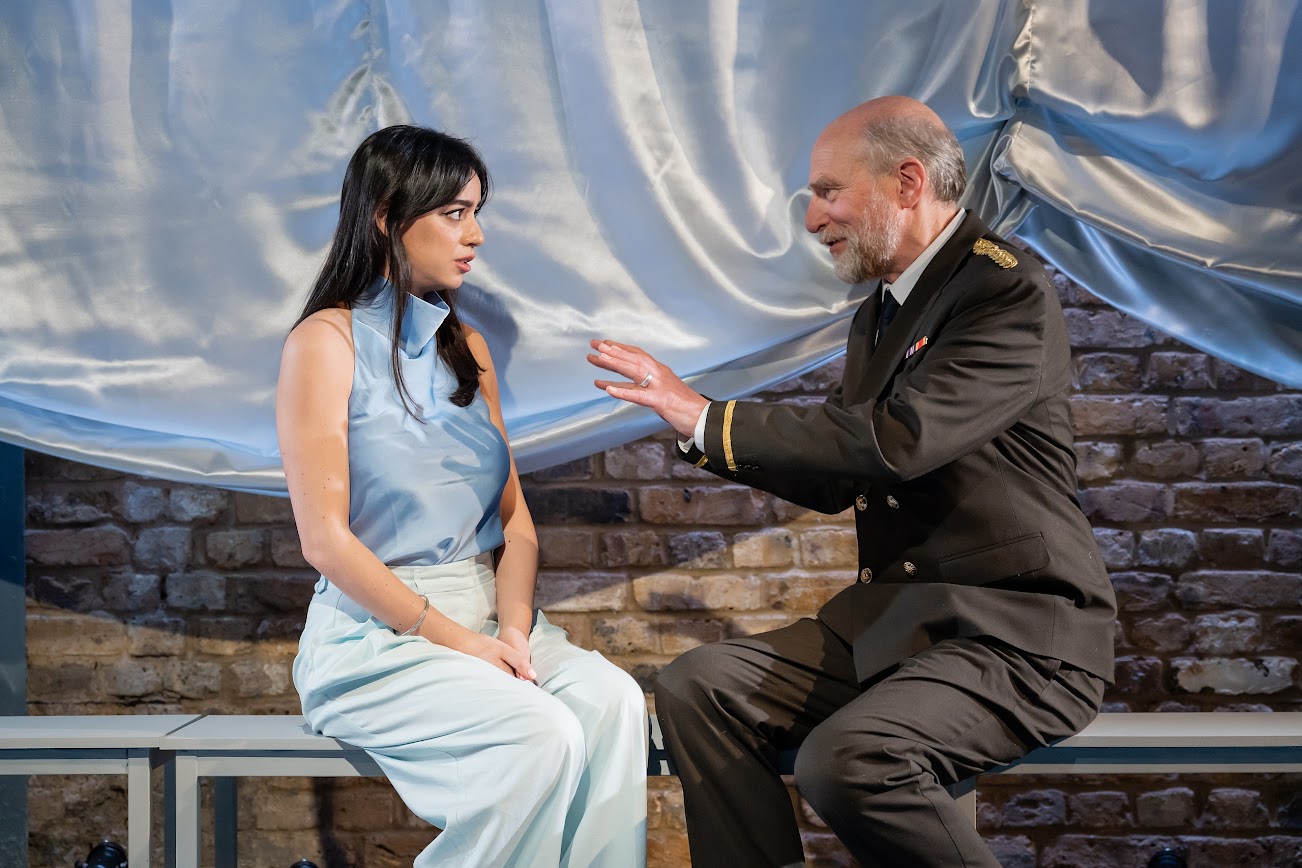
In Stephen Sharkey’s adaptation Euripides’ eight characters and chorus are pared down to three: Simon Kunz gives his portrayal of Agammemnon a Shakespearian gravitas; Clytemnestra is played with powerful anger by Indra Ove and in a superb performance by Mithra Malek, Iphigenia is seen as childish, trusting, betrayed and resolute as the character deepens through the play.
The reduction of the characters focuses on the family relationship while neglecting the other pressures on Agammemnon: of the army, the war and the compulsion of religion. These are reported by Agammemnon who pleads that he is trying to command a war fleet and to be in favour with the gods but these other demands, given equal weight in the original dama, are secondary here to the family dynamic. We know, of course, as the original audience did, that when Agamemnon kills Iphigenia he seals his own fate as Clytemnestra will go on to kill him.
Iphigenia in Aulis resonates because it is timeless, the truths it tells stay true. To bring it to a new audience, this production brings two innovations.
One is video clips screened through the production of women speaking about their experiences. They are Caribbean, Africa, China, Eastern Europe and others, some speaking in their own languages. They talk about fatherhood, motherhood, the vulnerability of children and other issues but I didn’t find the interruptions welcome. The only one I thought helpful was a Chinese woman saying, ‘If I died for my country my family would be proud of me’, that spoke directly to the script.
The other novelty director Serdar Bilis contributes are set pieces in which the actors talk about their lives, their childhoods, relationship with their parents and so on in scenes so clearly workshopped it looks like a peek into the rehearsal room. I don’t think it brings a lot to Euripides.
At times there is beautiful, haunting music from Kalia Lyraki who is under-used, I would have swapped the rather average videos for more of her.
Playwright: Euripides, adapted by Stephen Sharkey
Director: Serdar Bilis
Cast: Simon Kunz, Indra Ove, Mithra Malek
Music: Kalia Lyraki
Duration: 80 minutes no interval
Until: 2 May 2026