


Envisioned primarily as a theatrical tale about football fans (and probably football hooligans as well), Wojciech Kuczok’s “Ambona Ludu” tells the story of one of the most painful Polish maladies of recent years: ideological stratification. It prevents different social groups from reaching consensus and has led to ongoing political civil strife.
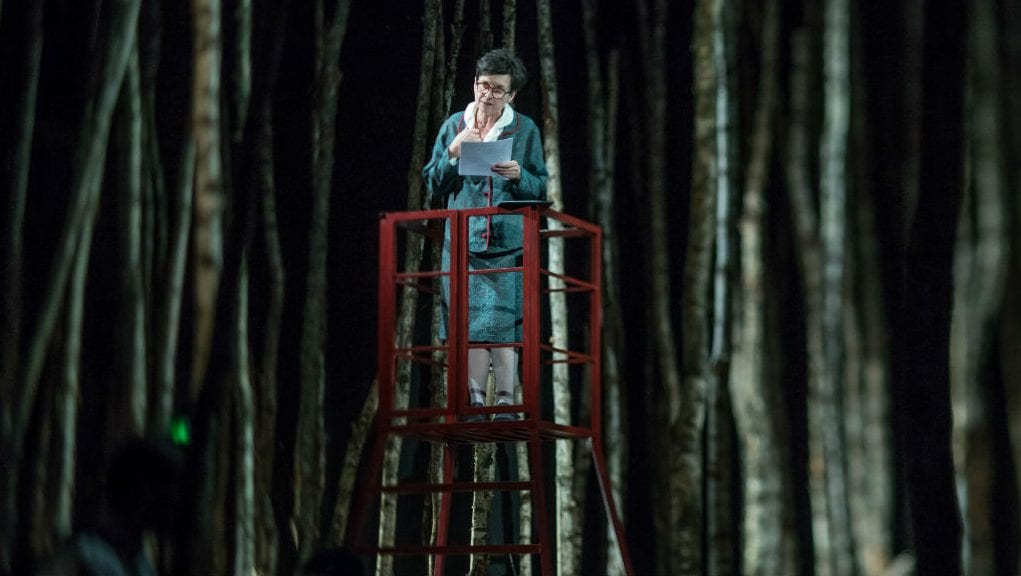
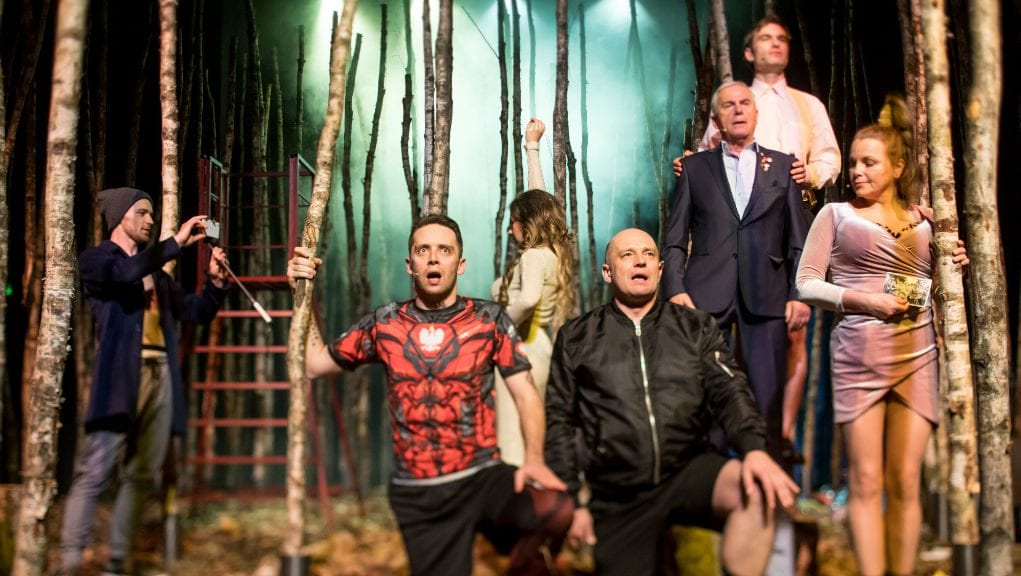
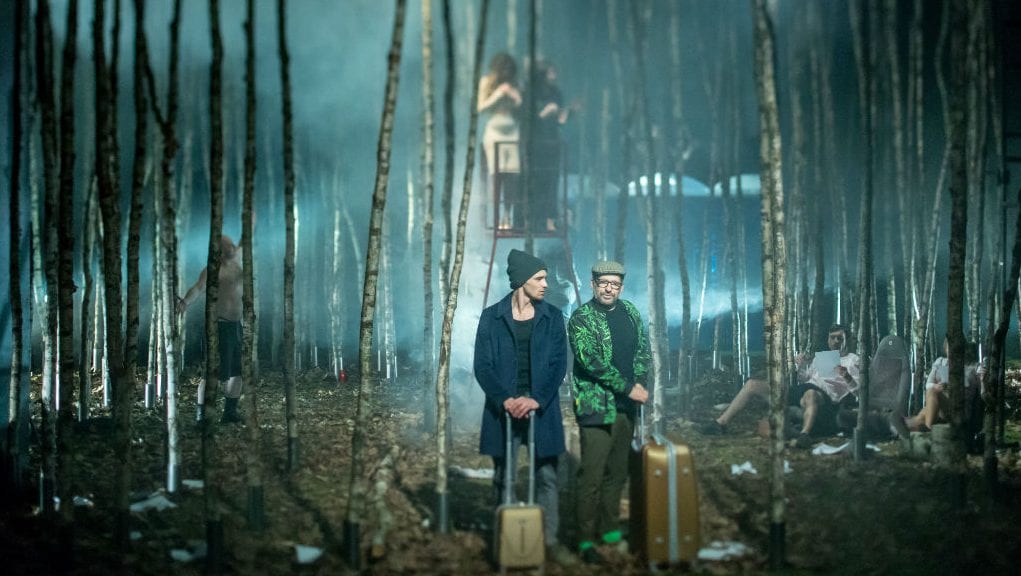
The play’s protagonists meet in a dense wood which, from the very beginning, successfully hides them not only from the audience’s view but also from one another. There’s a subtle cultural hint underlying Mirek Kaczmarek’s stage design that’s worth mentioning: the trees on stage are birches, which every Pole instantly associates with the 2010 Air Force Tu-154 crash, an event that has been dividing Polish society for almost seven years. Thus, being stuck in the birch forest, Kuczok’s characters are doomed to impeded communication.
The first to emerge from the woods are the diehard fans of Lech Poznań (the vigorous Marcin Kalisz and Filip Frątczak) who fashion themselves as the epitome of patriotism. Their devotion to the football club takes the form of vulgar songs and riots, whereas their affection for the motherland manifests itself in patriotic t-shirts and tattoos. It is their nationalistic views that will prevail throughout the performance, either overtly or subtly hidden behind the mask of patriotism.
Serving as counterbalances to the hooligans are the numerous representatives of the Polish intelligentsia. The most fascinating of them is the professor, portrayed by Daniela Popławska. While she appears onstage only twice–to read out scholarly comments on contemporary Poland–she immediately becomes the symbol of the detachment that is leading to the decay of the Polish elites. In addition to our academic, the intelligentsia is also represented by an actress rehearsing for the staging of “The Wedding” (a drama dealing with Polish internal feuds of the 19th century), as well as the eccentric director who proclaims the need to abandon all speech onstage, and the artistic director who compares Poland to a pit filled with excrement.
While the onstage world created by Kuczok relies on stereotypes, it is far from being simplistic and one-dimensional. The seemingly violent nationalism of Filip Frątczak’s character, for instance, turns out to be an attempt to deal with the trauma of losing his mother, the love for whom is replaced with love of homeland. The seemingly liberated and cultured artists, on the other hand, are quick to abandon their cosmopolitan views. As a result, the actress gives in to flirtation with one of the hooligans. And the director admits that he is fed up with his own constant scenic experiments that, it turns out, make no sense even to him.
Almost a year has passed since the performance’s premiere. But Kuczok doesn’t treat topical political tensions as the core of the play. Rather, he uses the political points as a pretext to comment on Poles’ general inability to communicate beyond differences. As a result, “Ambona Ludu” remains just as topical and relevant today as it was in December 2016. Even more importantly, it seems that now that the political atmosphere has become more heated and the strife between the right- and left-wing has exacerbated even further, the staging’s light-hearted narration gives us some well-deserved respite from the ever-present aggressive and pessimistic political environment.