


Eugene Onegin tells the timeless love story of wanting what you can’t have. Pyotr Il’yich Tchaikovsky’s opera, inspired by Alexander Pushkin’s 1833 novel in verse, concerns the titular Onegin, a society dandy, jaded by excess and stifled by his own emotional reserve. After inheriting his uncle’s estate in the countryside, he meets neighbour Tatyana Larin, who lives off a diet of romantic novels and happily whiles away long hours ‘dream[ing] of Byron’. When confronted with something close to the real deal – Onegin cuts a suitably Byronic figure, possessed of a seductively aloof and enigmatic air – what can she do but imitate her fictional forebears and pen an outrageously candid love letter? Onegin rebuffs her juvenile sincerity (he is used to a world of tinselled superficiality) but many years later, when she becomes the wife of a prince, he has a change of heart.
Wild Arts, the young opera touring company founded by Orlando Jopling in 2022, brings this story to Holland Park with impressive verve and insight. For director Dominic Dromgoole (former impresario of the Globe) the keynote is simplicity, a tribute to Tchaikovsky’s original intentions for the production, which eschewed spectacle but insisted upon historical veracity and the rawness of its central characters’ feelings. The stage remains bare apart from swathes of white curtains – one of the less successful decisions of the night but which did indeed focus attention on the cast and convey their simple country living. So too did the breezy and evocative costumes by designer Tatiana Dolmatovskaya. The Larin women were garbed in white linen dresses, true to the eighteenth-century enamourment with the chemise à la reine popularised by Marie Antoinette. As the action moved to a St Petersburg ball, colour snuck into the production as well as a metropolitan sophistication, dramatising the class distinctions that were once grounds enough for Onegin to dismiss the provincial Tatyana’s love.
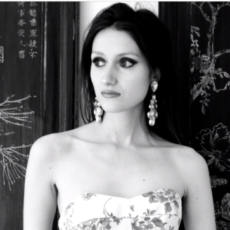
Timothy Nelson is a formidable Onegin, knowing just how to exude the right level of romantic wistfulness and misanthropic disdain (think Shakespeare’s Timon). Galina Averina brought youthful timidity to Tatyana’s earlier scenes and gradually gained vocal momentum in the letter aria, delivering a performance that took the audience inside of a heart raging with the fires of unexpressed love. Xavier Hetherington cuts a fine figure as Lensky, playing him as a poet that speaks in passionate hyperbole and who, through jealousy, is awakened to the challenges of love and its obligations. The orchestra – comprised of a string ensemble, horns, woodwinds and a timpani drum – is successfully reduced by conductor Orlando Jopling, providing stirring instrumentation that explodes when set against the emotional containment.
But, for all its fine performances, the production’s innovation was also where it could have been further developed: the English translation. Written by Siofra Dromgoole, this new libretto is admirably fresh, intelligent and lucid, but it certainly feels removed from Pushkin’s jewelled poetic tableaus of imagery and his raconteur’s ability to charm through language. Like Onegin, he always holds something back. It was a shame then that the story occasionally felt explicatory and overinterpreted, suggesting, as this version did, that Onegin rejected Tatyana solely because he lacked sufficient self-knowledge. (For a masterclass in capturing Pushkin’s voice turn to the pages of James E. Falen’s effervescent translation.)
Nevertheless, Eugene Onegin is a marvellous rendition of Pushkin’s tale of youthful romance and haunting ‘what ifs’. Dominic Droomgoole strips the story back to its emotional essence – love, jealousy and regret – allowing music and vocals to take centre stage. At once relatable and accessible to new opera-goers, this Wild Arts production makes for an enchanting summer evening.
Wild Arts at Opera Holland Park
Eugene Onegin ☆☆☆☆
Music: Pyotr Il’yich Tchaikovsky
Libretto: Pyotr Il’yich Tchaikovsky and Konstantin Stepanovich Shilovsky after the verse novel by Alexander Pushkin
Translator: Siofra Dromgoole
Director: Dominic Dromgoole
Conductor: Orlando Jopling
Photo credits: Allan Titmuss
Cast includes: Timothy Nelson; Galina Averina; Xavier Hetherington; Emily Hodkinson; Siôn Goronwy; Hannah Sandison; Rozanna Madylus; Robert Burt; Alex Pratley; Laura Mekhail.
Running Time: 2 hours and 45 minutes, including a half hour interval
Review by Olivia Hurton
13th August 2025