

The Crucible is a 1961 opera written by American composer Robert Ward (1917-2013) on a libretto by Bernard Stambler. It is a faithful adaptation of Arthur Miller’s homonymous play (1953). The opera won the Pulitzer Prize for Music in 1962. The plot is based on the historical mass hysteria that led to the Salem Witch Trials of 1692-1693. Several village girls are caught dancing naked by Reverend Parris, subsequently accused of witchcraft and, in order to be spared, confess to having been visited by the Devil himself or by the spectres of some of their neighbours, who are in his service. Their mendacious accusations lead to the execution of nineteen innocent persons.
The libretto preserves Arthur Miller’s allegory of the “Red Scare” of the 1950s: the similarities he had noticed between the collective frenzy of the witch hunt and the investigations of the House Committee on Un-American Activities (‘naming names’) triggered the parallels he made in his text. Theatre always functions as a mirror to society, and the stage director of the opera and artistic director of the WNO, Francesca Zambello, writes in the programme: “The analogies to our contemporary society resonate throughout this work.”
Ward’s opera was chosen as one of three iconic American works to celebrate both the American semiquincentennial and the 70th birthday of Washington National Opera, together with Scott Joplin’s Treemonisha and Leonard Bernstein’s West Side Story. The performance was preceded by a short talk given by Ken Weiss, WNO’s Music Administrator, in dialogue with mezzo-soprano J’Nai Bridges – the interpreter of Elizabeth Proctor’s part.
Robert Ward’s score is varied, without highly original valences. One can hear Puccini’s influence, and once even Offenbach’s. Classical and modern features are blended, as the composer resorts both to the technique of the fugue and to jazzy harmonies and rhythms, which never go beyond the scope of the opera genre, however. The most memorable scene is probably the first one, in which binary and ternary rhythms are alternated (2+3 bars), and which embeds the psalm “Jesus, my consolation”. Another excellent fragment is the ensemble in Act II, in which Abigail’s ‘vision’ of a yellow bird (sent by Satan) triggers a general hysteria in the courtroom, expressed musically through a frantic tempo, with imitation between the voices, which auditorily suggests the pathological contagion of the pretence.
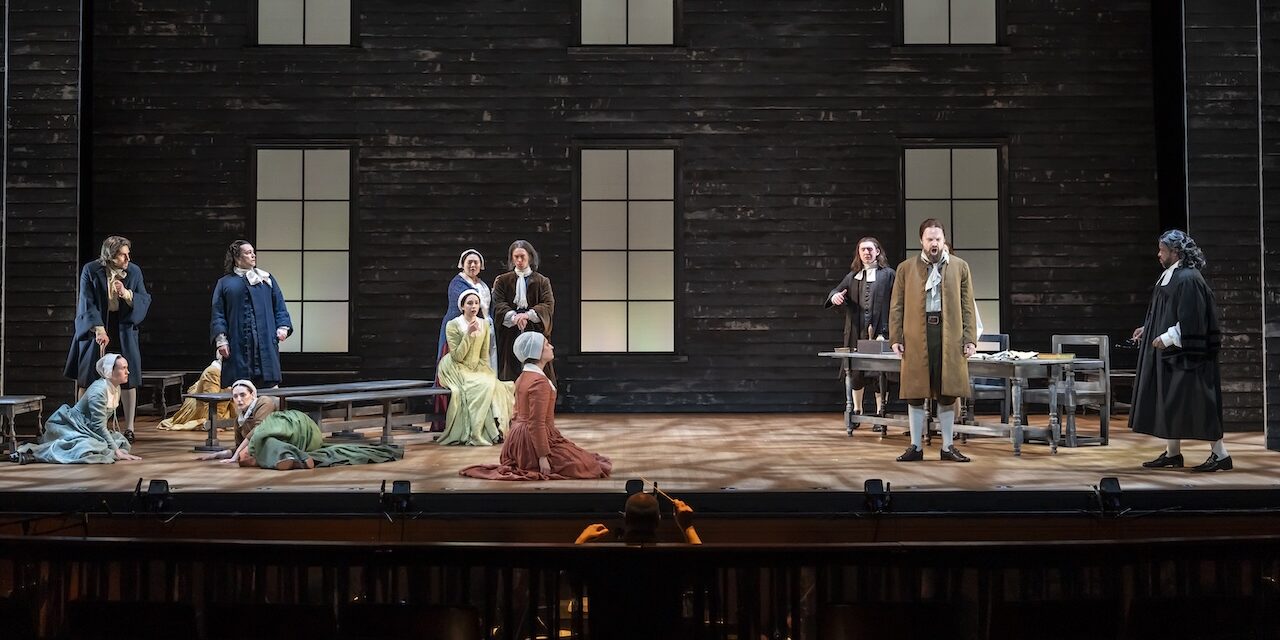
Zambello’s production is both dynamic and balanced. Jessica Jahn designed period costumes that allow the audience to feel the historical atmosphere, but without overdoing the fashion ornaments – an inspired choice that conveys the idea that this is a story that could happen in any age, standing for the perennial fallibility of human nature.
The performance starts with pre-recorded crickets and the only striking visual effect of the production – a steaming tub with girls dancing and laughing around it. The tribal drums express the ritual, while the crackling of a vinyl LP may be a reference to McCarthy’s age – the only one, in fact.
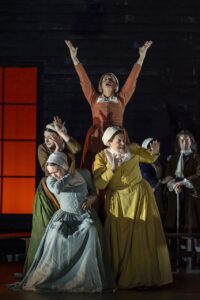
The star of the performance was soprano Lauren Carroll (Abigail), whose beautiful timbre, masterful vibrato, soaring high notes, and convincing acting predict a great career. Mezzo-soprano Michelle Mariposa (Rebecca) and lyrical soprano Kresley Figueroa (Mary Warren) complete the trio of very talented young artists in the show, while tenors Chauncey Packer (Danforth) and Alexander McKissick (Parris) were an exciting counterbalance to the ladies. J’Nai Bridges (Elizabeth), Ryan McKinny (Proctor), and Robert Frazier (Hale) were good choices for their parts.
Generously hosted by the George Washington University when the WNO dissociated itself from the Kennedy Center, this performance overcame the shortcomings of imperfect acoustics and offered a rewarding experience to its audience.
The George Washington University Lisner Auditorium
By Robert Ward (composer) and Bernard Stambler (librettist)
Based on the play by Arthur Miller
Director: Francesca Zambello
Photo Credit: Scott Suchman
Cast includes J’Nai Bridges, Ryan McKinny, Lauren Carroll, Chauncey Packer, Alexander McKissick, Robert Frazier, Michelle Mariposa, Kresley Figueroa
Running Time (103 minutes plus a 25-minute interval)
29 March 2026, 2 p.m