
The auditorium of an opera house is a place for grand passions and improbable fantasies, where dreaming is done in arias and the principals appear to be on another level of existence. Yet as Ruggero Leoncavallo’s Pagliacci (1892) attests, sometimes art refuses to stay safely sequestered within the ornate frame of the proscenium stage.
Leoncavallo’s fin-de-siècle opera, which the English Touring Opera has revived with élan for their Spring 2026 season, calls attention to the great fallacy of artistic performance—that role and self can somehow exist apart, that one fashions a persona and ‘acts’ rather than excavating or building upon certain strands of oneself. Rooted in the body and experienced in the nerves, performance is a transformation of selfhood, never a total extinction of it.
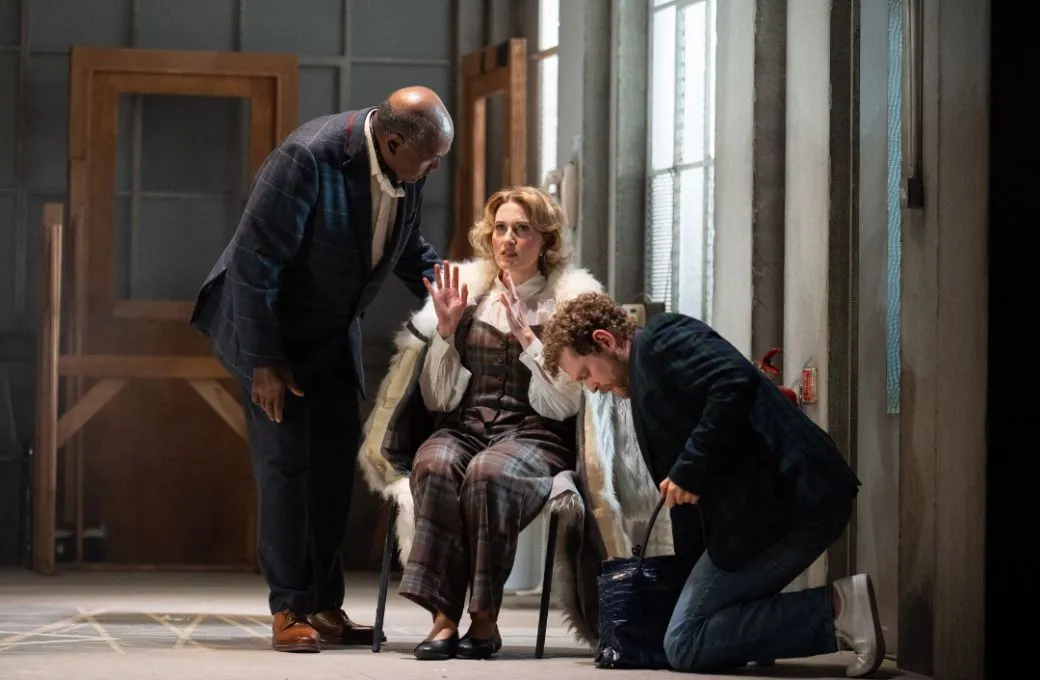
At the centre of the story are performers Nedda and Canio, a showbiz couple for the ages, beloved by voyeuristic fans and famed for their explosive onstage re-enactments of their offstage romantic relationship. (The programme cites arch-thespians Elizabeth Taylor and Richard Burton as a key reference point.) However, when we meet them, their feelings have become lukewarm. Canio is a weary presence at the press conference prior to their latest show due to suspicions of his wife’s infidelity, and Nedda, resenting her lack of freedom within marriage, dreams of eloping with Silvio, her sweet-lipped lover, as she studies her playscript. Both husband and wife not only perform illusions for a living, but are sustained by them. Nedda doesn’t want to shatter the appearance of marital bliss, while Canio can only confront his wife effectively by first getting into the role of the cuckolded clown Pagliacci. Actors (and by extension artists), muses Leoncavallo, cannot bear too much reality.
Director Eleanor Burke performs a stunning act of theatrical legerdemain in turning this piece into a full-bodied piece of work when it might have remained a minority taste, lacking as it does the epic scale of other operas. Her attentiveness to developing character psychology is evident in Canio, Nedda and Tonio, all of whom variously act to preserve their (fragile) egos and self-images, as they are assiduously scrutinised and gazed upon by the disconcerting presence of the ten-person chorus.
As front-page worthy stars, Burke’s cast perform with watchable charm and vocal power. Ronald Samm plays Canio as an apoplectic Othello, all agonising fits and gnashing teeth, but with rational grounds for his jealousy. Paula Sides was an authentically conflicted Nedda, torn between competing desires personally and professionally, hungering for freedom like the starlings reflected in her soaring notes. Matthew Siveter’s Tonio had a lethal case of sour grapes, one that drove him to seize opportunities to throw Nedda’s life into chaos. His vocals in particular showed exquisite range, flitting between rueful melancholy, pointed vengefulness and light mockery. Performances by Beppe (Harry Grigg) and Silvio (Danny Shelvey) were solid, but one felt they didn’t as forcibly contribute to the emotional texture of the piece.
Gerry Cornelius tackled the score with a virtuoso’s energy: the strings blew as if shimmering, the woodwind had a breezy purity of sound, and the brass was gloriously resonant. This was complemented by Robin Norton-Hale’s new English translation, a sprightly and lucid piece of writing – one does not envy anyone who has to translate the Italian libretto into English and keep it aligned with the tempo of the music.
The set design, while achieving fluidity, was regrettably less impactful. The show opened to a dreary rehearsal room which, after the interval, was replaced with a luminous plastic pink kitchen (a kitschy fantasy that looked as if it had been purloined from Greta Gerwig’s Barbie). The tightly contained staging did, however, underscore the difficulty of carving out pockets of privacy in these performers’ lives. Raw emotions bleed into the actors’ show because there is nowhere else for them to live.
In this production, the English Touring Opera successfully revives an operatic classic and astutely grounds it in contemporary preoccupations: the insatiable consumption of celebrity gossip, the performativity of romantic roles, and the conflict women experience between duties to themselves and those they love. Most powerfully though, it speaks to something timeless, the nature of art and its relation to a performer’s life.
Pagliacci
Music and libretto by Ruggero Leoncavallo
Conducted by Gerry Cornelius
Directed by Eleanor Burke
Cast includes: Paula Sides, Ronald Samm, Matthew Siveter, Danny Shelvey, Harry Grigg.
Until: 23rd May 2026 (touring at multiple venues)
Running Time: 1 hour and 45 minutes, including a 20-minute interval.
Review by Olivia Hurton
10th April 2026