

Accessibility is the defining ambition of the revival of Sir Thomas Allen’s production of The Marriage of Figaro. The English-language delivery sharpens the comic rhythms with punchy, conversational phrasing without flattening Mozart’s musical elegance. While occasional quasi-Italianate inflections create a curiously hybrid vocal texture, the production’s visual and musical sophistication more than compensates.
Susanna’s observation that disgraceful men create offences neatly captures the opera’s comic machinery. Much of the farcical tension stems from male behaviour, particularly the Count’s infidelity and Figaro’s misplaced suspicion of Susanna. Although the overture features none of the opera’s later melodies, its restless energy and dynamic orchestral lines foreshadow the chaos that unfolds over the course of Susanna and Figaro’s wedding day.
This exuberance is not immediately matched visually when the curtain rises. Peasants, servants, straw bundles, and glimpses of the Count’s estate appear in muted khaki and pale grey tones against a calm blue sky softened by dawn light. The atmosphere initially feels restrained, even as the constant bustle of movement quickly absorbs the music’s nervous vitality.
Rather than competing with the rapid vocal exchanges through exaggerated stage business, the production allows the music itself to generate much of the comedy. Even in the deliberately absurd family reunion scene—where Susanna and Figaro, Marcellina and Bartolo, and finally the Count and Basilio converge—the humour emerges primarily through the densely layered sextet. The staging remains controlled, with performers arranged in groupings that subtly mirror the musical interplay of competing major and minor tonalities. The result feels theatrically full rather than visually overcrowded.
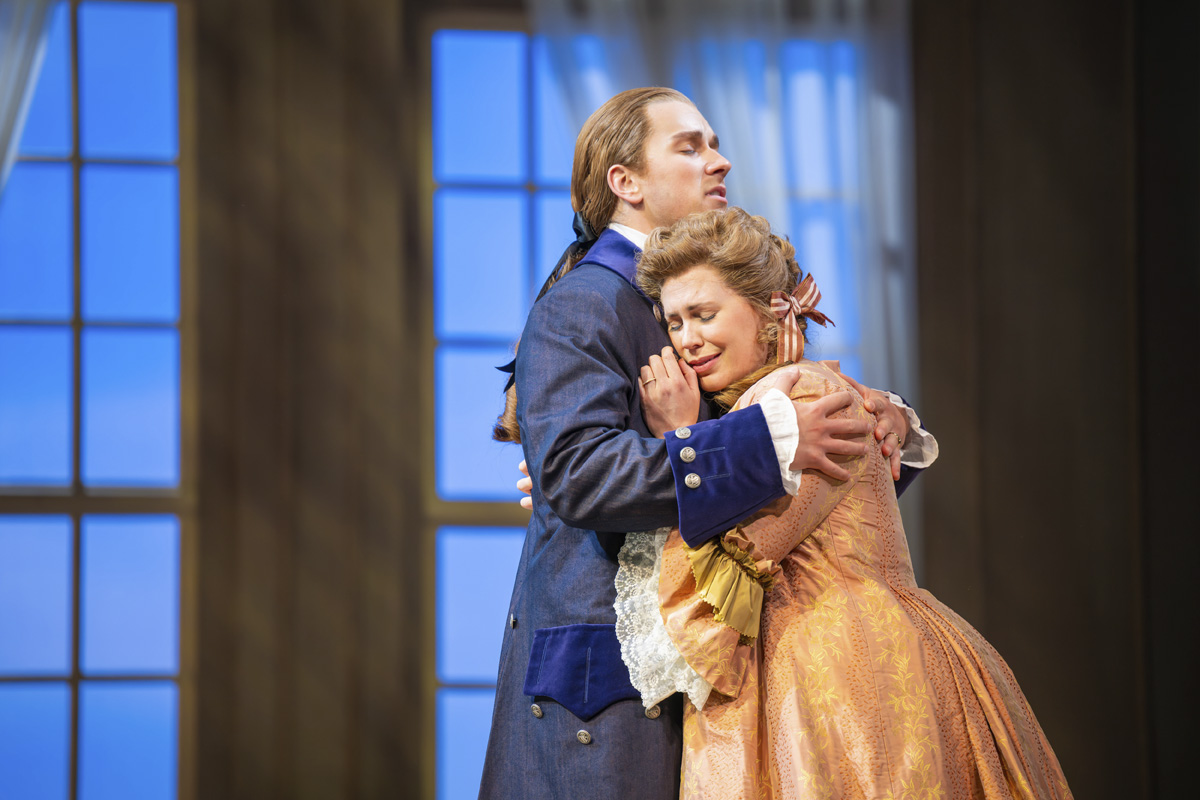
Similarly, the production’s splendid stage design never becomes oppressive, preserving a sense of spatial openness beneath its visual richness. The Countess’s status is conveyed with restraint through the furnishings of her Act II room. A careful balance of intimacy and expansiveness is achieved through serene blue doors and full-height paned windows opening onto a washed blue horizon. The set briefly suspends the opera’s farcical momentum, creating space for the Countess’s despair to register in her opening aria while ensuring her solitude never feels dramatically isolated. At times, this openness is pushed into overt comic effect, as in the window sequence where Cherubino escapes and Antonio later re-enters through the same opening.
The theatrical openness expands further in Act IV, when the house lights rise as Figaro launches into his bitter reflections on women’s deception. Addressing the audience directly, he transforms the aria into a moment of shared complicity. The effect is sharpened by the mocking trumpet interjections, whose sardonic commentary proves no less pointed during the Count’s appearances.
The production’s accessibility ultimately rests on Mozart’s memorable melodies and vibrant orchestration, supported by Simon Higlett’s stage design and Amanda Holden’s English translation. The cast not only sustains this foundation but enhances it. Ava Dodd’s Susanna, on stage for much of the performance, maintains a finely judged balance of charm and intelligence in both vocal and physical expression. Edward Jowle’s Figaro provides much of the comedy, with memorable moments such as his attempt to hide behind a straw bundle, his head just visible in shadow. Beyond these comic touches, Jowle brings vocal flexibility and expressive movement to a Figaro defined by wit, suspicion, and restless energy.
Alexandra Lowe’s velvet tone lends the Countess a relaxed warmth, matched by her poise and restraint. Paired with Dodd’s more silvery sound, the letter-writing duet is particularly delicate. Ian Rucker presents the Count as a figure of assured, if brittle, authority; his controlled vocal intensity avoids reducing anger to sheer volume, resulting in a more grounded and convincing portrayal.
Simone McIntosh’s Cherubino is a standout. The adolescent page’s restless volatility and kinetic energy are vividly conveyed in both voice and movement, and even within crowded ensembles McIntosh consistently draws focus. The supporting cast is strong throughout, while the chorus contributes vitality and presence rather than fading into the background. Dane Lam’s conducting keeps the pacing fluid and responsive without ever feeling forced.
Infidelity here feels insubstantial, while joy is grounded and tangible. This production ultimately affirms comedy, energy, and human connection, allowing lightness to gently eclipse the opera’s underlying tensions.
The Marriage of Figaro (1786)
Music by Wolfgang Amadeus Mozart
Librettist: Lorenzo Da Ponte
Directed by Sir Thomas Allen
Chorus directed by Susannah Wapshott
Conducted by Dane Lam
Cast Includes: Edward Jowle; Ava Dodd; Alexandra Lowe; Ian Rucker; Simone McIntosh
Until (on tour): 23 May 2026 (Glasgow)
Running Time: 3 hours and 10 minutes including a 20-minute interval
Photo Credit: Mihaela Bodlovic