

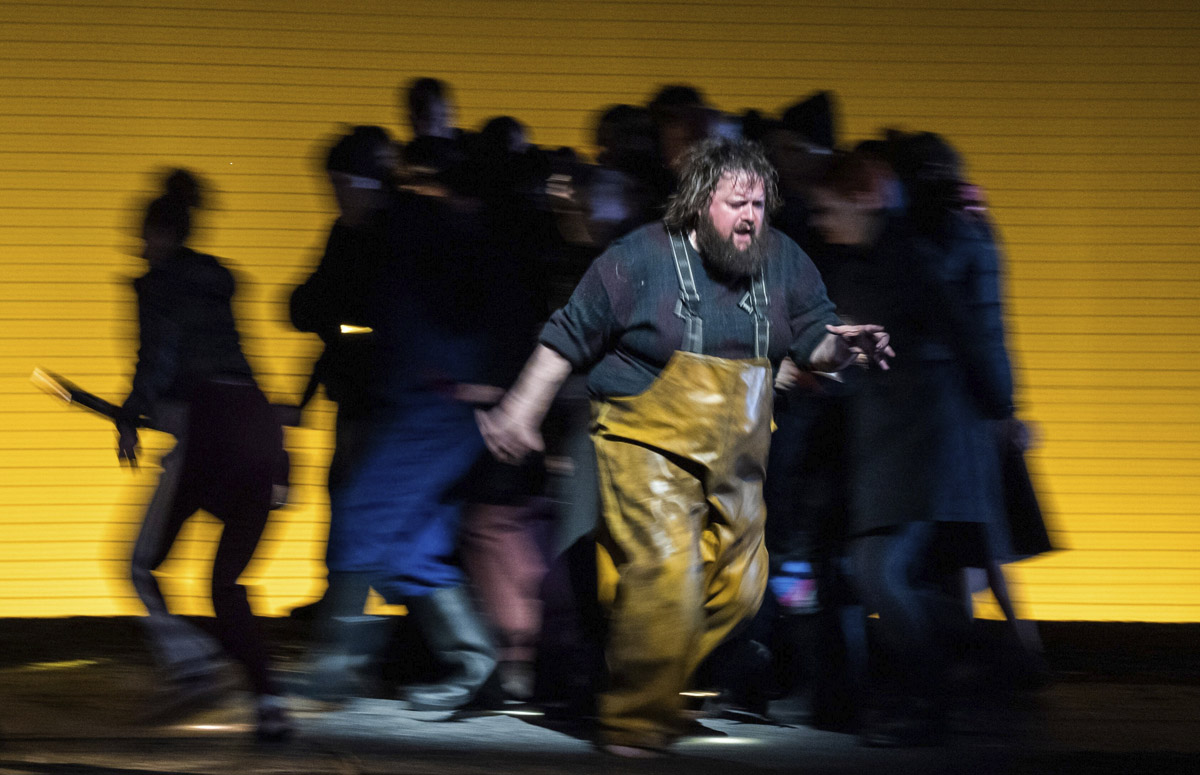

Deborah Warner’s fine 2022 production of Peter Grimes, Benjamin Britten’s searing tale of abuse and isolation, returns with the three main principals and a new conductor. The mob rules this run-down seaside town, whose livelihood depends on the sea and its fishermen.
Grimes is a fisherman ostracised by a hostile society following his rough treatment and the deaths of the child apprentices who worked for him. Only Ellen Orford and Balstrode attempt to help, but after the death of Grimes’s latest apprentice, even they turn away. Balstrode ultimately tells him to take his boat far out to sea and sink it.
Michael Levine’s effective set designs, combined with Peter Mumford’s lighting, use an adaptable backdrop to recreate the shimmering sea, dawn, storm, and oppressive darkness, evoking a suffocating atmosphere.
Warner dispenses with the opening courtroom inquest into the death of Grimes’s apprentice after days at sea without food and water. Instead, what appears to be a beached whale trapped in a fishing net reveals Grimes, in weathered yellow oilskins, sleeping on the shore, haunted by the event. A powerful image of the dead child is portrayed by a suspended aerialist (Jack Horner). If there were any doubt as to Grimes’s guilt, despite the open verdict, Act III makes clear his culpability through his brutal treatment of the children.
Czech conductor and new Royal Opera director of opera Jakub Hrůša takes the baton, bringing an insightful and atmospheric reading. He coaxes striking sounds from the orchestral interludes: the calm of the sea at dawn and its sparkle, as well as the frenzy of the storm. In Act II, each time new characters stumble into the Boar, Hrůša seems to bring the storm in with them.
The mob, faceless and invisible in the dark, moving as one under torchlight, steadily increases the pressure on Grimes, magnificently portrayed once again by British tenor Allan Clayton. Clayton seems born to sing Grimes, and few today do it better. His Grimes is tortured, unkempt, and deeply marked by his status as an outsider. He does not look after himself, and so cannot look after his apprentices. His introspective aria “Now the Great Bear” is a highlight—meltingly beautiful—though it is puzzling that he sings it with his back to the audience.
Swedish soprano Maria Bengtsson has grown into the role of the lonely widow Ellen, an oasis in Grimes’s personal storm. The embroidery aria is exquisitely sung, with heartbroken warmth and a rich palette of colour and phrasing.
British bass-baritone Bryn Terfel returns as Balstrode. Seemingly one of the few who helps Grimes, he is also the one who tells him to go far out to sea and not return. In doing so, he appears to clear his own path towards Ellen. Terfel dominates whenever he appears—a commanding presence, his voice still in fine form, though some passages lack power and a vibrato is beginning to emerge.
British mezzo-soprano Christine Rice gives a fine performance as the vicious Mrs Sedley, the town’s laudanum-addicted, rabble-rousing amateur sleuth, darkly muttering “murder most foul it is” with obsessive intensity.
There are also strong contributions from Jacques Imbrailo as Ned Keene, Catherine Wyn-Rogers as Auntie, Jennifer France and Natalia Labourdette as Auntie’s nieces, and John Graham-Hall and James Gilchrist as Bob Boles and Rev. Adams respectively.
In the final scene, Grimes repeats the ballad “Old Joe has gone fishing”, accompanied only by a distant foghorn, heightening his isolation. He is eventually joined by Balstrode and Ellen. The precision of tuning and timing is a credit to the three singers, performing unaccompanied from different parts of the stage before the orchestra re-enters.
The chorus, always crucial in this opera, performs superbly as the venomous mob pursuing Grimes, brutally attacking an effigy of him before discarding it like refuse.
Hrůša finds both the wind in the score and the shimmer of the sea in the closing moments, as the image of the dead boy finally comes to rest on the seabed.
A disturbing but rewarding evening.
Royal Opera House, Covent Garden
Music by Benjamin Britten
Libretto by Montague Slater after The Borough by George Crabbe
Conductor: Jakub Hrůŝa
Director: Deborah Warner
Set design: Michael Levine
First performance 7th June 1945 Sadlers Wells Theatre
Cast includes Allan Clayton, Maria Bengtsson, Bryn Terfel, Clive Bayley, Jacques Imbrailo, Catherine Wyn-Rogers, Christine Rice, John Graham-Hall, Barnaby Rea, James Gilchrist, Jennifer France, Natalia Imbrailo, Jack Horner
Running time 3 hours 35 minutes with two intervals
Until 28th May 2026
Photo Credit Tristram Kenton