


In the English countryside, Grange Park Opera turns a performance into a wider summer ritual. Arrival through the grounds, the interval and the picnic all become part of the evening, so that John Tavener’s Krishna begins before the curtain rises. The setting proves an apt frame for a work that is less conventional opera than spiritual journey, unfolding through a sequence of sacred tableaux rather than dramatic conflict.
John Tavener’s Krishna occupies an unusual place in the operatic landscape. Neither conventional drama nor straightforward religious pageant, it unfolds as a series of sacred images drawn from the life of Krishna, the Hindu deity who is at once child and god, lover and king, playful trickster and cosmic saviour. The work asks less to be followed than contemplated, inviting its audience into a devotional world where symbolism, music and ritual carry as much weight as narrative.
Guided by a Celestial Narrator, the opera traces Krishna’s life through a sequence of emblematic episodes rather than a conventional plot. From divine birth and childhood miracles to his enchantment of Radha and the gopis, heroic feats and eventual departure from the earthly world, the work charts a movement from incarnation to transcendence. The arc is one of descent and return, culminating in Krishna’s promise to return whenever truth declines and disorder prevails.
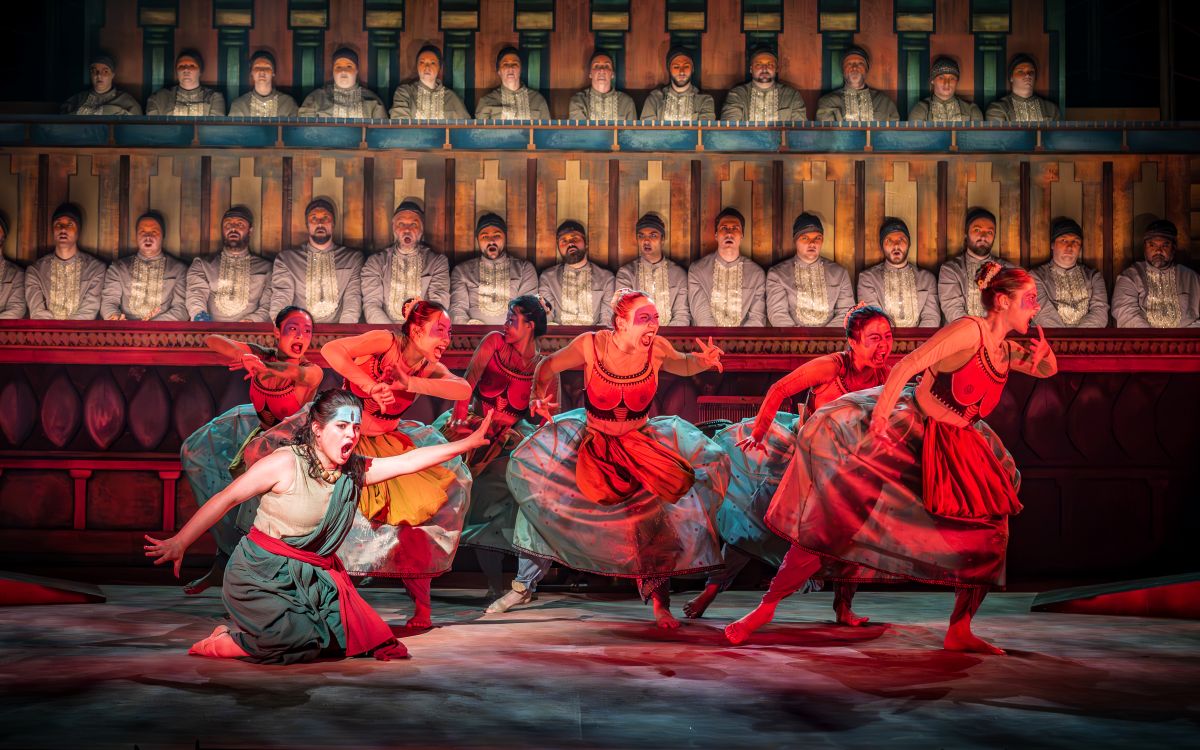
Splitting Krishna between four singers gives the title figure a shifting, many-sided identity. Rosa Sparks is especially convincing as the child Krishna, her bright soprano floating above the orchestra with innocence and mischief. In the Putana scene, the rocking choreography and red light darken the ritual frame, so that the purity of her sound suggests the paradox of a child who contains the cosmos. Eliran Kadussi’s countertenor brings a seductive charge to the river scene with the gopis, Elgan Llŷr Thomas’s young Krishna moves towards romantic devotion, and Brett Polegato’s mature Krishna adds baritonal authority and metaphysical weight. Because no single voice can contain him, each reveals a different aspect of his identity. Krishna is at once child and god, lover and king, trickster and saviour, human and divine. The result feels less like a character developing through time than a sacred figure glimpsed from several angles, one and many at the same moment.
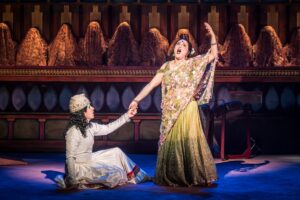
Ross Ramgobin’s Celestial Narrator gives the evening its necessary thread, his firm baritone grounding a work that otherwise unfolds through tableau, repetition and symbolic image. Sara Fulgoni’s double presence as Bhumi and Yashoda neatly spans the opera’s scale, from the Earth’s lament to the domestic tenderness of Krishna’s childhood. The later meeting of Radha and Rukmini becomes not simply a romantic complication but a joining of two devotional modes. Radha embodies ecstatic longing for the divine, while Rukmini represents faithful marital devotion. Krishna belongs to both. Their meeting therefore becomes more than a convergence of lovers; it unites two paths towards the same spiritual goal, giving emotional depth to the opera’s wider meditation on love as a route to transcendence.
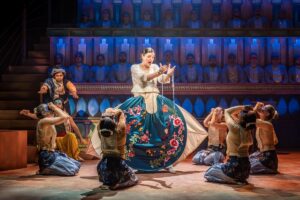
The staging organises itself around symmetry. The chorus sits in temple-like formation, functioning less as a crowd than as a ritual collective, mantra-like in its repetitions, gathering at the close around an absent god and turning absence into presence. Rachana Jadhav’s designs feel closer to icon and procession than realist stage picture, while Nao Masuda’s onstage drumming and the dancers add ceremonial rather than illustrative weight. The most suggestive image is the entrance of child Radha blindfolded. In Indian thought the blindfold is a classic image of the ignorance that veils the soul from its own nature, and its removal signifies awakening. Radha appears as a soul before recognition, already drawn towards Krishna but not yet able to see him, quietly preparing the opera’s larger movement from separation into devotion.
Tavener’s vocal writing can seem static, the singers circling repeated phrases rather than developing them. Yet the opera’s many repetitions are easier to understand in light of the devotional traditions that inspired it. The recurring Hare Krishna mantra functions not simply as chant but as a mystical expression of the love between Radha and Krishna. In Hindu practice, the repeated invocation of divine names is itself an act of devotion, so the score’s circular patterns aim less at dramatic development than spiritual presence. What can initially feel dramatically immobile gradually reveals its own logic: contemplation rather than narrative momentum. Even so, the ritual stillness occasionally risks slowing the dramatic pulse when too little changes around it.
Krishna will not convince everyone. Its ritual pace and refusal of conventional operatic drama demand patience, and audiences seeking psychological realism or narrative urgency may find themselves at a distance from its contemplative world. Yet for those willing to meet it on its own terms, it offers something increasingly rare: not simply drama, but an encounter with another way of imagining the relationship between art, devotion and transcendence.
For a non-Hindu, the production’s strongest effect was the urge to look further into it, and once I understood more of its references than first meet the eye, my enjoyment only deepened. Krishna rewards the curiosity it provokes. Its rewards are cumulative rather than immediate. The more one enters its symbolic and spiritual world, the richer it becomes. Krishna is a god who descends, departs, and promises to return; this production leaves behind a similar sense of invitation, asking the audience not merely to watch but to contemplate.
Music and Libretto by John Tavener
Director: Sir David Pountney
Conductor: Mark Shanahan
Choreographer: Shobana Jeyasingh
Cast Includes: Ross Ramgobin as the Celestial Narrator; Sara Fulgoni as Bhumi and
Yashoda; Rosa Sparks as Krishna as a child; Eliran Kadussi as Krishna as an adolescent;
Elgan Llŷr Thomas as Krishna as a young man; Brett Polegato as Krishna as a man; Julia
Sitkovetsky as Radha; Jennifer Statham as Radha as a child; Nazan Fikret as Rukmini; Nao
Masuda as Onstage Drummer
Until: At Grange Park Opera until 2 July 2026