

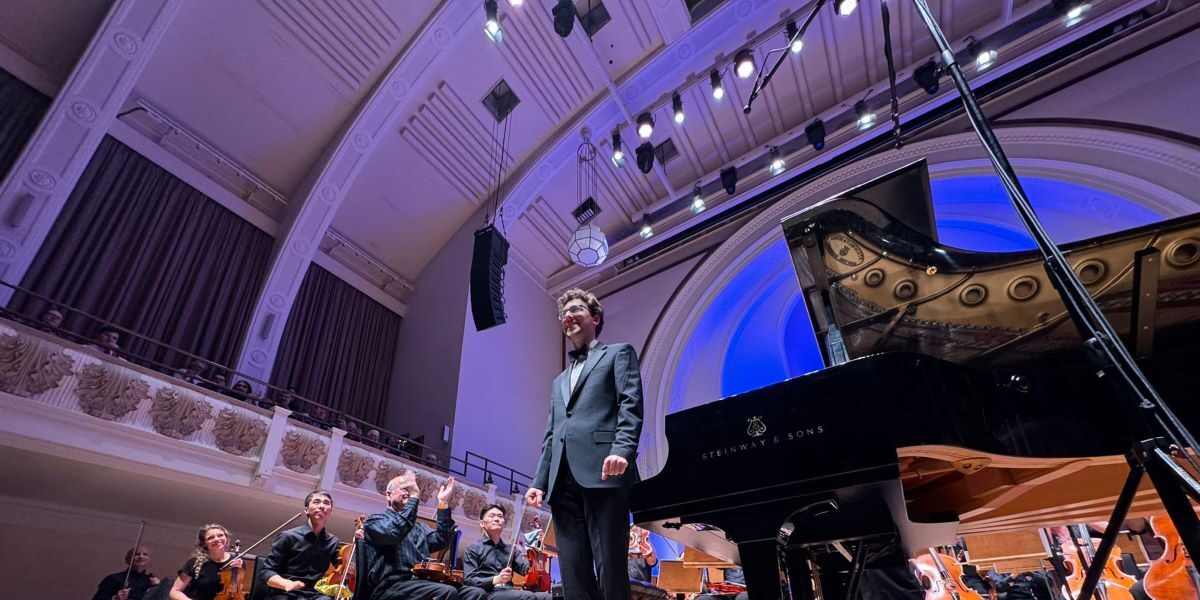
The Doctors’ Orchestra is an amateur orchestra that brings medics together at regular intervals across the year in charitable causes; and this concert at Cadogan Hall was devoted to raising funds for ‘Freedom from Torture’, which advocates for torture victims both in their own countries and as asylum seekers. Judging from the packed hall, sold-out on the night, this concert was an outstanding success in its primary and wholly admirable purpose.
The musical results were more uneven. This is not really a criticism of the players – indeed it is remarkable that these individuals, already so talented and dedicated in one area, can find time to devote to showcasing their equal abilities in others. There are some outstanding individuals in the orchestra and indeed each section played with great distinction at many points in the evening, particularly the brass and woodwind. But when players do not get together often as a whole there are inevitably issues of balance and cohesion and points of awkward transition especially in demanding works such as these.
The most successful part of the evening, and perhaps the one where most rehearsal time had been spent, was the Rachmaninov First Piano Concerto, a work which is unjustifiably neglected in favour of its more famous and rhapsodic siblings. Its first version was written when the composer was a teenager, and then heavily revised much later. The result may not have the spooling, long, instantly memorable melodies of number 2 and 3, but it is tightly written work, with memorable orchestration and many passages of original and inventive filigree dialogue between piano and orchestra. It owes much to the Grieg concerto in structure, but it is unmistakably Rachmaninov in harmonic and rhythmic textures. In short, it is a very well made piece.
The Polish pianist Krzysztof Moskalewicz was alive to its demands, totally convincing in the more virtuosic passages, with runs and passagework of immaculate precision and evenness of tone; but there was also much delicacy of touch and timbre in his interplay with the orchestral forces. As an encore he played Chopin’s ‘Revolutionary’ Prelude, bringing out with rare skill the dialogue between the violent turbulence of the left hand and the pleading, placatory intercessions of the right. We would happily have heard many more pieces from him in that vein, and he is clearly a talent to look out for and cherish.
The works that framed the concerto went in and out of focus. Smetana’s portrait of the river Vltava/Moldau got off to an uncertain, sluggish start, before coming into focus in the contrasting middle sections, reminding us in some respects of Wagner’s contemporary depiction of the Rhine in its orchestral effects. Similarly, the inner movements of Brahms’ 4th Symphony were more effectively projected and sustained than the outer ones, where the conductor’s tempi were too sedate and the dynamics lacked differentiation. However, the evening ended well when the orchestra suddenly found the sense of relentless taut focus needed to finish the last movement, as the thirty variations work their way through to a fierce defiance of time’s inexorable arrow.
A final salute to the triangle player – it is not often that you have a programme in which the triangle features prominently in all three works, and all credit to him for jangling memorably every time.
Soloist: Krzysztof Moskalewicz
Doctors’ Orchestra
Conductor: Steven Brearley
16 March 2026
2 hrs