

Who, as a child, did not skip around the playground after history lessons chanting, ‘Divorced, beheaded, died, divorced, beheaded, survived’? With the jingle’s measured beats and singsong rhyme, the tragedies of Henry VIII’s six wives took on the air of an otherworldly fairy tale. The story we learnt was about a malefic Tudor Bluebeard who liked hunting game, overturning age-old religions, and selecting brides, like jewels, from the coffers of Europe’s noble families before dispatching them as he best saw fit—simply because he could. But because patriarchal structures have perniciously persisted, 500 years ago is not remote. Perhaps we couldn’t see it then, but the lyrical sugar-coating of history was inuring us to horrific acts of male violence against women that remain ever-present.
In Ava Pickett’s salty historical play,1536, an act of theatrical time travel is performed. Aided by the intimate environs of the Ambassador theatre, the audience are made to feel the unsettling similarities between the subjection of women, past and present. Named for the year of Anne Boleyn’s death, the play is a tribute to the queen who faced misogynistic maltreatment at the hands of Henry VIII, who ruthlessly exploited his legal and political power to see to her imprisonment and eventual beheading. But it is also an intelligent divergence from these well-known events. Pickett calls forth from the shadows the working-class women of the sixteenth-century —the hopeful brides, dutiful daughters, abused wives, and attentive midwives—which history, traditionally written by educated men, has rendered little more than marginalia. In the absence of an archive documenting their day-to-day lives (few women, outside of royalty, could write), the playwright draws on her personal experiences to flesh out the complex nexus of desires and devastations experienced by her characters.
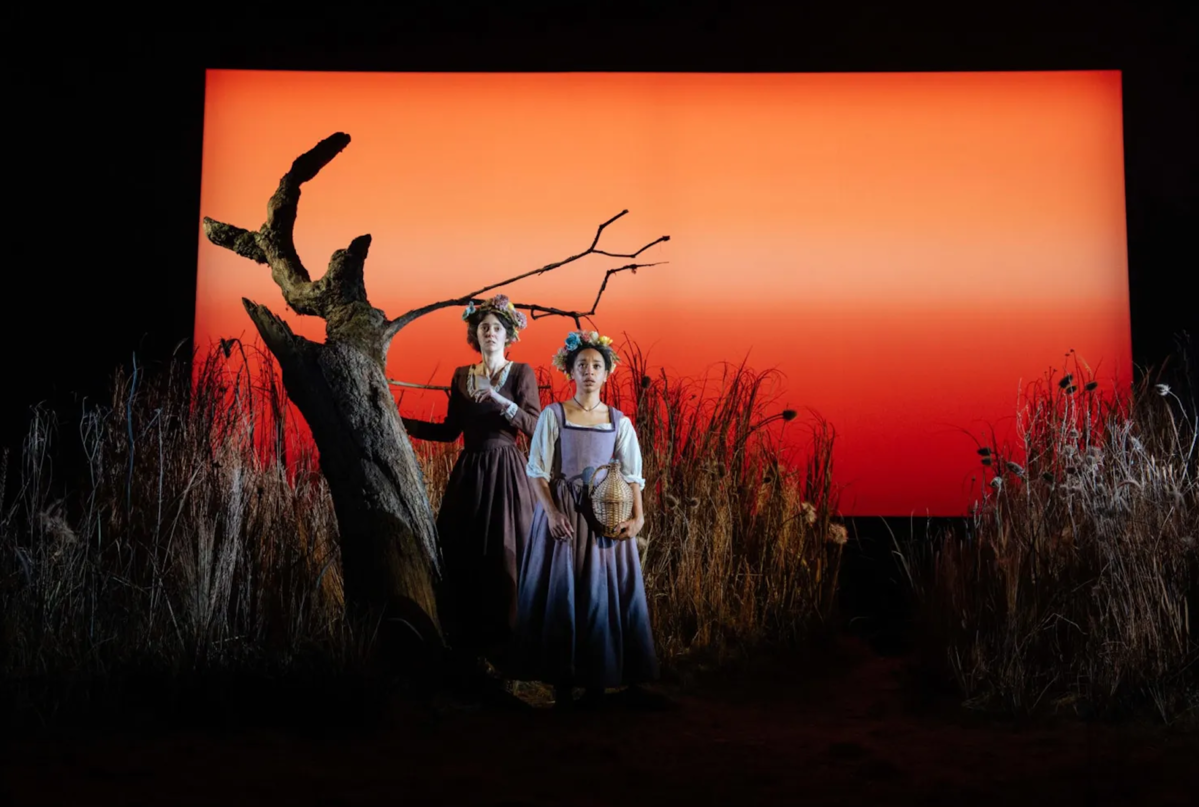
Set in an Essex field abuzz with news of Anne Boleyn’s impending execution, three women meet to exchange notes on local men, scrutinise each other’s physical appearances, moan about work, and then ‘talk about shit that happens elsewhere’. Leading the trio is Anna, played with scintillating abandon by Siena Kelly. Provocative, vivacious and romantic in a village that tries to contain female desire, she shares a great deal with the imprisoned queen (the likeness of their names isn’t coincidental). A succession of scenes begins with her having sex against a tree, an act which she believes confers upon her the only power available to women, the ability to attract a man. Of course, Pickett is quick to show the flaws of this thinking. First, like the king, these men have short attention spans. And when the men disappear, so does Anna’s self-worth. Second, despite her quick-wittedness and ability to inspire sexual fascination, she lacks the most prepossessing enticement: a sizeable dowry. As such, Anna is offered impassioned dalliances in the fields rather than solemn invitations to the altar.
Her two close friends offer alternative models of femininity, both of which are equally unsatisfying. Mariella is a midwife who has obediently followed her family into the profession yet utterly loathes it, exposing her as it does to blood, guts and death on a daily basis. Tanya Reynolds superbly infuses the character with studied self-containment: her Mariella is warm yet withdrawn, lovelorn yet never self-pitying, deeply pragmatic yet inclined to dream. Then there is Jane, the so-called ‘good girl’ of the group, whom Liv Hill plays with ditzy innocence and blushing vulnerability. She reports the latest news, obediently adheres to her father’s wishes and is jovially teased by the other girls. For her compliance with male ideals of femininity, she is rewarded with a husband. But it’s not long before she’s seen at the market with a black eye and her other half is caught with his trousers down in the fields with her best friend.
If 1536 is ‘a love letter to friendship’, as Pickett described it in 2024 at the Susan Smith Blackburn Prize for playwriting, one inspired by the female intimacies she’s had since she was 14, the playwright is also aware that such closeness, when tested, has an underside of ‘ugliness’. Girlish banter is suffused with casual misogyny. ‘She eats like a pig,’ says the immaculately polished Anna of the ungainly Jane. Women are pitted against each other throughout the play, since capturing a man, who possesses every economic and legal power they are bereft of, offers hope (however dubious) of protection in a world that is mercilessly patriarchal. Pickett’s intellectual incisiveness lies in her ability to lay bare these conditions which are plainly averse to sisterhood without passing moral judgement on the decisions of her characters. The failure, she makes clear, is systemic.
Yet in a bitterly ironic twist, Pickett shows that patriarchy doesn’t even reward men. Mariella’s old flame William, imbued with a beguiling gentleness by George Kemp, has accorded with the expectations of his station. He has married sensibly (for money) and is about to secure the future of his estate with the imminent birth of his heir. But in solitary moments he continues to wander around the market and pine for the midwife from his past. The well-seasoned misogynist and psychological manipulator Richard, who is brought to life by Oliver Johnstone, fairs little better. He has married Jane, a girl with breeding and wealth behind her, yet he complains that she irritates him. He sexually uses and discards Anna for a more prosperous match, but in doing so, his life is emptied of any semblance of feeling. Without saying too much, even if the final scenes of the play hadn’t happened, would Richard ever have been capable of finding happiness?
That these characters’ lives feel static and systematically narrowed is reflected excellently in Max Jones’s unchanging set: a stretch of long dry grass inhabited only by a gnarled, lifeless tree. In the foreground is a cyclorama which intensifies with Jack Knowles’s lighting design from golden yellow to ominous incarnadine, mirroring the politics at court, heating up as every scene passes. Vitality can be found instead in Pickett’s Essex dialogue, which is replete with wry understatement, earthy barbs, and judiciously deployed profanities.
Actress Margot Robbie, a vehement champion of 1536 and a co-producer of its current West End transfer, said of the play, ‘It’s set in 1536 but the conversations these women have are the same ones that women now are having’. Holding a mirror up to the precarious status of women in patriarchal systems; the way the privileged and powerful influence the behaviours of the masses; and illuminating how seemingly innocuous gossip polices social norms, it is clear that behind Ava Pickett’s characterful writing is a storyteller with a rousing political message. While Hollywood is now knocking at her door, I hope she’ll spare a moment for the theatre; it needs her urgent and enlightened voice.
Written by: Ava Pickett
Director: Lyndsey Turner
Photo credits: Helen Murray
Cast includes: Siena Kelly; Liv Hill; Tanya Reynolds; Oliver Johnstone; George Kemp.
Until: Saturday 1st August 2026
Running Time: 1 hour and 50 minutes, with no interval
Review by Olivia Hurton