

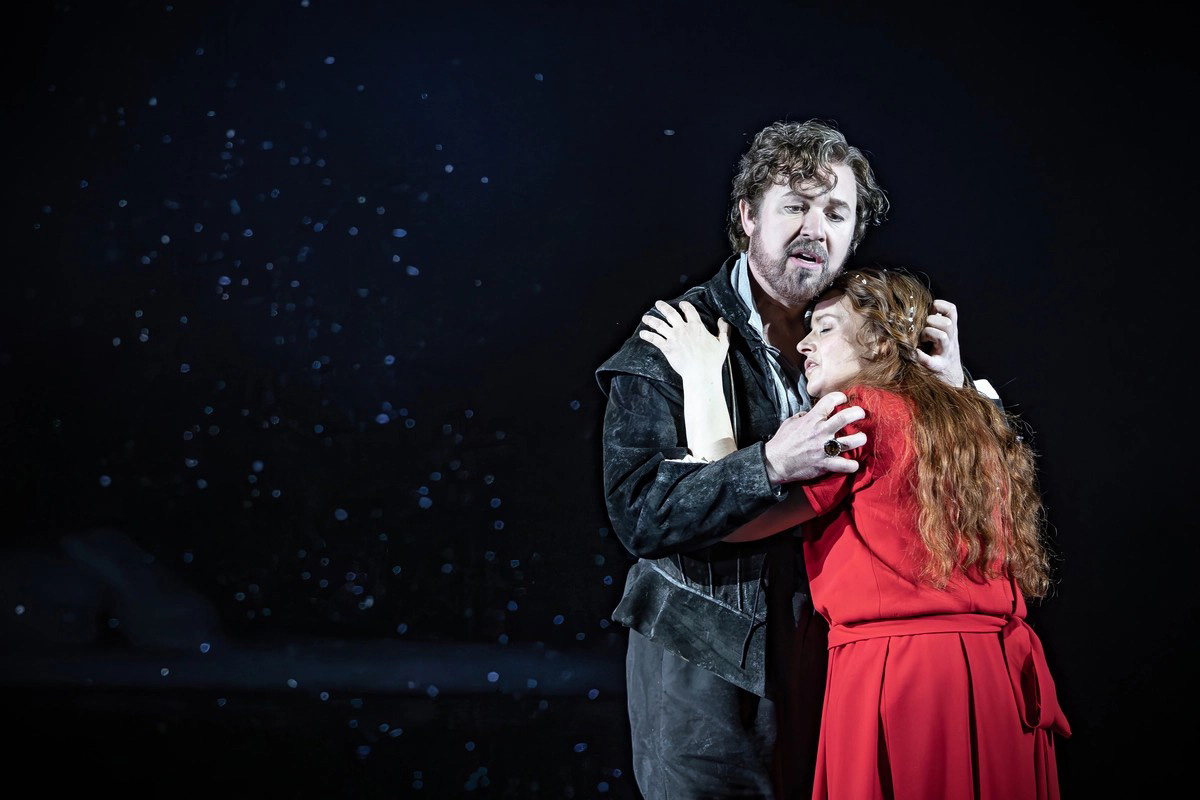

This opera — the first of Wagner’s music dramas to reach the classic repertoire — is something of an enigma. While it has some wonderful music, the story of the tormented wanderer and the young woman who saves him hardly provides the drama we need for grand opera. So directors try to find new approaches that turn the ghost story of the lost ship and its cursed captain into something new and relevant to a less “romantic” age. In this production for the Welsh National Opera, Jack Furness places Senta, the Dutchman’s redeemer, at the psychological centre of the drama. This approach sheds new light on some aspects of the opera but leaves other themes in the shadows.
The opera begins with Daland’s ship taking shelter from a storm in a bay before making its final journey to his home port. There, Daland encounters another ship and befriends its sinister captain, who boasts of the wealth he has accumulated during his voyages. The greedy Daland strikes a deal with the stranger, promising to arrange the marriage of his daughter to the newcomer. Unbeknownst to him, the stranger is the fabled Flying Dutchman. He is cursed to sail the seas for eternity and can only be released from this torment if a woman proves her eternal faithfulness to him. Senta, Daland’s daughter, knows of the legend and dreams of being the one to free the Dutchman from his torment. She meets the stranger, and they strike a fateful bargain.
Before looking at the key performances in the main roles, I have to say that the WNO chorus and orchestra are, as always, superb. The male chorus, as Daland’s sailors in Act 1, and the whole chorus, as the villagers during the celebrations in Act 3, fully embrace the music and the drama. Conductor Tomas Hanus, the departing music director of WNO, clearly knows his team well. The threat posed to this marvellous band of performers by the cuts facing WNO next season is scandalous.
Rachel Nicholls, as the disturbed daughter of Daland, is a powerhouse of dramatic force, never more moving than in the Dutchman ballad she sings to the other women of the village at the start of Act 2. However, though she is a seasoned Wagnerian soprano, there were moments when her voice sounded near its limit in the highest reaches of the music. Simon Bailey, as the Dutchman, was suitably sinister and cold, never quite believing in the promises Senta makes to “be faithful unto death”. However, the production’s focus on Senta leaves him as a less dominant figure than one is used to. As Daland, the uncaring father, James Cresswell is solid and secure, but there is little father-daughter chemistry here — and Furness’s invention of a non-speaking role for Senta’s dead mother does alter the dramatic balance unpredictably. The two tenor roles — steersman and hunter — were sung with conviction and beauty by Trystan Llyr Griffiths and Leonardo Caimi.
Furness has produced a cogent reading of the drama, placing Senta’s strange obsession with the legend of the cursed wanderer in the context of the early loss of her mother, shown in mime during the overture. But some aspects of the drama are less clear. The shadowy figures of women in ancient dresses — while the singers are in modern dress — are presumably women who have disappointed the Dutchman in previous eras. The almost total absence of scenery and props — no spinning wheels for the village women — is perhaps as much due to the need to design a production that can tour as it is to the way the story focuses on Senta’s psychology. But the portrayal of Senta’s final moments is perplexing.
I welcome the courage of WNO in adding this production to its repertoire, and it has a great deal to say about a key aspect of Wagner’s opera — and about a theme of female self-sacrifice that recurs in later works. But a Dutchman without a ghost ship and undead sailors does seem to me a missed opportunity. Had the singing been a little more inspiring, this might not have mattered. Even so, it is a production well worth seeing, both for the excellence of the chorus and orchestra and for its fresh perspective on an old masterpiece.
Bristol Hippodrome
Music and libretto: Richard Wagner
Conductor: Tomas Hanus
Director: Jack Furness
Performers include: Rachel Nicholls, Simon Bailey, James Cresswell
Running time: 2 hours 45 minutes
Dates: until 15 May
Photos: Craig Fuller