


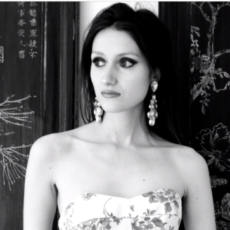
Ruth Fainlight: Somewhere Else Entirely marks Emily Andersen’s cinematic debut. By trade, she is a widely acclaimed photographer and lecturer at Nottingham Trent University, but her deep affection for her friend, the American-born writer and modernist poet Ruth Fainlight, prompted her to make her first venture into filmmaking. In just fifty minutes, Somewhere Else Entirely offers an intimate insight into the arteries of Fainlight’s brain, a space full of meditation, nostalgic reverie, and critical reflection. It casts its subject as a vernacular sibyl, able to gaze at life unflinchingly and turn observations into sharp, crystal-cut shards of poetry.
Much of the power of Somewhere Else Entirely lies in Andersen’s sensitivity to her subject. After a lifetime of specialising in portrait photography, Andersen transposes a familiar technique: constructing character by way of environment. Throughout the film, the camera moves gently between the rooms of Fainlight’s West London apartment, from a writer’s desk piled high with an assortment of books and cherished letters to scenes in the kitchen where Fainlight brings eggs to boil or slices through translucent layers of lettuce. There is also a particularly wonderful shot of a nineteenth-century antique bookcase brimming with the tomes that formed Fainlight’s early education – the legacy left to her by an aunt.
Andersen’s habitual lingering over the seemingly incidental, even coarse objects of domestic existence reflects the poet’s interest in the ways these are so often freighted with emotional force. In Fainlight’s poem ‘Handbag’, for instance, she writes fondly of her mother’s battered old bag which was possessed of the ‘Odour/of leather and powder, which ever/ since then has meant womanliness, / and love, and anguish, and war’. These kinds of Proustian moments are frequent in Fainlight’s work and Andersen’s cinematography finds a direct visual language for them.
Another interesting stylistic choice is that Fainlight never speaks directly to the camera. All her cogitations on close relationships, time passing, and the nature of poetry are delivered off-screen through a voiceover. Inspiration descending is ‘as if a big cat has jumped on your back’, and contemplating where women are to find artistic muses, Fainlight wryly concludes ‘my muse is myself’. Andersen’s technique ensures the viewer is engulfed in the poet’s world; there is a complete absence of self-consciousness, resulting in an attractive candour and intimacy, as if we’re eavesdropping on Fainlight’s private reflections.
On a more melancholic note, however, this single-voice style amplifies the fact that an artist’s existence is defined by solitude. (Indeed, in the Q&A Andersen disclosed that scenes filmed with other people didn’t make the final cut.) This loneliness is particularly potent when Fainlight recites the titular poem ‘Somewhere Else Entirely’, an elegy written in memory of her late husband Alan Sillitoe, the author of the 1951 novel Saturday Night and Sunday Morning. With a voice full of rich, crackling warmth, Fainlight muses that ‘Although every room/ retains so many memories, / sounds and images, is / saturated with your essence, / I know I’ll never meet you here’. As the camera scans the rooms the literary couple shared, the poet’s disembodied voice is poignantly haunting.
Ruth Fainlight: Somewhere Else Entirely is a remarkable debut film; Anderson achieves the rare feat of translating a distinctive poetic spirit and energy into a gripping cinematic medium. Instead of trying to impose a directorial narrative, she moves sympathetically with the vagaries and psychological processes of the artist’s mind. The result is that, if only briefly, the viewer feels somewhere else entirely.
Ruth Fainlight: Somewhere Else Entirely ☆☆☆☆☆
Director: Emily Andersen
Running Time: 1 hour and 35 minutes, including an interval
Review by Olivia Hurton
25th September 2025