

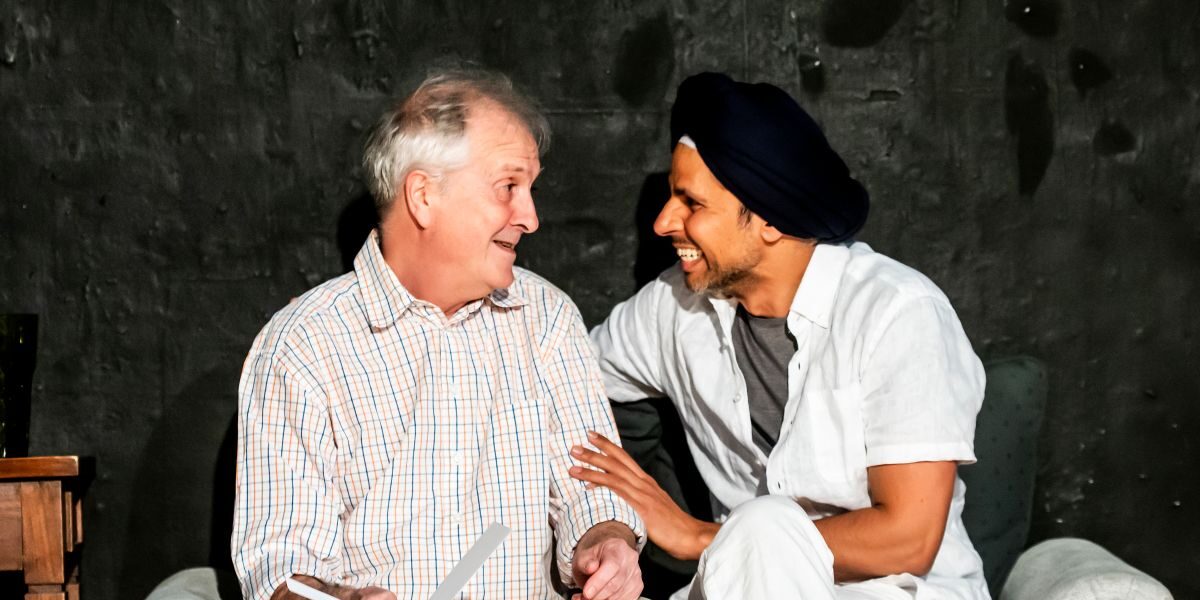

It is a while since I was reviewing at the Old Red Lion, and it was good to be back in this dark, somewhat grungy, upper room where so many notable theatrical adventures have started off. It is a space that rewards bold minimalism, in concept and design, and that is certainly in evidence in the set created by Jason Marc-Williams & Noah Cousins. Just the frame of a doorway with a stained-glass fanlight, a sofa with an array of birthday cards on a sidetable and a wheelchair off-stage: a few suggestive starting points that indicate that this is to be a drama of character created above all by the interplay of the three actors in the cast.
It turns out we are in a run-down cottage in Norfolk, to which Frank has retired once the other members of his family back in Essex have died or moved away. The opening scene establishes that the action is taking place on the hottest recorded day in meteorological history, and that Frank’s cantankerous dislocation from his environment is not just down to the weather but is in fact early-onset Alzheimer’s. This emerges in a tender and sensitively written set of exchanges with Sandeep, a Sikh neighbour who has become Frank’s informal carer. As he departs to do the shopping there is a new arrival in the form of Michael, Frank’s estranged son, who has been travelling for many years in Southern America. Again, writer Tim Graves handles their reunion scene with great sensitivity and a fine ear for comic misunderstandings. It is clear that Michael has returned because he feels he must, not because he wishes it and that there is a great weight of unresolved business between the two, with heavy hints of homophobia and past abuse.
These are the threads and themes out of which the texture of the play is woven most successfully: fathers and gay sons, the mutual incomprehension of youth and age, and the fragmentation of both understanding and personality. The actors inhabit and explete these areas with great skill. Christopher Poke, as Frank, gives an exceptional performance in which you can never quite tell whether he is on the ball or off with the fairies, or somewhere between the two – it is both comic and tragic in its inflections, sometimes simultaneously. Crucially the writing does not enter sentimental territory here, emphasising that Frank is in many ways and unpleasant, conflicted and unresolved personality well before the onset of dementia; and this makes the central performance all the more credible, and the final redemptive pay-offs more rewarding.
The other two performances are at their strongest in their relationship to Frank rather than with each other. Amrik Tumber turns in an exquisitely sensitive performance as Sandeep, gradually unveiling the relationship between his caring personality and his Sikh faith, and personal damage that echoes the father-son dynamic in the main plot. His back-and-forth with Frank, stoically absorbing and deflecting the old man’s unfiltered prejudice and anger, is deftly and movingly achieved. Whereas the strength of the relationship between Frank and Michael lies in its bleak acknowledgement of unresolved wounds and conflict, homing in on the conclusion that part of the problem is that they are too alike in personality, both too rigid to forgive and adapt except in extreme circumstances. Edward Fisher’s moody and truculent defensiveness brings out this aspect with real success.
There are two areas where the play fall short, when viewed as a whole. There seems to me no need for an interval – the action should really run through without a break and it was hard to recapature the incisiveness of the first half on resumption. Secondly, I found the focus on a developing relationship between Sandeep and Michael in the second half unconvincing in both concept and execution. With so many important and complex themes already in play there did not seem to be enough space to properly broach another and do it justice. Moreover, by introducing a detailed exposition of Michael’s shamanism and Sandeep’s Sikhism as part of their connection, the dramatic pulse ebbed in favour of exposition rather than resolution.
Overall, though, this is a worthwhile and thought-provoking play with three fine performances at its centre that do full justice to the issues placed under scrutiny.
Writer: Tim Graves
Director: Jason Marc-Williams
Cast: Edward Fisher, Christopher Poke, Amrik Tumber
Until May 16 2026
90 minute with interval
Photo Credit: Lidia Crisafulli