
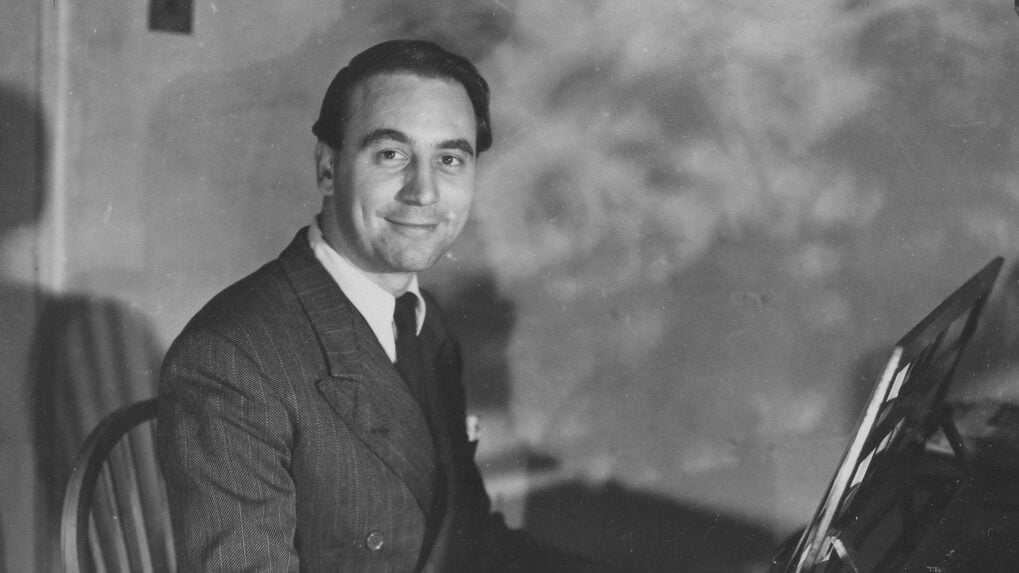
Outside Cambridge, where he was a leading figure in the musical firmament for some thirty years, the name of Peter Tranchell is not well known. Yet he composed a good deal of music which carries a very individual stamp, one which the foundation that now carries his name seeks to introduce to a wider audience. Much of his output was written both at and for Gonville and Caius College, Cambridge, and the first half of this programme contained music focused on the life of the college chapel and other occasional pieces, while the second half was given over to a more substantial single work, the single-act comic operetta, Twice A Kiss, here performed by an exceptional cast led by Christopher Purves, who sang in its last revival back in 1982.
Tranchell’s style is academic to be sure, with plenty of experiments with serial style, and rhythmic and contrapuntal complexity. But above all there is a quirky, irreverent sense of humour in play which is most engaging. At its best, there is a deft dexterity and light touch matched with a good judgement of musical proportions so that none of the pieces overstay their welcome. The audience was consistently engaged and entertained with plenty of spontaneous laughter at witty word-setting or pointed sonic effects. He was composer with an equal facility in writing for organ and choirs, piano and voices, and in shaping operatic ensembles with a tight sense of drama and translucency of texture.
The first half, subtitled ‘entertainments for organ, piano and choir’ was somewhat miscellaneous, but nevertheless contained some finely contrasted items. After a movement from an organ sonata, we enjoyed seven brief piano pieces, each tonally based around a musical note and with those notes connected in Hindu symbolism with particular animals. Tranchell’s descriptive text commentaries were read knowingly by Tasmin Little, while the pieces themselves, sounding like Messiaen at his most pictorial, were played dexterously by Piers Lane. These were followed by two delightful choral settings – the first, and a real gem, was a droll creation indeed – the literal text of a newspaper article about a dog that would not budge from the roadside brought to life; then followed by a contrasting and arresting memorial setting of famous quatrains from Fitzgerald’s Rubaiyat of Omar Khayyam. Rare indeed it is when a composer can add memorable music to poetry that already has a music of its own.
The last piece ahead of the interval was a piece for organ and piano called Tickling the Keys by Maho Ishizaka, the winning entry in a composition competition named after Tranchell. This took the form of a duet for piano and chamber organ, full of contrasted tempi and timbres, which showed off the qualities of the two instruments distinctively.
The second half was hugely enjoyable and genuinely funny. At a time when you hardly ever see Restoration comedy on stage in London, it was a delight to have a confected one here. The plot hardly matters, but contains the usual stock characters of wily servants, lecherous self-important masters, and put-upon wives and wards. The libretto, by Maurice Holt, provides rich opportunties for characterful solo numbers and punchy, concerted ensembles; and the music spins past with many memorable melodies along the way. James Gilchrist, Henry Waddington and Jennifer France, in particular, acted their roles with panache, and Christopher Purves stole the show as the devious actor-manager, Honeywood. Chamber organ and piano again provided the instrumental accompaniment, a pert, delicately shaded combination that reminded me of use made of both by Rossini in his Petite Messe Solennelle.
There are plenty of other un- or underperformed works by Tranchell, which, on this evidence, deserve to be unearthed and revealed to a wider audience.
St Paul’s, Knightsbridge
Composers: Maho Ishizaka & Peter Tranchell
Libretto: Maurice Holt
Cast: Sophie Bevan, Jennifer France, Daniel Gilchrist, James Gilchrist, Chris Purves, Hilary Summers, Henry Waddington
18 April 2026
Photo Credit: Independent Society of Musicians