

This sequence of five short plays builds on the success of a similar exercise that Nicolas Kent put together some years ago focused on Afghanistan. Similarly, this sequence aims to draw attention to forgotten or hazily understood aspects of the Ukrainian conflict and its causes, while also bringing these themes to dramatic life. If all the plays succeed in the first laudable objective, it is in the second half that the plays really flare into full dramatic life as well.
It is always hard to convey a bulk of unfamiliar information and ideas within a dramatic setting without there being more telling than showing. Even the best, most experienced dramatists, such as Stoppard, can falter at this point. It is an issue for Jonathan Myerson’s ‘Always’ and David Edgar’s ‘Five Day War’ devoted to the political approach to the Russian invasion of 2022. In the first we encounter a hostage situation where a politician and his wife staying in a hotel overlooking Kiev’s Maidan Square are forced to allow a couple of agents provocateurs to take over their room as a sniper’s vantage point. Their son is a protestor on the square, but while this is an inherently dramatic scenario, and one the actors play up for all they are worth, the dialogue is too heavily and obviously freighted with material about the Budapest Declaration of 1994 and the twists and turns of the Yankovych administration in Ukraine.
Likewise, ‘Five Days War’ is a bit too much of an unsresolved talking shop, as a group of individuals identifed as future collaborators in helping run Ukraine after the invasion compare notes in a safe house while they wait for the expected ‘five-day campaign’ to conclude. While there are many interesting viewpoints on display here, the dramatic pulse is fitful, and I found myself looking at my watch towards the end.
After the interval came the more resonant dramatic offerings. ‘Three Mates’ by Natalka Vorozhbit was built around an exceptional performance by Ian Bonar as Andriy, a man sheltering with his wife during a nightime air raid. He is avoiding conscription and the monologue offers a deep pyschological study of someone torn between a determination to survive and protect his family and guilt over the different choices taken his two closes friends. Here the particular is universalised memorably in a distinctive twist on a perennial theme of theatre – loyalty fo comrades.
Again, the next play, ‘Wretched Things’ by David Greig, explored another aspect of the classic theme of conflicted loyalties in war, this time through the formula of three soldiers holed up under fire in a ruined primary school, still decorated with pictures drawn by the children in peacetime. They have a choice to save themselves or the life of a wounded North Korean soldier. Here the arguments are dramatically grounded and credible and the dilemmas fully realised in the action.
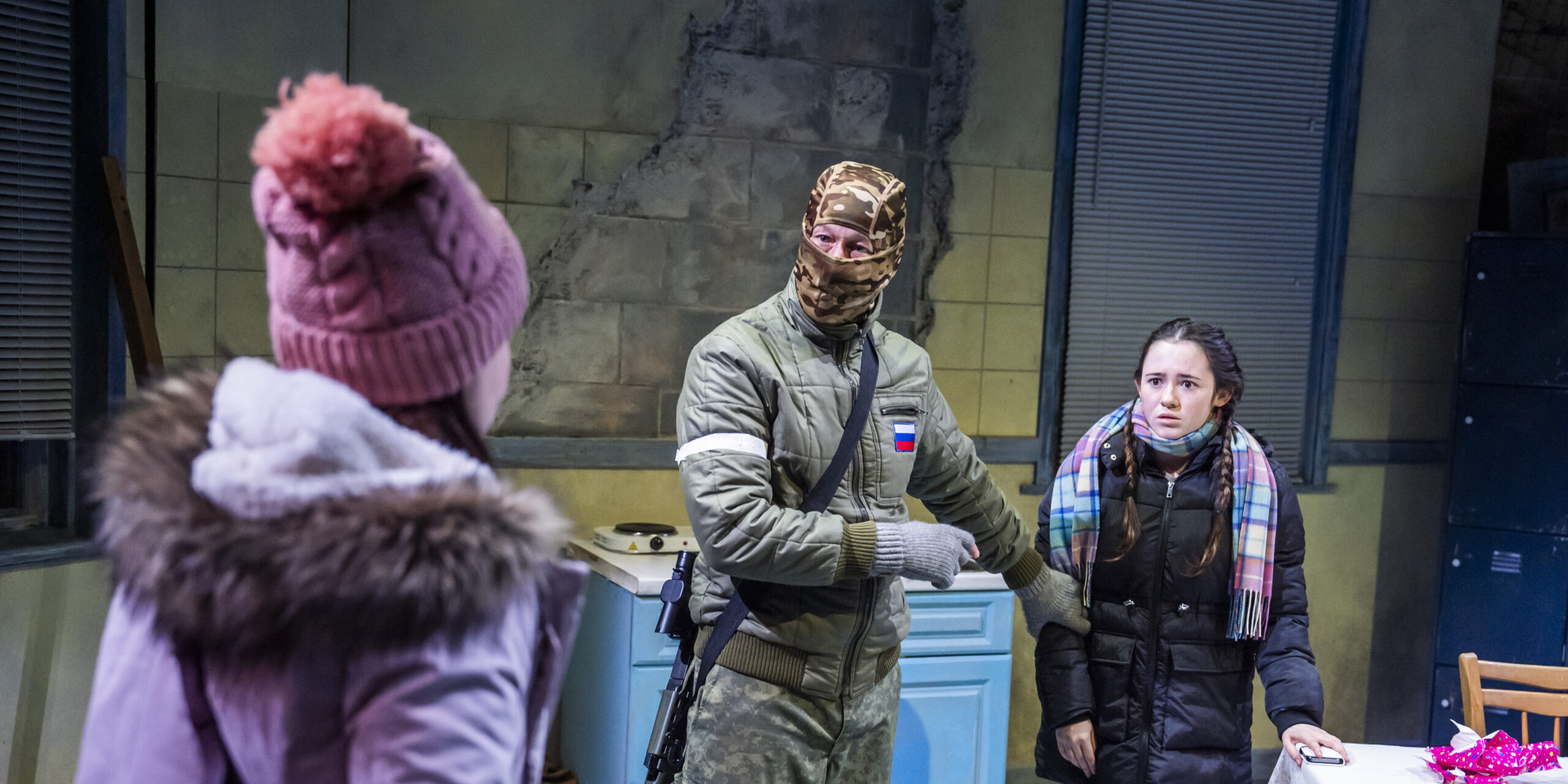
Perhaps the most touching and important play was the final one, ‘Taken’ by Cat Goscovitch, beautifully played by Jade Williams and Clara Read. It is often forgotten that the Russian troops have kidnapped over 20,000 children and submitted them to forced resettlement and re-education in Russia. This play brings this tragedy to life in the story of one mother and daughter who do find each other again, but without any kind of pat or easy happy ending, a finely calculated ambiguity that does full justice to the raw pain of the subject matter.
Two very positive aspects with which to conclude…
Linking all the plays as scenery changes took place was the very appealing contribution of vocalist Mariia Petrovska, who accompanied herself on the bandura with fine technique and emotional intensity that offered an appropriate underscore to the evening, enhanced by her own anecdotes of exile and return.
Finally, all credit to director Nicolas Kent for reversing the normal pattern of staging in Arcola Studio 1, something I have been waiting to see a director do for a very long time. This former warehouse is an awkward space both in sightlines and layout. By placing the main stage events opposite rather than underneath the suspended platform he opened things up for the actors and audience without compromising the flow of entrances and exits. I hope we can see this pattern repeated in other productions.
Writers: David Edgar, Cat Goscovitch, David Greig, Jonathan Myerson and Natalka Vorozhbyt translated by Sasha Dugdale
Director: Nicolas Kent
Until 28 March 2026
2 hrs 40 mins with interval
Photo Credit: Tristram Kenton