

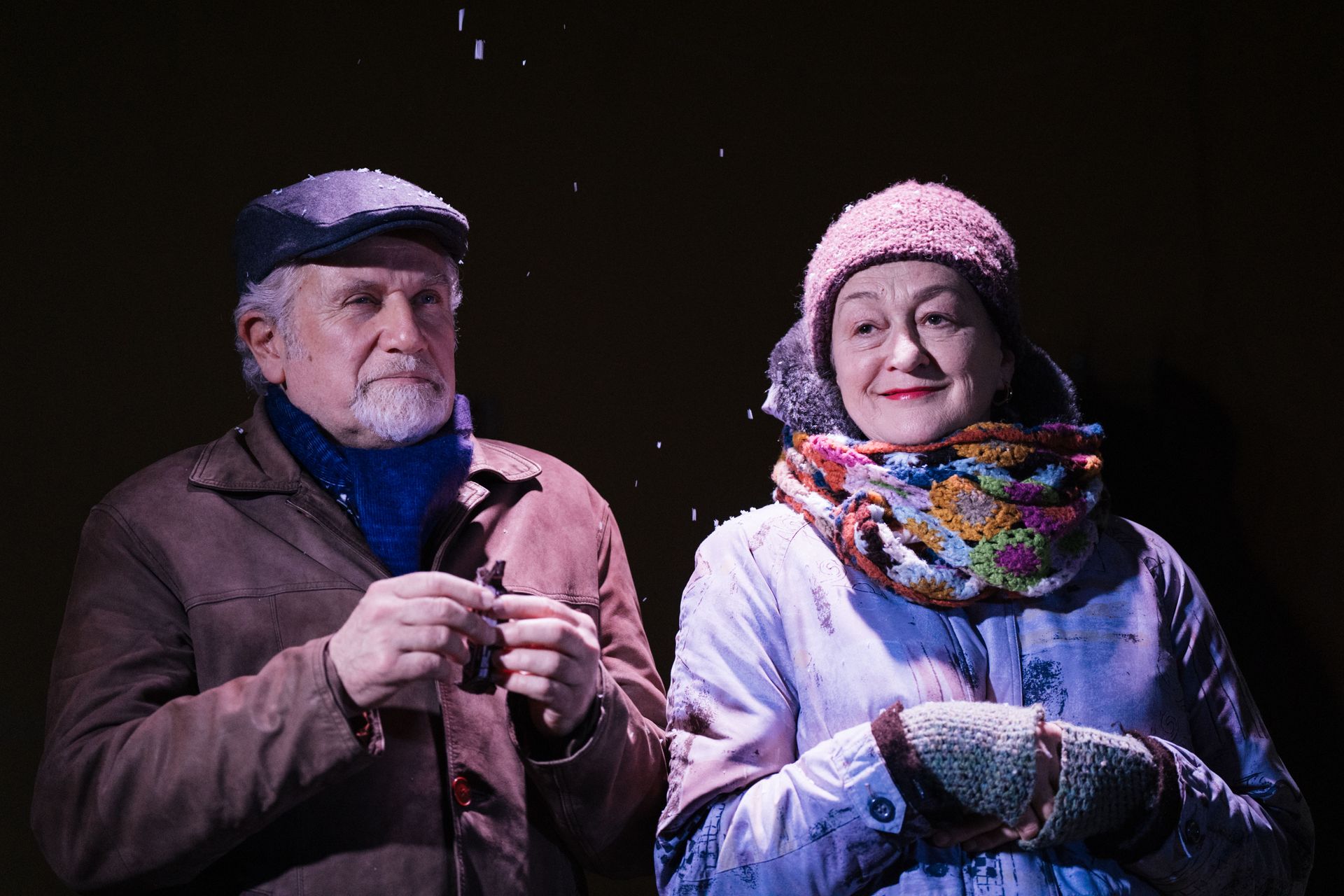


Seeing DONBAS in the claustrophobic hush of Theatre503 is a smart theatrical decision. Olga Braga’s writing, which moves cleanly between gallows wit and grief, needs a room that can take intimacy seriously, and director Anthony Simpson-Pike and the designers oblige. The 20-something Sashko has just been released from Russian prison and immediately clashes with Seryoga, his bruising, conflicted father who has recently acquired a Russian passport, driving a family teetering between survival and self-destruction. The grandmother Vera navigates her quiet, tender bond with her companion, the Russian Ivan, while Seryoga’s live-in mistress Marianca tends to the fragile domestic fabric. The absence of the mother, Vera’s daughter, hangs like a quiet ache at the centre of the home. Two Russian occupiers in a neighbouring abandoned house are rendered both banal and monstrous. What could have read as a set of theatrical clichés do have a few surprises up their sleeve.
Mythic currents seep through memory and everyday gestures. Sashko bonds with Nadya (Vera’s granddaughter and his at least half-sister) through stories of the Cossack past, namely the uprising led by hetman Bohdan Khmelnytsky. Khmelnytsky is alternately lionised and denounced, and potently alive. Inspired by the past to fight the present, Nadya becomes increasingly emboldened to speak and enact violence against their current invaders, the Russians. The production does not take an explicit view to this nationalistic fervour, only depicts it in a way that’s fanciful and passionate, if simplified. Seryoga points out that his son’s talk about being proudly “100% Ukrainian” is misguided, as his own grandmother was Russian. Ivan, too, continues to wear the Order of the Red Star, having been “born into a country that no longer exists”.
The cast assembles several striking presences. Jack Bandeira’s Sashko is combustible, brash youthful heroics leavened by brittle tenderness, while Philippe Spall gives Seryoga the kind of bruise-lined pragmatism that keeps the play anchored. Sasha Syzonenko’s Marianca and Ksenia Devriendt’s Nadya provide the production with its quieter and most dangerous pulses.
Identity is given texture by habit, like a son repeatedly punching his chest in defiance and little pop-culture pins (see how many times the characters say Claudia Schiffer). Transitions glide with a filmmaker’s economy, like when the snow left over from the scene of Vera and Ivan on their night walk is smoothed by Marianka sweeping the floor the next moment. The play trusts the tiny, domestic element. There are expected, inverted echoes to Gogol’s Taras Bulba, including the violent, ritualised ties between father and son, the intoxicating lure of combat and belonging.
And yet, for all its disciplined lines and committed cast, the production staggers under the weight of its own appetite. It insists on holding nearly every hot topic at once, from war and myth to propaganda, sex work, intergenerational complicity, national purity, and the psychology of occupation, and while individual threads have power, the weave occasionally unravels. The play wants epic breath while simultaneously insisting on the intimacy of a single home. These two impulses are complementary but here they are rarely knitted together with the exacting precision the play needs.
That problem is compounded by directorial choices that prize intensity over clarity. The ending, staged as a literal invasion, is theatrically loud and visceral. But after the lights are on and the sirens are gone, there is an emotional vacancy, as if the play had spent its accumulated moral capital on the last, emphatic shock rather than on the quiet accounting that should follow.
Notably, Liza Kettle and Steve Watts as Vera and Ivan provide essential human ballast, their scenes are the play’s soft centre. Yet some secondary characters feel lightly sketched. This really matters when the drama is asking us to care about a whole community through the prism of a tight domestic snapshot. In a play with so many tensions, in which geographical boundaries come and go as they please and people affected by the invasion must find a way to simply live, there is no stance to be found. The Russian invasion of Ukraine is going into its fifth year. While DONBAS does do well in highlighting some key human tensions, the lack of opinion or direction on the conflict itself does impact my overall takeaway. Several reviewers have praised the production’s vividness and pace; while I share this sense, I do feel that a couple of figures never quite earn the emotional attention the script hands them.
The play’s greatest strength is its refusal to simplify heroism. Sashko’s chest-puffs of patriotism read less as noble sacrifice than as an ongoing, grieving refusal to yield. Mythology is shown as a shelter and a danger in the same breath.
Writer: Olga Braga
Director: Anthony-Simpsion Pike
Lighting Designer: Christopher Nairne
Sound Designer: Xana
Cast: Jack Bandeira, Ksenia Devriendt, Liz Kettle, Philippe Spall, Sasha Syzonenko, Steve Watts
Press photo: Helen Murray
Running time: 1 hr 40 min, no interval
Until: 7th March 2026