


To anyone not versed in the annals of theatre history, upon hearing the title of David Hare’s latest play Grace Pervades, one might reasonably ask, ‘grace pervades what?’ The rather indelicate answer is ‘grace pervades the hussy’—it was how theatre critic Charles Reade had once ungraciously referred to Ellen Terry, the Victorian-era actress who was celebrated for her performing and lambasted for having two children outside of wedlock. This is an apt entry point for a play that weighs personal lives against professional ones, asking, at its heart, whether acting and living are somehow incompatible.
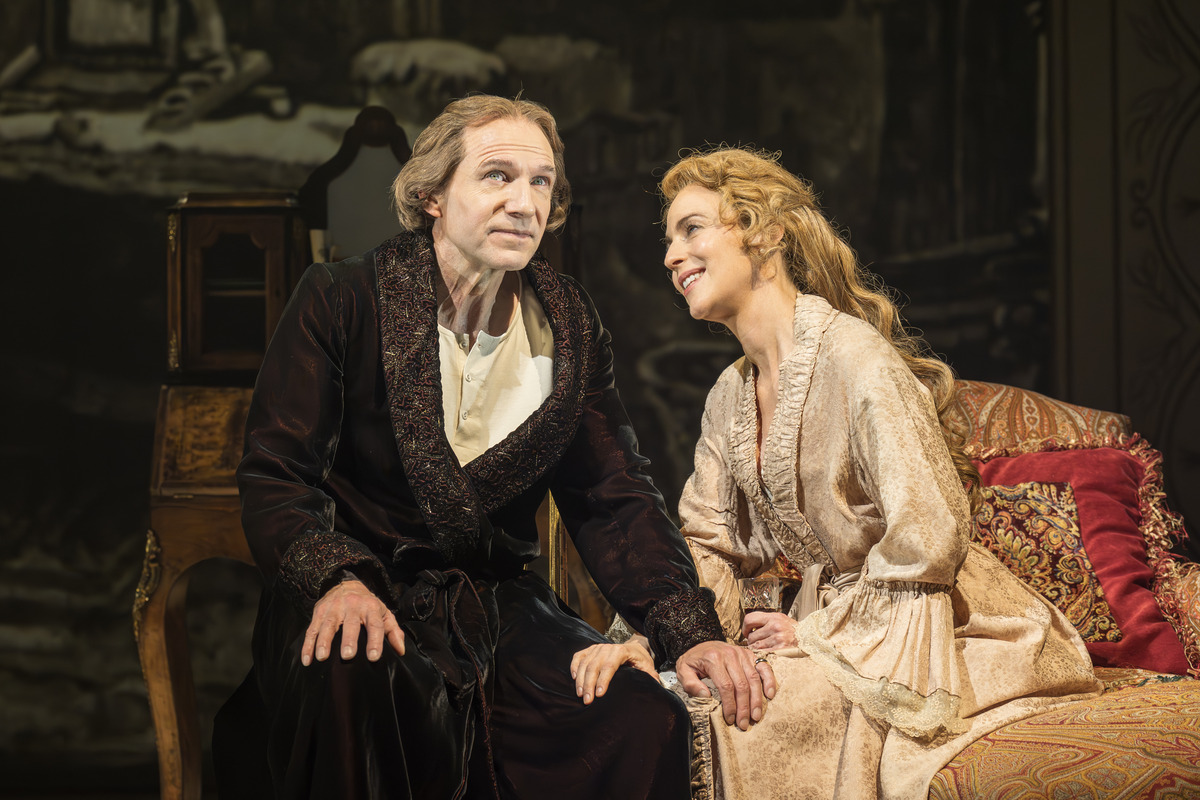
Hare is less interested in plot than clashing theatrical philosophies. Grace Pervades dissects four attitudes towards the dramatic art from leading Victorian thespians. Given their family ties or close personal relationships, it’s all the more remarkable they should have such disparate ideas. For actor-manager Henry Irving, played by Ralph Fiennes, theatre is life itself—his whole personality hinges on the fact that he owns the Lyceum Theatre and when he talks about acting it is with the sombre piety of a Catholic going to confession. His foil is Ellen Terry, the ebullient Miranda Raison, for whom acting is simply a job; it pays the bills and she just so happens to be spectacularly brilliant at it. Her two children have their own opinions. Edward Gordon Craig, performed with nerdy superciliousness by Jordan Metcalfe, incessantly theorises about how theatre needs a radical overhaul: actors and writers, with their oversized personalities, should be brushed away in favour of symbols, gestures, and light. Terry’s daughter Edith Craig, played by a sprightly Ruby Ashbourne Serkis, sets about making a theatrical revolution happen from a purpose-built barn stage in Kent, where all classes can mingle, women’s stories are heard, and social reform is the objective.
As the old adage goes, in a good play everyone is right. This is certainly the case here, with each viewpoint getting a decent share of stage time from Hare so the audience can contemplate their relative merits and limitations. Invariably though, Fiennes seemed to dominate; his light-touch acting making for a humorously ironic contrast to Irving’s high mannerism and risible enunciation. Particularly enjoyable was the scene where Raison’s unflustered Terry recounts to Irving how she flies down banisters before coming on stage and that if he wants to improve, he must try ‘to be more last minute’. In other words, to stop taking it all so seriously. (Some, however, might argue Irving wasn’t serious enough about his business—under his management the Lyceum was left with gargantuan debts.)
The play’s action takes place in a variety of personal and professional locale—there are drawing rooms, dressing rooms, utopian theatres in back gardens, avant-garde theatres in Russia. Set Designer Bob Crowley superbly underscores that drama unfolds in manifold places through helpful scenic projections, lending atmospheric fluidity to transitional moments. No one stage looks the same; neither is there one approach to the craft. What is less conspicuous, however, is the chronology on signage above the stage, which is unhelpfully located beyond eyeline if you’re seated towards the back of the stalls.
If this play has a fault, it is perhaps that it is too deeply rooted in luvvie land. Dramatic devotee that I am, I felt some unspoken prayers answered in seeing the spectres of theatrical giants and their outré personalities raised once more. Yet I do wonder if Grace Pervades has a message that would be as meaningful outside of the golden extravagance of the historic Haymarket Theatre. Today, is it a theatrical revolution we need—or a real one?
By David Hare
Director: Jeremy Herrin
Photo credits: Marc Brenner
Cast includes: Ralph Fiennes, Jordan Metcalfe, Miranda Raison, Ruby Ashbourne Serkis, Kathryn Wider, Maggie Service and others.
Until: 11th July 2026
Running Time: 2 hours and 30 minutes, including a 20-minute interval
Review by Olivia Hurton
30th April 2026