

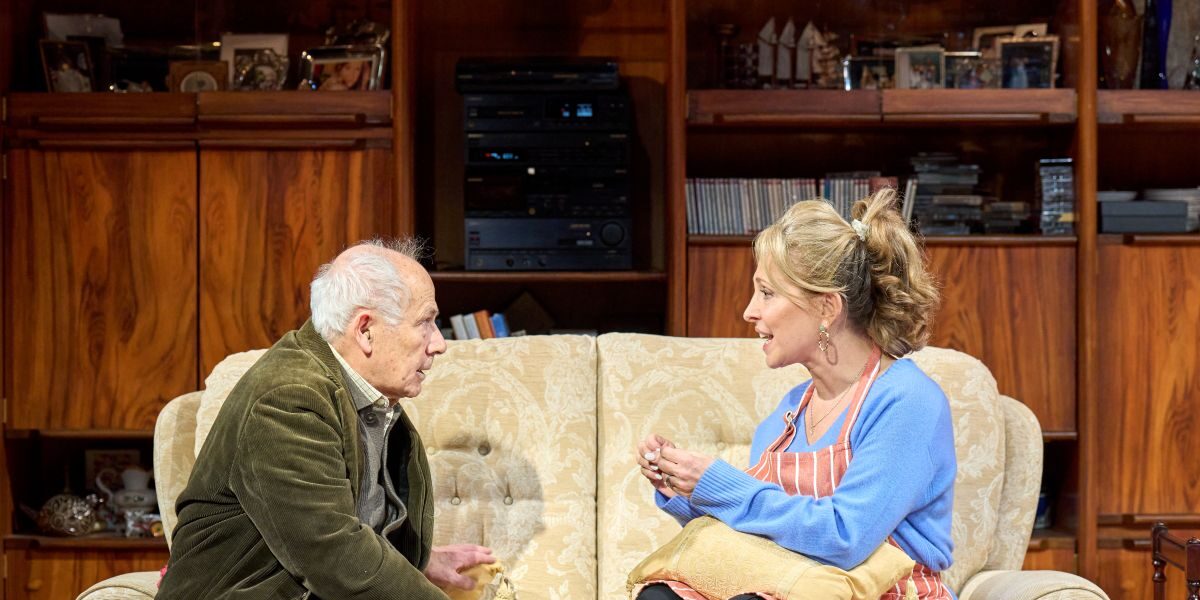

This play was first produced at the National Theatre back in 2011, marking an earlier period of crisis and conflict in Gaza. It is revived now at a time of even deeper crisis, but is still located in its original time-frame, losing none of its topicality along the way. It is a highly ambitious work, full of both plot and character, and carrying very specific echoes of the early plays of Arthur Miller. Through the lens of a Jewish family in Edgware we are invited to explore and reflect on some of the biggest political issues of our time.
The Rosenbergs are a family with fault lines. We meet them on the eve of a memorial service for the elder son, killed while fighting as a pilot for Israel. As the family members gather, we learn that parents David and Lesley are trying to revive their kosher catering business, younger son Jonny is in danger of going off the rails, and daughter Ruth, a high-flying lawyer, is at odds with her family over a her role in a human rights investigation involving Israel’s role in Gaza. As the action begins, we encounter David’s delusions of grandeur, Lesley’s desperate attempts to keep the family together, and the emergence of a consistent tug-of-war between loyalty to family and broader community.
The writing operates across an impressive range of registers from archetypal Jewish tropes through to earnest intellectual debate on a high plane. The blend of character revelation and heated argument, testament of the debt to Miller, works well. Certainly the play does not seem dated and locks into contemporary concerns very effectively. However, the pace often seems sluggish, which is down to the varied quality of the performances from the cast. There are points where the interchanges really catch fire and others where time hangs heavy.
The women are uniformly excellent, and indeed the key scene between Oberman and Myer-Bennett before the interval was pacy, incisive, and quick-silver in mood shifts, and all that one could wish for. They were highly skilful in demonstrating both stoic endurance and emotional brittleness that fully complemented their complicated back-stories.
The other scene that took the audience into a special zone of concentration was a long back-and-forth between two of the outsiders to the family, played with combative dexterity by Adrian Lukis and Dan Fredenburgh. Pitting a pillar of the local Jewish community against a smooth human rights lawyer allowed free range for a nuanced exchange of views on how Israel is judged internationally that was admirably fair while also hard-hitting and dramatically credible.
Unfortunately, elsewhere some of the performances were underpowered. In the key role of the patriarch, David, Nicholas Woodeson was uncertain of his lines at points, and both Alex Zur, as the local rabbi, and Nitai Levi, as the overlooked younger son, could have made more of their roles, while still granting the point that their parts are somewhat underwritten, functional roles.
The set seemed broadly similar in layout to the living room interior I last saw in Fallen Angels, though differently furnished of course; and given the physically static nature of the play there was not much occasion for innovative intervention by the sound and lighting creatives.
All in all, the play itself more than justified its revival, but aspects of its delivery left something to be desired. It is perhaps one of those occasions where a visit later in the run may yet demonstrate a production that has settled and found its true groove.
Writer: Ryan Craig
Director: Lindsay Posner
Cast: Dan Fredenburgh, Nitai Levi, Adrian Lukis, Dorothea Myer-Bennett. Tracy-Ann Oberman, Nicholas Woodeson, Alex Zur
Until 2 May 2026
2 hours 15 mins with interval
Photo Credit: Manuel Harlan