

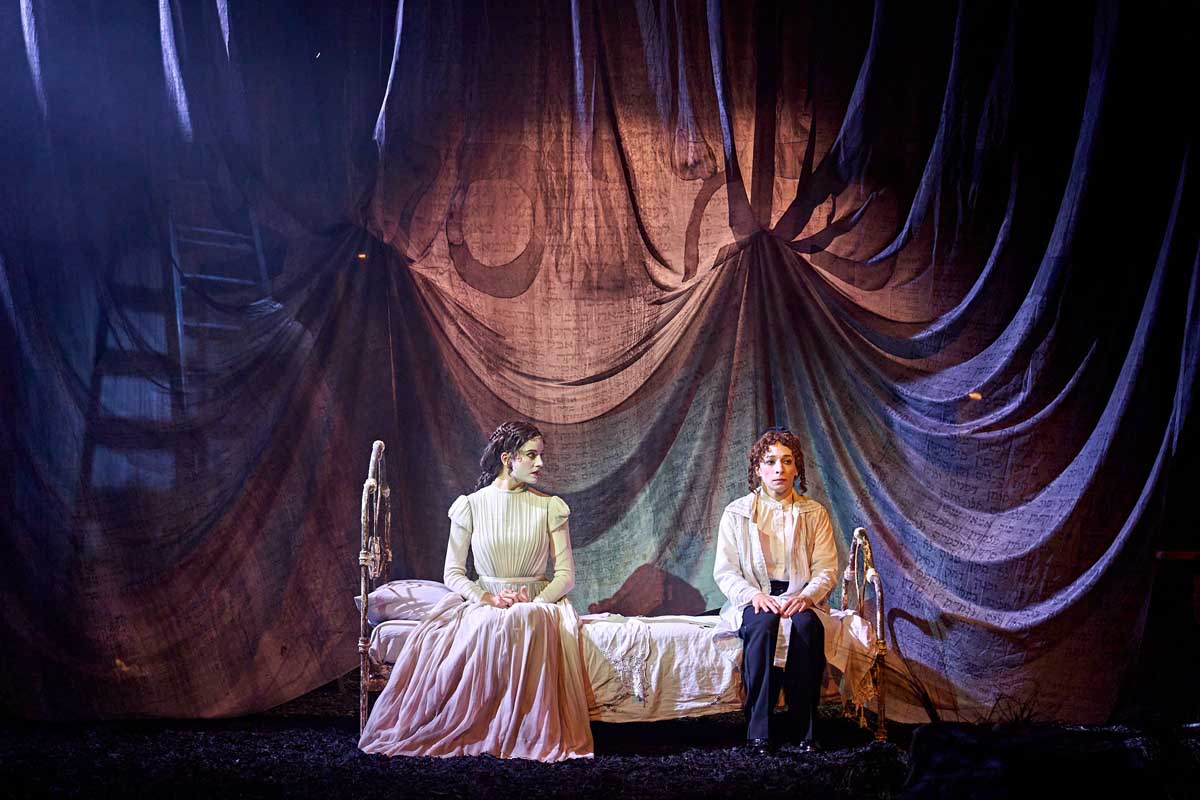

Kadimah Yiddish Theatre’s bold and intellectually ambitious staging of Yentl, now playing at Marylebone Theatre, brings Isaac Bashevis Singer’s celebrated story vividly to life, exploring the price of knowledge, the fluidity of gender and identity, and the tension between tradition and self-discovery. From its opening moments, the production frames Yentl’s journey through a mystical idea introduced in the prologue: that the sacred name of God itself contains both masculine and feminine elements, suggesting that the boundaries between them may be less fixed than tradition assumes. At moments the actors speak Yiddish, with English subtitles projected above the stage, a device that lends authenticity while keeping the story accessible to audiences unfamiliar with the language.
Yentl is a bright young woman whose father nurtures her love of learning, secretly teaching her sacred texts traditionally forbidden to women. After his death, she leaves her village and assumes the male identity of Anshel, entering a yeshiva where she can study openly. While Singer’s original story already hints at the ambiguities of Yentl’s identity, this production brings those tensions strikingly to the fore. From the outset, the tension between her female self and male persona signals the story’s central exploration of gender and identity.
At the yeshiva Yentl forms a friendship with Avigdor, a young man infatuated with Hodes, his intended bride. Circumstances soon entangle Yentl in a complicated relationship with Hodes, whose affection for “Anshel” draws her into a web of emotional and moral contradictions that her disguise makes impossible to resolve openly.
Amy Hack delivers a compelling performance as Yentl, capturing both her intellectual curiosity and emotional vulnerability. Her portrayal traces Yentl’s gradual awakening — not only to the intellectual freedoms of the male world she enters as Anshel, but also to a growing recognition of her own sexuality. In this production, that awakening is framed in strikingly modern terms: Yentl emerges as a character whose emotional and physical attachments suggest a distinctly bisexual identity. Hach’s Yentl ultimately accepts her ambiguous position — a woman who finds fulfilment within a world traditionally reserved for men. As Yentl herself reflects, she possesses a man’s soul within a woman’s body, and appears strikingly at ease inhabiting that paradox.

Ashley Margolis brings warmth and emotional openness to Avigdor, and his scenes with Hach generate a natural, often touching chemistry that gives convincing weight to their bond. Genevieve Kingsford portrays Hodes with grace and sensitivity, capturing her innocence and emotional vulnerability, particularly her lack of understanding of sexual intimacy. Hodes’ marriage to Yentl remains both tragic and darkly ironic, yet the production balances this with emotional nuance, revealing Yentl’s profound attachment to Avigdor alongside her complicated tenderness toward Hodes – a dynamic that further underlines the production’s suggestion of Yentl’s bisexual identity.
Director Gary Abrahams draws on classic Yiddish theatrical traditions. The actors’ lightly whitened faces evoke the subtle mask-like make-up historically associated with that tradition, emphasising that the production embraces a consciously theatrical style rather than naturalistic realism. Evelyn Krape, as narrator, functions almost as a Greek chorus, moving fluidly between characters and perspectives, foreshadowing events and giving voice to Yentl’s inner turmoil with wit, authority and philosophical insight.
The production’s visual language is rich with symbolism. A grey wall punctuated with illuminated niches suggests the many paths of Jewish learning, each briefly lighting as different aspects of study or spiritual inquiry are invoked. A tall grey ladder rising toward the highest niche evokes both Jacob’s biblical ladder and the symbolic ascent described in Kabbalistic thought. The image becomes an eloquent metaphor for Yentl’s quest: her pursuit of knowledge is both intellectual and spiritual, yet the path she must take is fraught with ethical complexity.
The symbolism reaches its most powerful moment in the final scene, when Yentl dons tzitzit (ציצית) and tefillin – ritual garments traditionally worn by Jewish males from the age of thirteen following their Bar Mitzvah. In defiance of that tradition, she performs the ritual herself, reciting the prayer “Elohai, neshama shenatata bi tehorah hi…” (“My God, the soul You have given me is pure; You created it, You formed it, You breathed it into me, and You preserve it within me…”). The gesture becomes both an act of defiance and a profound statement of spiritual self-assertion. By invoking the purity of the soul bestowed by God, Yentl affirms that her identity, which she herself describes as a man’s soul inhabiting a woman’s body, is part of divine creation. The prayer thus becomes more than a challenge to religious convention: it is a theological claim that the soul God has given her is pure regardless of the form it takes, and that the boundaries between male and female may be more fluid than tradition allows.
At times, however, the production’s philosophical framing proves demanding. The prologue leans heavily into abstract reflection, introducing ideas about the unity and duality of male and female identities before the narrative itself has fully unfolded. For some viewers this early emphasis may feel opaque before the dramatic action gathers momentum. As the play progresses, however, these ideas acquire greater clarity and resonance as Yentl’s journey reveals the complex interplay between intellectual aspiration, sexuality and spiritual self-recognition.
Intellectually ambitious and visually imaginative, the production ultimately presents Yentl as a figure who finds her true home within a male-dominated intellectual world while refusing to abandon her own complex identity. Her spiritual, intellectual and emotional awakenings become inseparably intertwined, culminating in the defiant final image of her donning tzitzit and tefillin. The result is a thoughtful and nuanced meditation on identity, learning and self-realisation that lingers long after the curtain falls.
Yentl
Based on the short story ‘Yentl the Yeshiva Boy’ (published 1962)
By Isaac Bashevis Singer (1902–1991), Nobel Prize in Literature 1978
Adapted by Gary Abrahams, Elise Esther Hearst, and Galit Klas
Directed by Gary Abrahams
Cast: Amy Hack, Evelyn Krape, Ashley Margolis, Genevieve Kingsford
Produced by Kadimah Yiddish Theatre
Duration: Approx 2 hours and 10 minutes including a 20 min interval.
Until: Sunday 12 April 2026