

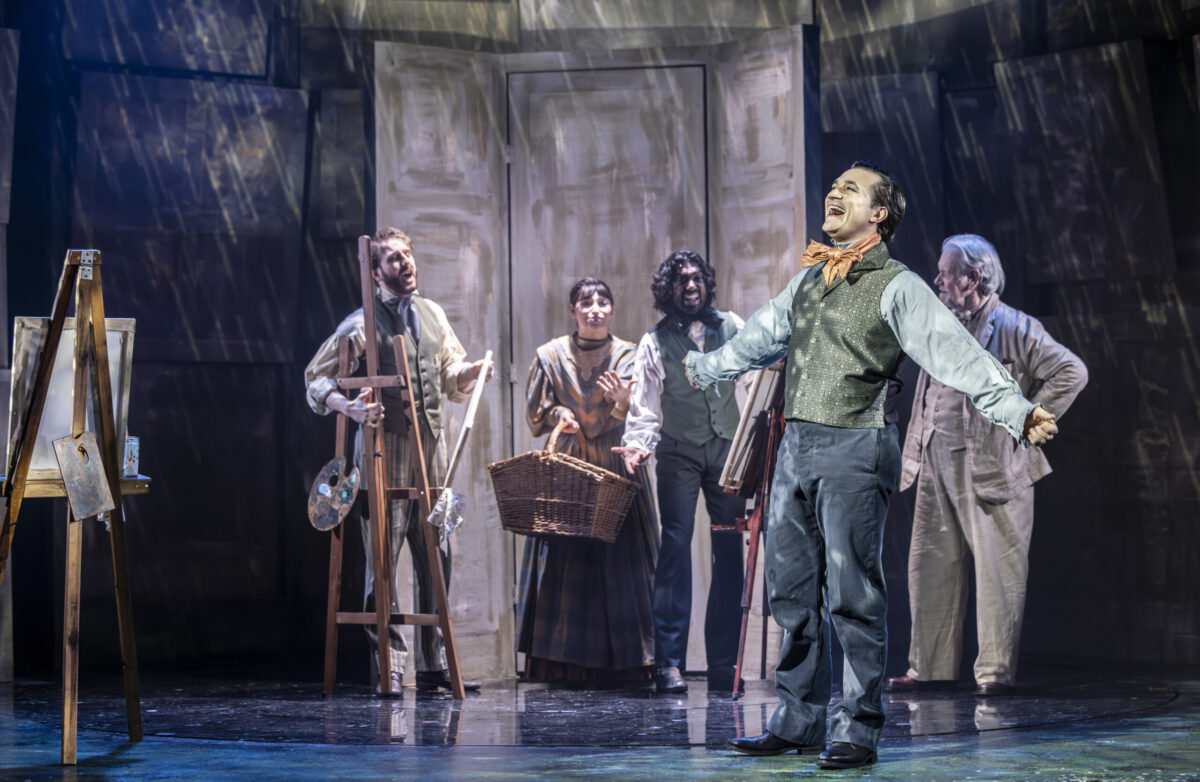

Set in 1916 in Paris during World War I, an old Claude Monet is struggling to finish his masterpiece painting, Water Lilies. His eyes are failing and he is relying on government support as the greatest living French artist. We are introduced to the younger Monet as he looks back on his youth and his friendship with Renoir, Manet, and Bazille, and their struggle to exhibit and get known.
It is obvious a lot of money has been put into this musical – but after half an hour into the first act, I began to wonder why. The costumes and scenery were lovely, the acting fair, but the book, songs and lyrics – which are everything to a musical – were torpid; they were all written by one person, Carmel Owen.
‘Much of the music for the musical came fast’, Owen tells us in the programme notes. Ah! Maybe that was the problem. As for the plot, the body of the production sees Edouard Manet’s teaching studio with the young Renoir and Monet challenging the master, and the three of them challenging the establishment of the Paris Salon. The fact that Owen found the story challenging shows up in the lack of dramatic tension in the first act – just so slow, with a lot of blokes doing blokey things.
The plot picks up with the development of Camille who finds herself pregnant. Monet’s abandonment of her exposes the shoddy behaviour of men of their class and exposes the plight of women in the nineteenth century and the dangers of falling in love with an artist.
The role of Monet is given few inner thoughts and watching him messing about with his bourgeois friends is not a vital enough plot to keep us glued to our seats. We see them carve out their own space to paint, but the male characters feel underdeveloped.
Owen is better when she is tackling the female roles which perhaps should have been the main focus of the story. Their predicament is much more of a pull. Both Camille and Blanche, Monet’s daughter-in-law are squashed into domestic roles not of their own making. The female actors put across most of the effervescence and personality. Brooke Bazarian as Camille saved the show with her vibrancy and sweet, but strong, voice. She was admirably supported by Natalie Day as Blanche struggling to break into painting with constant put downs from her selfish father-in-law, the older Monet – he has developed no wisdom about women.
The second act is more commanding, mainly due to the fact that women are given more space. Maybe I just don’t like seeing large groups of men on stage for so long, but for me, the depiction of their lives was simply dull (but in reality, their lives weren’t). I didn’t really care about any of them, though the actors did a commendable job.
Monet’s selfishness is a quality which has bedevilled his relationship with Camille who repeatedly left him because of the life of poverty he cursed her with in his pursuit of his art. In this, my sympathies are with her, but the production can certainly be seen as the triumph of art over domestic snares.
Book, Music & Lyrics: Carmel Owen
Cast: Jeff Shankley, Dean John-Wilson, Brooke Bazarian, Natalie Day, Sam Peggs, Ritesh Manugula, Aaron Pryce-Lewis, Steven Serlin, John Addison
Director: Christian Durham
Musical Director: Michael Webborn
Performances: 15th March to 9th May 2026
Running Time: 2 hours 20 mins (including interval)