


Il Trovatore, La Traviata and Rigoletto form the trilogia popolare—Verdi’s most beloved operatic triptych. At their centre are three figures deemed outcasts in their time: the gypsy Azucena, the courtesan Violetta, and the deformed jester Rigoletto.
Verdi was captivated by the powerful characters in Antonio García Gutiérrez’s play El Trobador, one of the most successful works of Spanish Romantic drama. He based Il Trovatore on this play, initially intending to title it Azucena, after the gypsy who stands at the heart of the drama. The role marked his first major dramatic showcase for a mezzo-soprano.
However, recognising the need for a soprano to balance the narrative, Verdi introduced Leonora as the love interest of Azucena’s ‘son’, Manrico, and the opera took its final title, Il Trovatore.
Much has been written about the opera’s supposedly “incomprehensible” plot. This production makes a compelling case that everything revolves around the trauma Azucena suffered fifteen years earlier, when her mother was burned at the stake for allegedly casting the evil eye on the Conte di Luna’s infant son. With her dying cry—“mi vendica”—she demanded vengeance. In a grief-stricken haze, Azucena abducts the Count’s child but, in a tragic mistake, throws her own baby into the flames instead. She then raises the stolen child as her son, Manrico.
From this perspective, the entire drama unfolds as a manifestation of Azucena’s unresolved trauma and obsessive need for revenge. Everything else is secondary. She is haunted by visions of her burning mother—bloodied, relentless, demanding vengeance—and by the memory of the child she destroyed.
Having seen many productions of Il Trovatore, I found Mexican director Francisco Negrin’s staging exceptional in its clarity of vision. It is perhaps the first to fully realise Verdi’s original intention by placing Azucena at the dramatic centre—she scarcely leaves the stage.
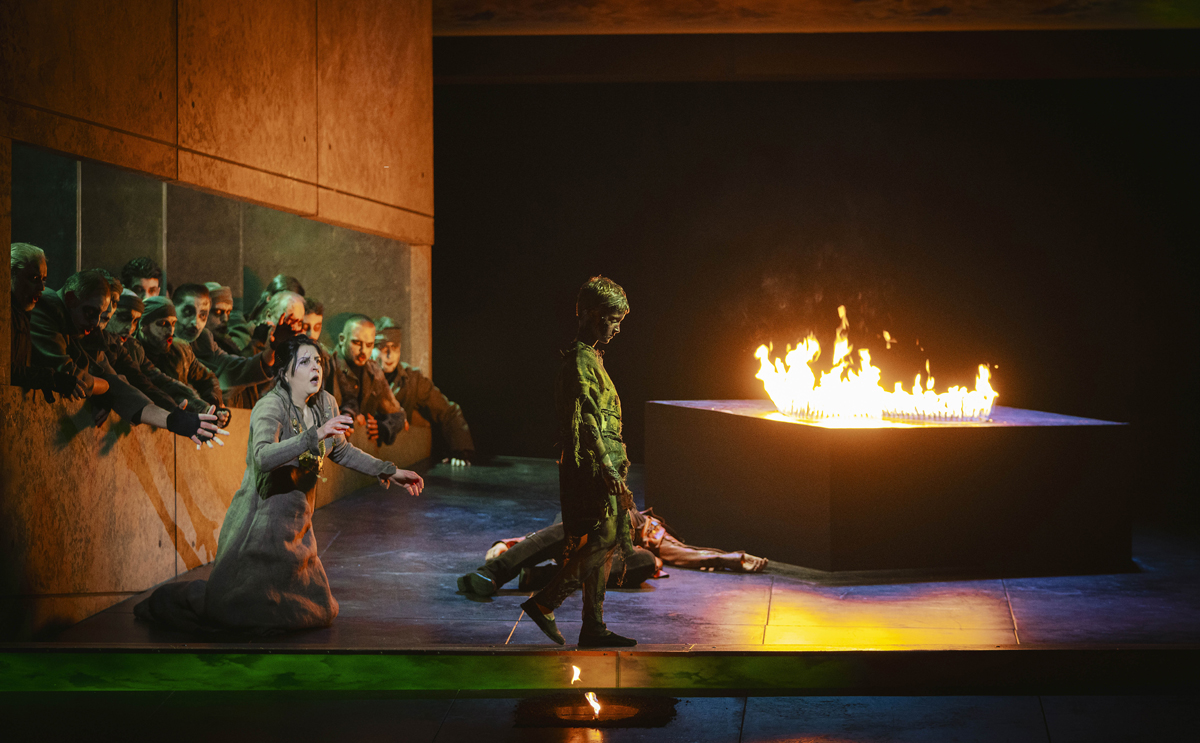
The production unfolds in semi-darkness, against a stark backdrop of grey and black vertical and horizontal slabs. A small flame burns persistently stage right, a constant reminder of the fatal fire. Azucena’s mother frequently appears above the action, continuing to dominate events years later, while Azucena cradles the charred body of her child. Flames recur throughout, conjured as visceral reminders of trauma. Figures crawl or move across the stage like apparitions, heightening the sense of psychological unrest. Scene changes are fluid, achieved through shifting slabs, and even the duel described in Scene 3—where Manrico is wounded by Luna—is enacted before the music begins.
Although Azucena does not appear musically until Scene 3, here she and her mother haunt the stage from the outset, establishing her obsessive presence as the driving force of the drama. As Ferrando recounts the story of her mother’s execution, Azucena prowls the stage, reliving the horror.
The cast delivers superb performances, both vocally and dramatically.
Armenian-French mezzo-soprano Varduhi Abrahamyan proves an extraordinarily versatile artist, equally at home in repertoire ranging from Handel to dramatic Verdi. As Azucena, she fully inhabits the ferocity of the character, arms outstretched, her anguish ever-present. The “Stride la vampa” scena is a standout, culminating in “il figlio mio avea bruciato” (“I burned my own son”), sung while cradling the child’s body. Her performance is sensational, marked by a warm, burnished timbre, a rich lower register, elegant phrasing, and a thrilling upper range.
French soprano Alexandra Marcellier, who stepped in at short notice to sing Cio-Cio-San in 2021 and later performed Vitellia in La clemenza di Tito in Monte-Carlo, replaces Pretty Yende here, making her Verdi role debut as Leonora. This is a significant step into heavier repertoire—one that has challenged many singers—but Marcellier rises to it impressively. She looks striking and performs with assurance, navigating the role’s demands with ease. “Tacea la notte placida” reveals a richly coloured voice, excellent coloratura, and admirable breath control. The great Verdi roles surely await her.
Italian tenor Piero Pretti, highly experienced in this repertoire, brings Manrico to life with emotional intensity. His warm phrasing and varied vocal palette are a pleasure, and the famous cabaletta “Di quella pira” delivers both dramatic urgency and ringing top notes.
The role of Conte di Luna sits high for baritones and is often relinquished as voices mature. Polish baritone Artur Ruciński, however, retains it successfully thanks to the natural lightness and flexibility of his voice. His “Il balen” is notable for its phrasing and breath control.
Russian bass Evgeny Stavinsky offers a richly sonorous Ferrando—luxury casting in this role.
An inspirational evening of superb singing, and a magnificent conclusion to a remarkable season.
Opéra de Monte-Carlo Salle Garnier
Il Trovatore
Opera in four parts
Co-production with Teatro Real de Madrid and Royal Danish Opera
Opéra de Monte-Carlo, Salle Garnier
Music by Giuseppe Verdi (1813–1901)
Libretto by Salvatore Cammarano, after El Trobador by Antonio García Gutiérrez
Conductor: Giacomo Sagripanti
Director: Francisco Negrin
First performance: Teatro Apollo, Rome, 19 January 1853
Photo credit: Marco Borelli