

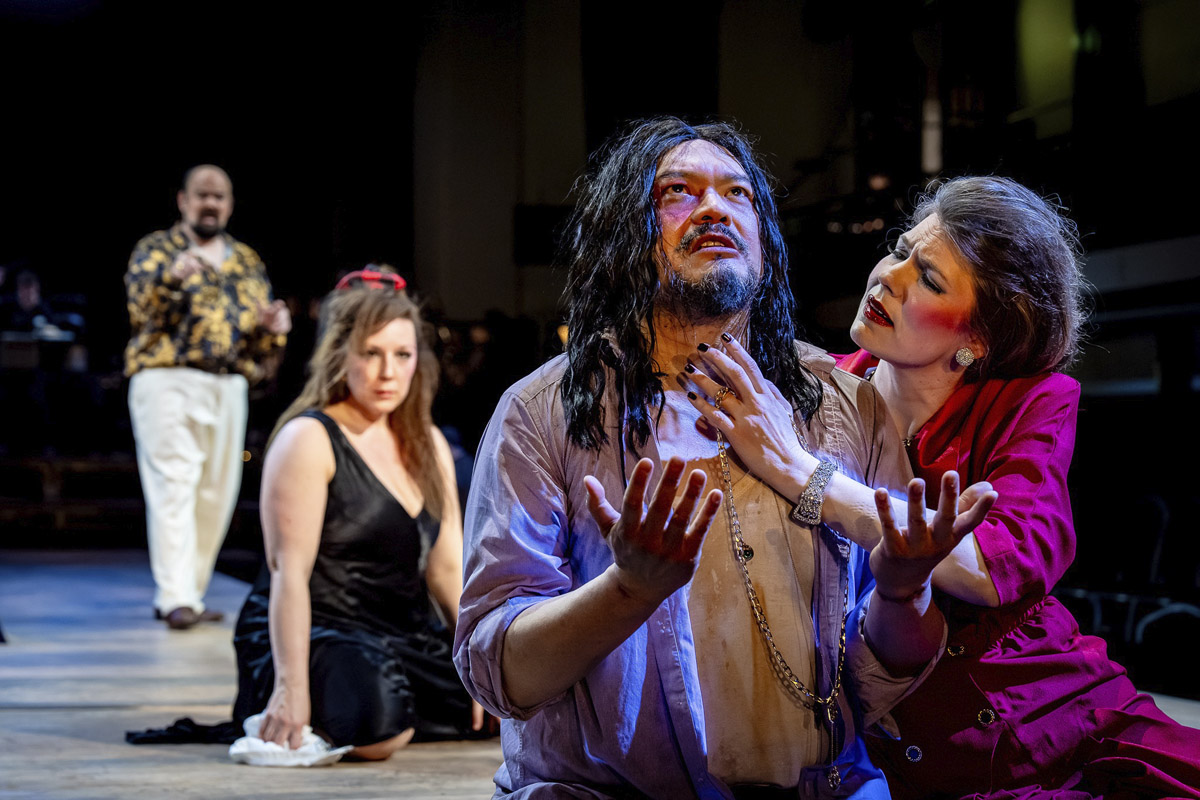

Richard Strauss composed some of the most beautiful operatic music for the female voice. Salome, his first big success, dating from 1905, certainly provides that, but in a drama that culminates in a teenage girl singing in ecstasy to a severed head. It is difficult to explain to someone who has not seen the work how such glorious music and a ghastly story can combine to create something so beautiful and mesmerising. If you want to know, try to get a ticket for Regent’s Opera’s production at York Hall in East London.
Salome is the daughter of Herodias, who has married Herod, Tetrarch of Judaea. It is Herod’s birthday party, and his sulky stepdaughter is not enjoying the festivities. Slipping away from the party, she hears the voice of Jokanaan, the prophet imprisoned in an underground cell by Herod. She demands to see him and becomes obsessed. After the prophet is led back to his cell, Herod, who has a perverted interest in Salome, asks her to dance for him and offers her a reward of her choosing. She dances, then demands the head of Jokanaan as her prize. Herod tries to dissuade her, but she is adamant and he reluctantly complies. The story ends with Salome kissing the severed head.
Director Mark Ravenhill sets the opera not in Herod’s palace in Judaea but in a seedy East London club. The birthday party sees a gaggle of followers greeting gang boss Herod and his blinged-up wife, entertained by a stripper. There is a consistency of vision to Ravenhill’s production, and he uses the runway stage, with the small orchestra on a platform at the back, to great effect. He solves the problem of the absent under-stage cell with ease, allowing the prophet’s voice to carry fully even when heard from afar. Best of all, Salome’s transition from stroppy teenager (in a Guns N’ Roses t-shirt) to sexual obsession and necrophiliac lust is well charted. The perennial problem of the over-hyped dance of the seven veils is solved brilliantly, with Salome using items of other people’s clothing to tease and taunt.
There is some fine singing too. Mae Heydorn as Herodias is compelling, singing with power and catching the fine line between fear of and contempt for her sleazy husband. Herod is a difficult role to bring to life, his desire for Salome and his dread of supernatural events sit uneasily alongside his position of power, and Robin Whitehouse, despite a fine high tenor voice, does not seem entirely at ease in it. In the smaller role of Narraboth, a captain driven to despair by the behaviour of the princess he admires, James Schouten is superb. Freddie Tong as Jokanaan is excellent, with an imposing stage presence and a strong bass voice capable of delivering with panache his fierce condemnation of the corruption he lays at Herodias’s door, though he did struggle with some of the higher passages. But best of all, as must be the case if this opera is to succeed, was Kirsty Taylor-Stokes as Salome. She was mesmerising. The demands of the role grow tougher as the opera moves towards its distressing climax, and she more than rose to the challenge. Her final soliloquy to the severed head was spine-chilling.
There are some awkward moments. Given the production’s gangland overtones, the passages in which Jews and Nazarenes dispute the legitimacy of Jokanaan’s prophecies feel out of place. And some of the seedier trappings of Herod’s party could have been pruned. But the seemingly limitless ambition of Regent’s Opera, who previously staged a widely admired Ring Cycle at this venue, has triumphed again. It feels wrong to call an opera like Salome “enjoyable.” Gripping is the word.
Venue: York Hall, Bethnal Green
Music: Richard Strauss
Conductor: Ben Woodward
Director: Mark Ravenhill
Performers incl: Kirsty Taylor-Stokes,Robin Whitehouse, Freddie Tong, Mae Haydon
Photo credit: Steve Gregson
Running time: 1 hours 40 minutes
Dates: until 23 April