

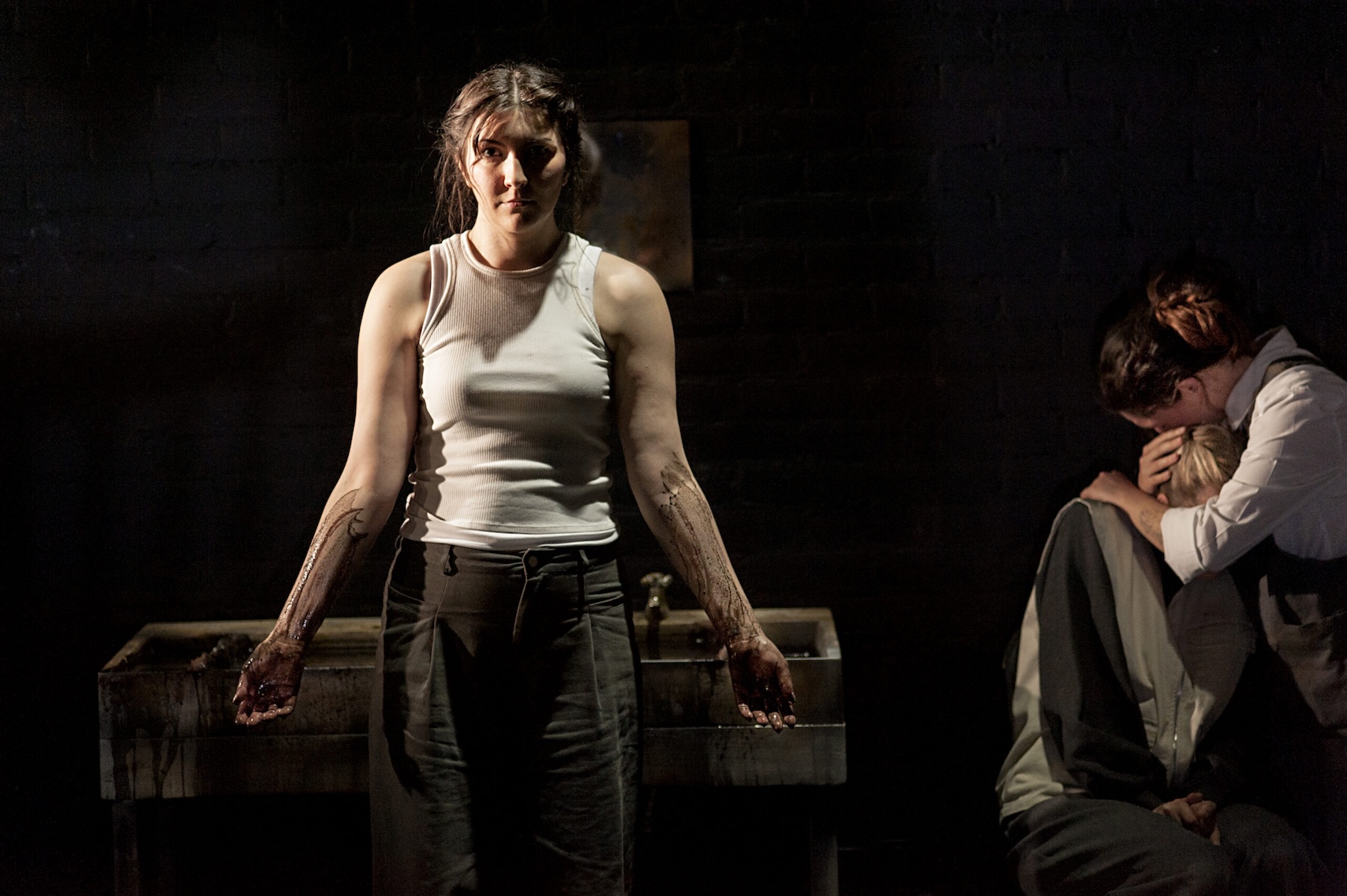
Hampstead Garden Opera’s production of The Rape of Lucretia seems to understand that this opera is not merely about an ancient violation, but about the long afterlife of violence: how it enters a room, how it alters the air, how it rearranges the body’s relation to itself. What emerges at Jackson’s Lane Theatre is a DIY staging in the best sense of the phrase; it’s resourceful, tactile, yet never feels approximate.
The opera is set within a tiny world of rails, chairs, a sink, television-like relics, and a space that behaves less like a Roman chamber than a strange urban jungle. Roman ambition, virtue, and cruelty are all showcased on a stage on which bodies must climb, hide, crouch, and force their way through the very architecture of the story. Microphones, speakers, flickering TV artefacts, and the orchestra are never hidden away (indeed, the orchestra takes up a good third of the stage), giving the production a porousness. The machinery of performance itself is part of the drama.
Let us remember Shakespeare: “This forced league doth force a further strife.” The corrupt Etruscan king Tarquinius’s desire is rabies. As he sings, “My blood is hot within me,” it lands as a diagnosis of some compulsion. His attempts to resist — clinging to walls, dousing himself at the sink — only make the inevitability clearer. As an alumnus of Britten/Pears programme, British light baritone Stephen Whitford understands the youthful, tormented, twisted and finally evil Tarquinius, perfectly. It is one of the production’s keenest instincts that this figure should not simply embody villainy, but the ruinous comedy of appetite ungoverned.
It has to be said: the audience feels the absence of captions acutely. Though a performance sung entirely in English, the lack of surtitles is difficult to ignore, especially for a programme that claims to care deeply about accessibility. That sense of speech under strain is heightened by the production’s multimedia instincts. And when Tarquinius edges towards Lucretia, the Male Chorus suddenly speaks directly and cinematically into the microphone, “The time is night.” This suddenly reveals how much of the preceding text has been half-heard, half-lost.
British soprano Olivia Rose Tringham as Female Chorus is the standout singer of the show and a future star. A graduate from the National Opera Studio, now an ENO Harewood artist, her voice is of thrilling intensity, with good pianissimi and almost too powerful for the venue. The Male Chorus – a role created for Peter Pears – is sung by British tenor Daniel Gray Bell, who sings with, warmth, clarity and compassion.
The vocal writing is served with particular care, especially in the female ensemble work that precedes the terrible deed. “How calm, how pure is this night.” The opera is flanked by two narrators – one male, one female – lend the evening a strange doubling effect, at one point insisting, “This is the story of Lucretia,” as though trying to hold the narrative steady even as it fractures around them.
Finally, the eponymous Lucretia. British mezzo-soprano Emma Roberts is an excellent, honey-toned dramatically credible Lucretia. Her portrayal of grief and despair in the small venue is particularly intensely powerful. However, as the role was created for contralto Kathleen Ferrier, a true contralto would explore more darkness in the lower range.
The scene with the flowers when Lucretia is made to explain what has happened is exquisite in its cruelty. Her maids, blithe and domestic, speak of orchids and arrangements and the beauty of what has grown – “These blossoms will please your lord” – while Lucretia is forced into a terrible recognition of what orchids resemble, what they signify, what they cannot stop signifying now. Her rejection of them is total; she flings the flowers out of the TV-like vessel and shakes the dirt and pebbles loose. This feels like the destruction of a preserved microhabitat, a tiny world of carefully maintained purity brought violently to dust, shattering of the very form by which Lucretia has understood herself as a woman. Ukranian bass-baritone, Oleksii Zasiadko as Collatinus, shimmers with warmth and horror as he comforted Lucretia in Act II, delivering also the understanding that it may be too late.
This production is so openly a mixed-media experience that one occasionally wonders whether the work might, in another universe, have been just as potent as a spoken word or modern musical theatre piece. Yet this is less a flaw than a provocation. When the Female Chorus offers the fragile line, “He will gather us together,” it doesn’t resolve anything. It lingers, uncertain, almost inadequate.
Jackson’s Lane Theatre delivers a living wound of a production, which is and will continue to be beautiful and interesting because it’s strange and difficult. It’s a worthy interpretation of this painful and perennially relevant story of sexual violence.
★ ★ ★ ★
Opera by Benjamin Britten
Libretto by Ronald Duncan
Stage Directors: Eleanor Burke and Alex Gotch
Music Director: Oliver Cope
Set/Costume Designer: Jennifer Gregory
Lighting Designer: Cheng Keng
Cast: Olivia Rose Tringham, Daniel Gray Bell, Emma Roberts, Stephen Whitford, Oleksii Zasiadko
Running time: 2 hrs 45 mins including 25 minute interval
Until: 26th April 2026