


Fringe theatre is at its best when it understands its limits. Entertaining Murder, playing at Upstairs at the Gatehouse, does not, and that becomes its defining problem. The Gatehouse has earned a reputation for punching above its weight with bold musical revivals. Entertaining Murder aims for the same, but falls short, let down by Chris Burgess’s script and its failure to do justice to a genuinely gripping true story.
On 9 January 1923, Edith Thompson and her lover Frederick Bywaters were hanged for the murder of her husband in what became known as the Ilford Murders. Burgess reimagines the case as a musical with Agatha Christie overtones, a narrator piecing together Edith’s letters, her affair with Freddie, and the trial that followed. The premise has real potential; the execution, less so.
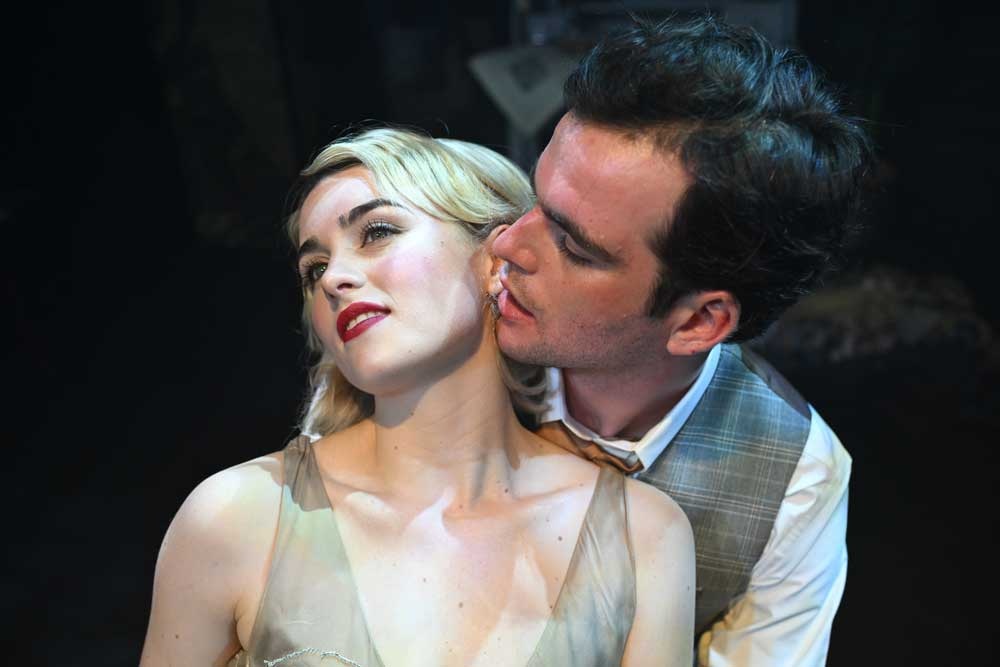
The two leads make an immediate impression. Daisy Snelson (Edith Thompson) and Dominic Sullivan (Frederick Bywaters) are physically compelling, and the opening promises much. It doesn’t sustain that momentum. One of the first numbers, Sixty Four Letters, lands like a cut-price Hamilton, and the unevenness persists throughout. Snelson brings a childlike wonder to Edith that draws the audience in, and she holds her own vocally in numbers such as Romance, but the material is too clichéd to allow her to truly shine. Sullivan, meanwhile, too often seems disengaged. He finds his footing in This Is No Concern of Yours, but elsewhere the cracks show: his voice strains on the higher notes in Proof and Enough, and his repeated returns to a water bottle feel jarringly unprofessional on such an intimate stage.
The supporting cast is where the production comes alive. Sue Kelvin (Older Avis Graydon) commands the stage with warmth and assurance, while Dora Gee (Younger Avis) is the evening’s vocal standout. Her Act Two number, That Day, is the show’s most affecting moment. Best of all is Alex Cosgriff (Percy Thompson). The murdered husband is so vividly drawn that he becomes the axis on which the drama turns, and Cosgriff and Gee are at their most electric in See Edith Thompson Swing, the musical’s sharpest and most original number.

The staging is basic—functional at best. A 1920s atmosphere is suggested on a budget, with an unstable chaise longue as the centrepiece and a bed in the corner that seems to exist mainly to give a visibly disgruntled Sullivan somewhere to sit between scenes. The costumes are similarly unremarkable.
Yet the production’s deepest flaw lies in how Burgess chooses to tell Edith’s story. The real Edith Thompson was a chief buyer at Carlton & Prior, earned more than both her husband and father, owned her own home, and was ambitious and unbound by the conventions of her time. Burgess reduces her to a woman financially dependent on her husband, defined by romance and desperation. In doing so, the play repeats the very prejudices that condemned her in life. For a story that might have offered a powerful reclamation of her legacy, this is a missed opportunity that is difficult to overlook. Had Burgess placed Edith fully at the centre, the result might have been far more emotionally resonant.
Entertaining Murder has the ingredients for a compelling night out: a sensational true story, capable performers, and an intimate stage. But lacklustre songs, uneven performances, and a script that fails its central figure mean it delivers neither the fun of a strong musical nor the emotional depth the story deserves.
Entertaining Murder – Musical
By Chris Burgess
Music by Steven Edis
Photo Credit: Louis Burgess
Cast Includes: Daisy Snelson; Dominic Sullivan; Sue Kelvin; Dora Gee and Alex Cosgriff
Until 10 May 2026
Duration: Two hours and 10 minutes, including one interval