


An Immersive Preview of the Met’s New Opera: El Último Sueño de Frida y Diego
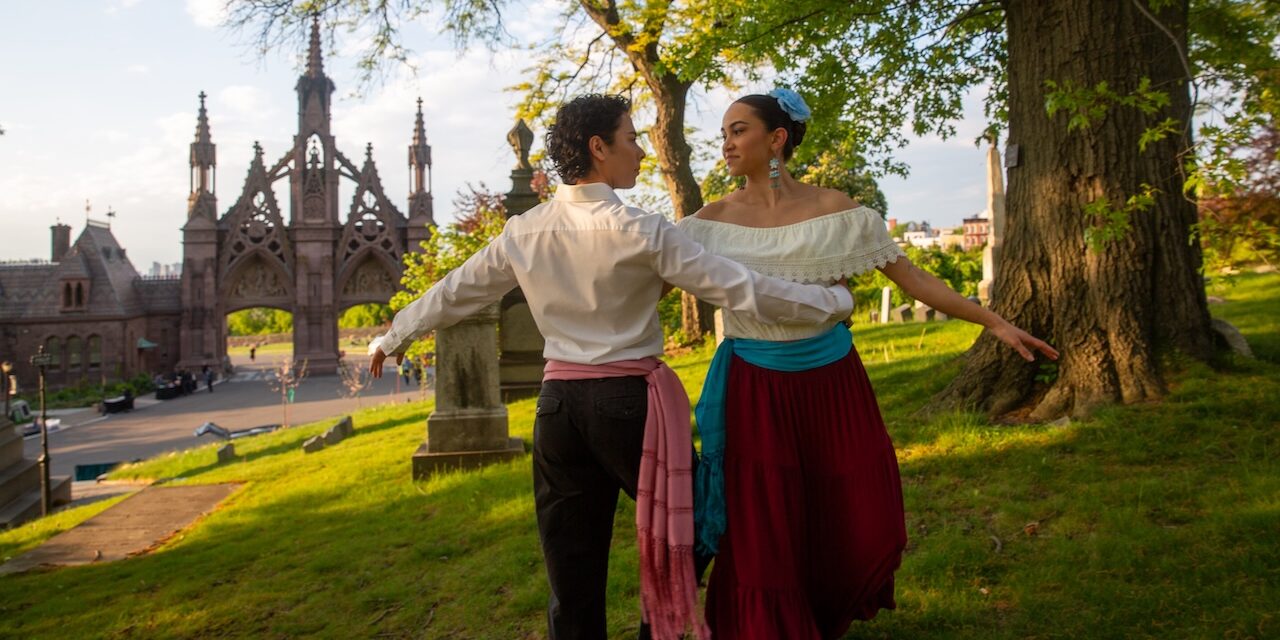
The imposing Gothic arches at the entrance of Brooklyn’s Green-Wood Cemetery may be one of the most underrated landmarks in New York City. Approaching them, up the long driveway leading to the cemetery, feels momentous, if not somber. But beyond the arches, on this night, lies a celebration. Since before the creation of the nearby Prospect Park or even Central Park, Green-Wood has been a place of congregation for New Yorkers. And it’s still true today, thanks to the tireless work of the team behind Green-Wood’s social programs. Together with Death of Classical (known for classical music concerts in catacombs and crypts) and the Metropolitan Opera, the cemetery was transformed into an intimate Day of the Dead celebration for Mexican artists and spouses, Frida Kahlo and Diego Rivera.
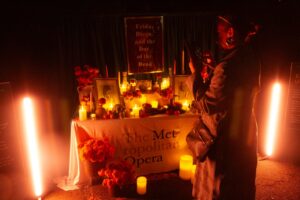
Though Day of the Dead is traditionally celebrated in November, the festivities are appropriate for the Met’s new opera, El Último Sueño de Frida y Diego. Set on the last Day of the Dead of Diego Rivera’s life, Frida has already passed on, leaving behind the famous last words: “I hope the exit is joyful and I hope never to return.” But the thin veil between Mexico and the underworld – and the characters on either side of it – conspires to reunite the spouses one more time in the world of the living. Visitors entering the park are greeted by dancers in traditional Mexican dress dotting the hillsides between graves. A large ofrenda is set up for Frida and Diego (by ofrenda artist Alejandra Kasloski), and musicians strumming their instruments wander leisurely among the crowds.
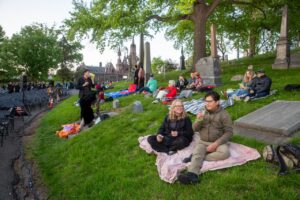
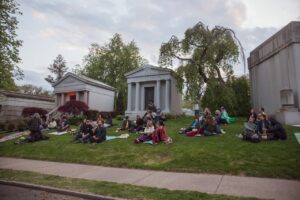
Green-Wood Cemetery is a place that both celebrates and transcends death, and it’s clear to see by observing the crowd gathered for tonight’s event. As the sun begins to sink below the mausoleum spires and the attendees get their fill of spirit tastings, everyone gathers towards the platform set up for the panel. Those who didn’t opt for general admission seating have brought picnic blankets. It’s beautiful to see people perched on the steps of the mausoleums or sprawled on the lawns before them. These resting places, some over a hundred years old, are so full of life thanks to the programming at Green-Wood, despite the irony that we are all gathered to celebrate an opera about death.
The panelists are El Último Sueño de Frida y Diego composer Gabriela Lena Frank (fresh off of receiving the 2026 Pulitzer Prize for Music) and librettist Nilo Cruz (also a Pulitzer winner), moderated by Mila Burns. Their conversation immediately takes on a very comfortable tone, as though we are all sitting in their living room and hearing these artists discuss their work. Frank and Cruz both speak at length about the process of putting together an opera that pays homage to its setting, Mexico City, as well as to the great artists who are its main characters. Frank in particular speaks about how she fought to have marimbas included in the orchestra – a large instrument that sacrificed much-needed space in the orchestra pit, but one that she felt was so necessary to the sound of Mexico. As the panelists speak about their process, the Met Opera performers treat us to excerpts from the show. Javier Arrey (baritone) performs as Diego Rivera at the end of his life, wishing that his late wife Frida would visit him on one last Day of the Dead. Isabel Leonard (mezzo-soprano) and Vanessa Isiguen (soprano) play Frida and Catrina, the goddess of the underworld, on the other side of the veil as Catrina attempts to convince Frida to do the one thing she swore not to – return to the living world. (In this performance especially, Frank and Cruz’s discussion about their process proves enlightening as they explain the persona of the goddess of the underworld, and how her characteristic laughter had to make its way into the songs.) Finally, in a moving countertenor performance, Nils Wanderer performs as another underworld soul who finally convinces Frida there may be something for her to return for after all.
The way that Frank and Cruz speak about Frida and Diego makes it feel as though they are all old friends. In fact, they speak about the different ways that Frida in particular had seeped into their daily lives during the writing process. Cruz describes setting up his produce on the counter as if it were a still-life, and a possession that moved him to bury nail clippings into his garden in an effort to feel closer to the earth. For her part, Frank describes being given a book of Frida’s paintings as a young girl, and how it taught her about the world like any child’s picture book would. As they reveal to us their process and the careful consideration behind each choice they made, the performers would bring it to life, giving us a taste of what it would be in its full glory at the Met.
The Met’s new opera, its third Spanish-language opera in as many years, opens on May 14th, 2026. On the panel, Gabriela Lena Frank and Nilo Cruz both go into detail about how the magical realism of Mexico and the vibrant storytelling of the Mexican underworld define this production as much as the two larger-than-life artists at its center. Nothing can promote El Último Sueño de Frida y Diego better than the passion and thoughtfulness of these two creators (not to mention their professional fangirling and a touch of witchy Frida possession). And on this night, surrounded by the graves of Green-Wood Cemetery and with an unblemished Brooklyn sunset above us, there is no better place to hear all about.
Photo credit: Justin Buschardt