


There is a reason why Simon Usher is one of our finest stage directors, and it’s not just his intelligence, which he has in spades; nor just his trust in the plays he works on, nor his trust in the actors he works with. His overarching directorial skill is his attention to detail.
Fosse’s play, ‘The Name’, having its UK premiere here at The White Bear, is a play that deserves such attention to detail. Other directors might flatten this play. Usher brings out its subtlety; the shifting flavours of the characters’ relationships.
This is Fosse’s first landmark play (he went on to win the Nobel Prize for Literature in 2023). Seemingly, it’s a story – or non-story – we all know, within a structure we all know: the pressure-cooker, one-room play. The characters are people we smile at affectionately before pulling back our smiles. They seem familiar. They’re us. And this is our family.
The White Bear is a lovely intimate theatre, the right place for a play such as this, where there is no stomping action to be found; rather, the action lies in the characters’ reactions to other characters’ words, their arrivals and exits, their presence and their aftertaste. If we all have different energies, which we do, and those energies react to the energies of others, as they do, that’s the friction point of drama.
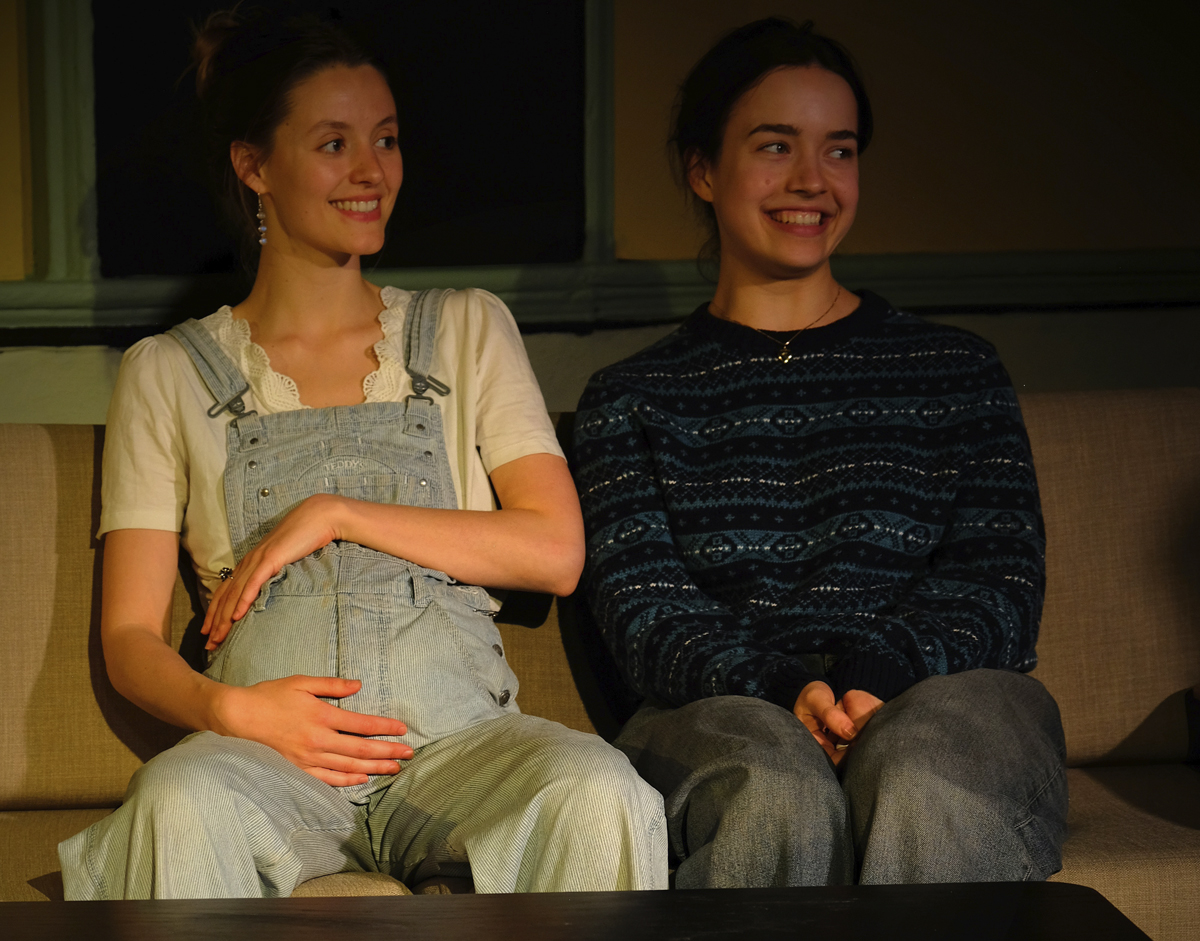
The play opens with a pregnant girl, The Girl (the deft Jasmin Dufa Pitt), in denim dungarees, sitting on a sofa.
The story structure is the classic one of a stranger knocking at the door. The Girl’s boyfriend (Daf Thomas, with eyes turned away from the crime, then suddenly blasting arrows in quick succession) arrives at The Girl’s parents’ house, suitcase and overnight bag in hand.
The Girl appears desperate to be noticed and loved. And what more ripe time is there than this: when she’s on the precipice of giving birth. Her not-niceness is not shown in actions – until the end – but in what the others, The Sister, The Mother and The Boy, say about her. Only The Dad (Tony Bell) has no harsh words for her, but that may be because they shared a traumatic moment which no one talks about directly, only in whispers.
The Girl and The Boy are joined by a third, The Sister (Thorseth Molnes), sweeties always in hand, as vibrant as her sister but with a less dangerous tenor to her. Then The Mother (Valerie Gogan) flits in and out. The Father, long awaited, has not yet appeared and does not yet know that his daughter has returned. We do not know whether The Mother has told him that The Girl is pregnant. This is set up as a future time-bomb.
When The Girl reacts harshly to her mother, with looks that could sink a battalion, it is not in response to anything her mother says in the moment. The Mother is an affable woman who laughs short laughs like the bin couple in Beckett’s ‘Endgame’ and complains of the pain in her leg, comments which receive no attention. The Girl is reacting, as we all react, to her past history with her mother.
Valerie Gogan’s performance is a masterclass in acting: the laugh no one joins in with, the looks towards her husband full of pent-up frustration, the refusal to meet her daughter’s eyes, the horse-skittish shakes of the head, and a delivery that is round and full.
The Boy, who has barely spoken but who has been spoken to and commented upon, has, near the end, a monologue about children yet to be born. The Girl asks him to stop because his words scare her, but at the same time she wants to hear them.
There’s poetry here, but not lyricism or finely crafted phrases. The poetry is in the repetitive “Yeses”, which all the characters, The Sister aside, use as if it’s a baton they must carry. Why, they do not know. The poetry is also in the silences; the rough-cut laughs.
Outside, a storm. The young couple go out rejoicing in it, and The Girl, who we feel would live on the edge, says: “And if the baby were born there…?” We think what an awful and frightening idea this is. They return. She is exhilarated. He is angry. That’s what she does to him.
The actors are immensely watchable, no one more so than The Girl, who, like Ibsen’s women, craves something monumental, even if that something will destroy her and her world.
Aside from The Mother and The Father, the other actors are young and relatively new to the game. When one actor in a play acts well, you know it’s their skill. When a whole cast acts well, you know it is casting, their skill, and that they are in the capable hands of a top-notch director. Usher directs with finesse.
Unlike much of what passes for plays nowadays, this is old school: a play that makes you think and feel strongly; a play that lingers.
The White Bear Theatre
Writer: Jon Fosse
Translated by Gregory Motton
Directed by Simon Usher
Cast: Jasmin Dufa Pitt, Daf Thomas, Marie Thorseth Molnes, Valerie Gogan, Tony Bell, Jan
Martin.
Until: 06 June 2026
Running Time: 1hr 10mins (no interval)
Photo credit: Charlie Usher