


Death Note: The Musical arrives at the Barbican with comically high expectations. The story follows high-achieving disillusioned student Light Yagami who discovers a supernatural notebook that kills anyone whose name he writes inside it. He decides to use it to rid the world of criminals and become the “god of a new world”, attracting the attention of detective L and setting off the intricate study of justice, ego, mortality, and the frightening elasticity of moral certainty.
The musical has already travelled through Japan, South Korea and beyond, earning considerable acclaim. The 2026 Barbican staging is the latest attempt to turn one of manga’s great moral battles into musical theatre. The manga thrives on details: strategic thinking, elaborate traps, the ease with which Light’s initial idealism mutates into narcissistic authoritarianism. The London musical, unfortunately, has little interest in most of this complexity.
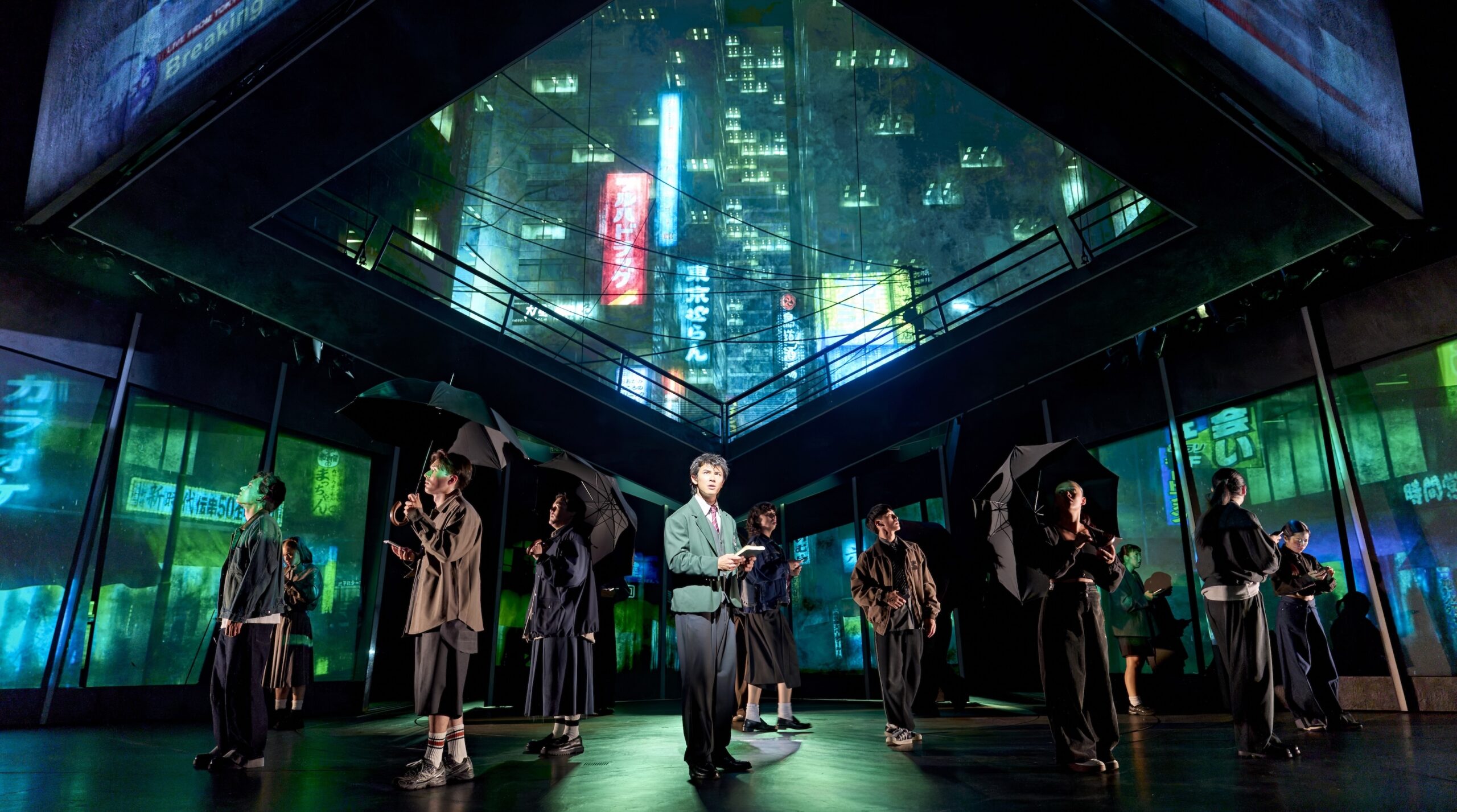
The production looks spectacular. Jon Bausor’s set, Jen Schriever’s lighting, Akhila Krishnan’s video design, and Fabian Aloise’s choreography give the show scale and visual polish of a major theatrical event. The venue certainly cannot get much better than the Barbican Theatre. The ensemble remains uniformly capable, and the principal cast can sing the roof off the place.
And the audience certainly loves it. At the performance attended, rapturous applause follows practically every major musical number. That enthusiasm feels genuine and understandable. There remains a great deal of spectacle here, and the show knows how to deliver a big musical-theatre moment.
The problem comes once the spectacle wears off, there remains little underneath it.
The opening establishes Light’s motivation quickly and gives Xander Pang plenty of opportunity to show off an impressive voice. Pang grows increasingly assured as Light embraces Kira’s power, but the performance never entirely convinces that this represents the frightening, committed sociopath at the centre of Death Note, coming across instead as a dubious Disney protagonist. The horror comes from watching an intelligent person construct a moral justification for murder, but the production announces his transformation rather than dramatising it.
Colin Ryan’s L remains probably the strongest performance of the evening. He understands that L’s eccentricity should never compromise his intelligence. His awkward physicality and tongue-in-cheek suggest a man who simply does not operate according to ordinary social rules.
Frank Wildhorn’s score can be muscular: “Where Is the Justice?” provides an efficient, punchy opening which establishes Light’s motive immediately, while “Hurricane” gives him an appropriately huge vocal showcase and platform for his growing sense of godhood. “The Game Begins” and “Secrets and Lies” establish the central cat-and-mouse game, and “Mortals and Fools” gives Rem some welcome emotional contrast.
Yet, the numbers rarely offer dramatic variety. Characters speak with theatrical intensity, then sing with theatrical intensity, and then return to speaking with essentially the same theatrical intensity. A song should change the dramatic temperature, expose an interior thought, complicate an argument or reveal something that ordinary dialogue cannot. In this production, the distinction seems simply to be that the next bit happens to have music underneath it.
“Playing His Game” provides a frustrating example. The original song focused on Light and L getting inside each other’s heads, echoing the anime sequence where both mentally overanalyse every movement. The London production transforms this into a video-game match. The dialogue continues to refer to them as tennis champions of Japan and England respectively, yet the match played resembles a video game. More importantly, the new lyrics reduce the psychological duel to a contest about winning, throwing away the mental depth that made their dynamic fascinating.
Misa Amane is given greater agency, which is a welcome directorial choice. Stephanie Zaharis’s “Misa Misa” sports K-pop-inflected gear and has the vocal ability to go with it. Yet the rewriting ultimately leaves Misa feeling strangely disconnected from the cruel universe around her. “We All Need a Hero” sounds like a Mariah Carey-inspired pop song which could ostensibly be about almost anything. Her tragedy becomes a relatively simple retelling of a nice girl who loses her parents, is adored by those around her, and falls for the wrong man, rather than the disturbing portrait of obsession (with Kira, with her own self-abnegation) that makes the original Misa so uncomfortable and memorable. “I’m Ready” feels more like a showcase for Zaharis than an insight into Misa. Giving her more material is not necessarily the same as giving her more depth.
Telly Leung clearly has fun with the role, and his physicality gives it plenty of comic energy, but this Ryuk primarily functions as a mischievous, apple-obsessed comic sidekick. It is also a substantial reduction of Ruyk’s detachment from human morality, his boredom, his fascination with Light’s experiment which should give the production an unsettling philosophical perspective that isn’t there. The comedy remains cutesy.
Grace Mouat fares better as Rem. Her performance finds a convincing balance between awkwardness, determination and sharpness, and the production’s decision to highly feminise Rem, bringing her closer to an almost angelic figure, works very well. Mouat gives Rem’s attachment to Misa genuine tenderness in “When Love Comes”.
Unfortunately, those moments are not enough. Songs like “Secrets and Lies” and “Borrowed Time”, though very well-executed by the performers, seem to be opportunities for big vocal performances which contribute to the show’s pace as opposed to quiet psychological reveals which contribute to the show’s meaning.
The adaptation obviously cannot include the manga’s every arc. Losing Near, Mello, Takada, and countless others is understandable in a two-hour timeframe. The issue is what gets preserved. Here, the answer seems to be the broadest possible version of Death Note: boy finds notebook, boy kills criminals, detective investigates, girl falls in love with boy, supernatural beings observe, and everything gets progressively louder.
Death Note: The Musical at the Barbican remains spectacular, a phenom providing Grade A rollercoaster entertainment, while also leaving the frustrating sense that something much sharper, stranger, and more faithful to the spirit of Death Note was standing just within reach.
Music by Frank Wildhorn
Lyrics by Jack Murphy
Directed by Stephen Whitson
Choreography by Fabian Aloise
Set designed by Jon Bausor
Cast includes Xander Pang, Colin Ryan, Stephanie Zaharis, Telly Leung, Grace Mouat
Running time: 2 hrs 20 mins including 20-minute interval
Until: 21st September 2026