


Gluck’s penultimate opera, Iphigénie en Tauride, represents the culmination of his lifelong commitment to operatic reform: stripping away excessive vocal ornamentation to allow music to serve the drama. The result is a work of extraordinary psychological intensity, demanding a director capable of matching its emotional depth.
The opera continues the tragic history of the House of Atreus. Diana rescues Iphigénie from sacrifice by her father Agamemnon and transports her to Tauride, where she becomes a priestess. Meanwhile, her brother Oreste, having murdered their mother Clytemnestra in revenge for Agamemnon’s death, is pursued by the Furies. Years later, Oreste and his devoted friend Pylade arrive in Tauride, where strangers are routinely sacrificed. Iphigénie is ordered to perform the ritual, unaware that one of the intended victims is her brother. Recognition, reconciliation and Diana’s intervention finally end the family’s cycle of violence.
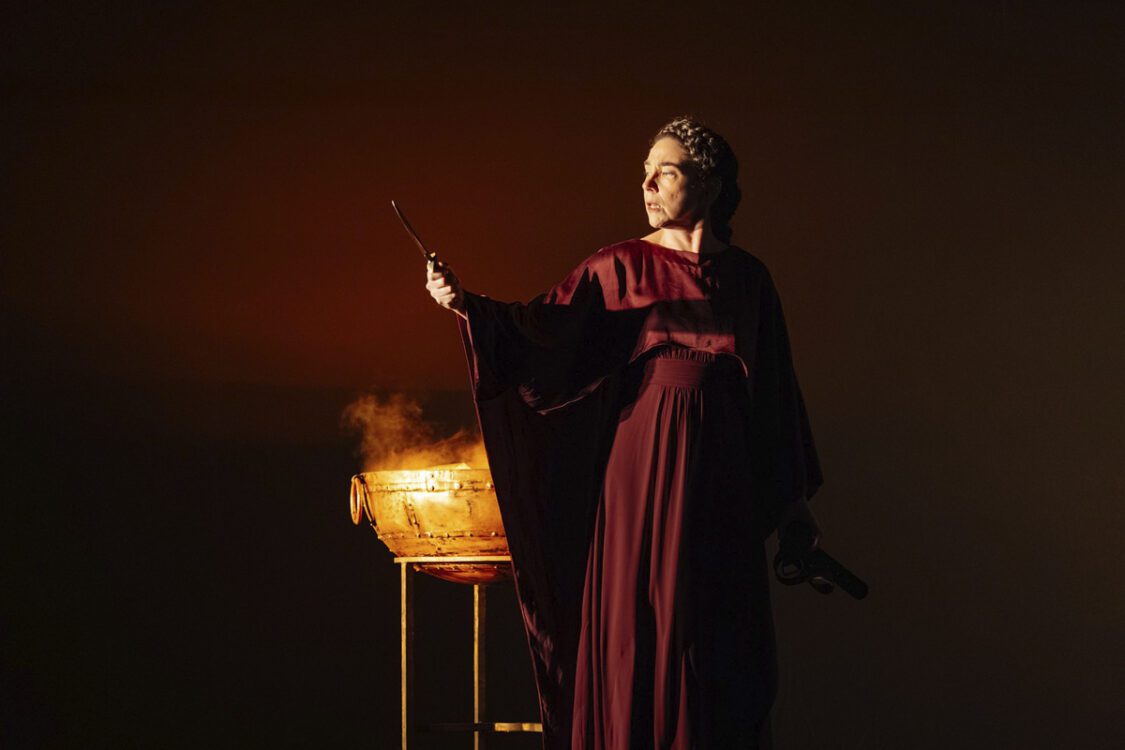
Lyndsey Turner’s minimalist production is a missed opportunity. The sets are nondescript, the costumes unremarkable, with Greeks in traditional attire juxtaposed against Thoas’s thugs in contemporary black suits. The action frequently feels static, despite the dramatic energy driving Gluck’s score and its vivid portrayal of characters haunted by traumatic pasts.
The director might have made the story more accessible by using the overture to evoke the family’s blood-soaked history: Agamemnon’s attempted sacrifice of Iphigénie, the murders of Agamemnon and Clytemnestra, and Oreste’s persecution by the Furies. Instead, brief flashbacks of the siblings playing as children contribute little to the drama. Recurring psychological memories might have conveyed the torment so powerfully expressed in the music. Too often, the singers stare into the abyss rather than confront the ghosts of their past.
Musically, however, the evening rises to considerable heights, particularly through British mezzo-soprano Christine Rice MBE as Iphigénie and South African baritone Jacques Imbrailo, winner of the 2007 BBC Cardiff Singer of the World Audience Prize, as Oreste.
Rice brings a warm, luscious tone and considerable dramatic intensity to Iphigénie, although a wider palette of vocal colour, particularly in repeated passages, would have added emotional depth.
Imbrailo delivers a magnificent portrayal of the tormented Oreste, while British tenor Nick Pritchard is equally impressive, vocally and dramatically, as Pylade. Their mutual devotion is startlingly intense, each insisting on dying to save the other. This relationship, often interpreted as homoerotic, is treated by Gluck with remarkable tenderness, while Turner leaves it tastefully ambiguous.
The siblings’ recognition scene is the evening’s musical and emotional highlight, Rice and Imbrailo conveying extraordinary vocal and physical intensity as anguish gives way to reunion.
By contrast, Morgan Pearse’s villainous Thoas is the vocal weak link. Gluck’s demanding, high-lying tessitura places considerable pressure on the baritone’s passaggio. Pearse’s upper register sounds thin rather than warmly rounded, diminishing the character’s authority.
Equally questionable is the decision to cast a child as Diana, a role Gluck composed for a soprano. Barely audible even with amplification, the young voice lacks the commanding presence required for the crucial deus ex machina finale, depriving it of dramatic weight.
The minor roles are well sung. British conductor David Bates makes an impressive ENO debut. A former professional countertenor, he demonstrates a deep understanding of the score and sensitivity to the singers’ needs.
Performed in French with English surtitles, the opera benefits from its original language, although much of the diction is unclear, notably less so from Oreste and Pylade.
Despite its staging shortcomings, Iphigénie en Tauride is well worth seeing. Gluck’s rarely performed masterpiece retains its extraordinary emotional power, and the compelling performances of Rice and Imbrailo, supported by Bates’s assured conducting, transcend the production’s missed opportunities. Ultimately, the music and the singers triumph.
Music: Christoph Willibald Gluck (1714–1787)
Libretto: Nicolas-François Guillard
Conductor: David Bates
Director: Lyndsey Turner
World premiere: 18 May 1779, Paris Opéra
Cast includes: Christine Rice, Jacques Imbrailo, Nick Pritchard, Morgan Pearse, Olivia Rose Tringham, Amy Holyland, Sarah Gilford and Robert Winslade Anderson.
Running time: Approximately 2 hours, including one interval.
Photography: Helen Murray