


The more often I see The Magic Flute, the more of an enigma it becomes. Is it a clever entertainment with a few Masonic in-jokes? An allegory of the universal quest for self-knowledge and happiness? Or simply a mash-up of themes and tunes designed to entertain a Viennese audience on a night out in 1791? Almost every new production throws light on some aspects of the opera while raising new questions about others.
This hugely entertaining version from Ensemble Orquesta at the Grimeborn Festival is a worthy addition to that tradition. Despite the limitations of a small auditorium – and, I assume, a small budget – it is an absolute musical joy and genuinely funny.
Prince Tamino, pursued by a serpent, is rescued by the Three Ladies, servants of the Queen of the Night. They tell him that her daughter Pamina has been kidnapped by Sarastro and give him a magic flute to aid his rescue attempt. The reluctant bird-catcher Papageno is forced to accompany him, armed with magic bells. But Tamino soon discovers that the Queen may not have told him the whole truth. Sarastro decides that Tamino must undergo a series of trials before being admitted to the “brotherhood”. In the end, Tamino and Pamina are united, while Papageno finds his Papagena.
Ensemble Orquesta has assembled a large cast, not all of them seasoned professionals, but all clearly sharing the visionary enthusiasm of Marcio da Silva, who directs and conducts. The principal roles are sung with considerable style, although the vocal balance is not always ideal.
As Pamina, Helen May is thrilling: a soprano voice worthy of a much bigger stage, combined with the dramatic subtlety the role requires. John Twitchen’s Tamino is almost as persuasive, although his comic exchanges with Flavio Lauria’s Papageno are occasionally laboured. As is often the case, the arias are sung in German while the dialogue is in English, and the accents of some performers sometimes make the jokes slow to land. Nevertheless, both Twitchen and Lauria make the most of their major arias.
Turkish bass Vedat Dalgiran, as Sarastro, has a voice that makes the foundations shake, and his key arias are gripping. Juliet Petrus, as the Queen of the Night, makes a huge dramatic and musical impact, delivering her stratospheric top notes beautifully.
The Three Ladies – Jordan Gascoigne, Juliet Telford and Rosemary Carlton-Willis – are clearly accomplished solo singers, but their carefully blended trio is a particular delight. From their first notes, as they appear fresh from killing the serpent, it is clear that we are in for something special.
High praise is also due to the six young singers who sing and “puppet” the Three Spirits. Their white puppets and imaginative movement are among the production’s most inspired features.
Da Silva is an energetic conductor, producing a convincing, singer-friendly sound from the Hastings Philharmonic Orchestra Ensemble, squeezed into an unfeasibly small space at the side of the stage.
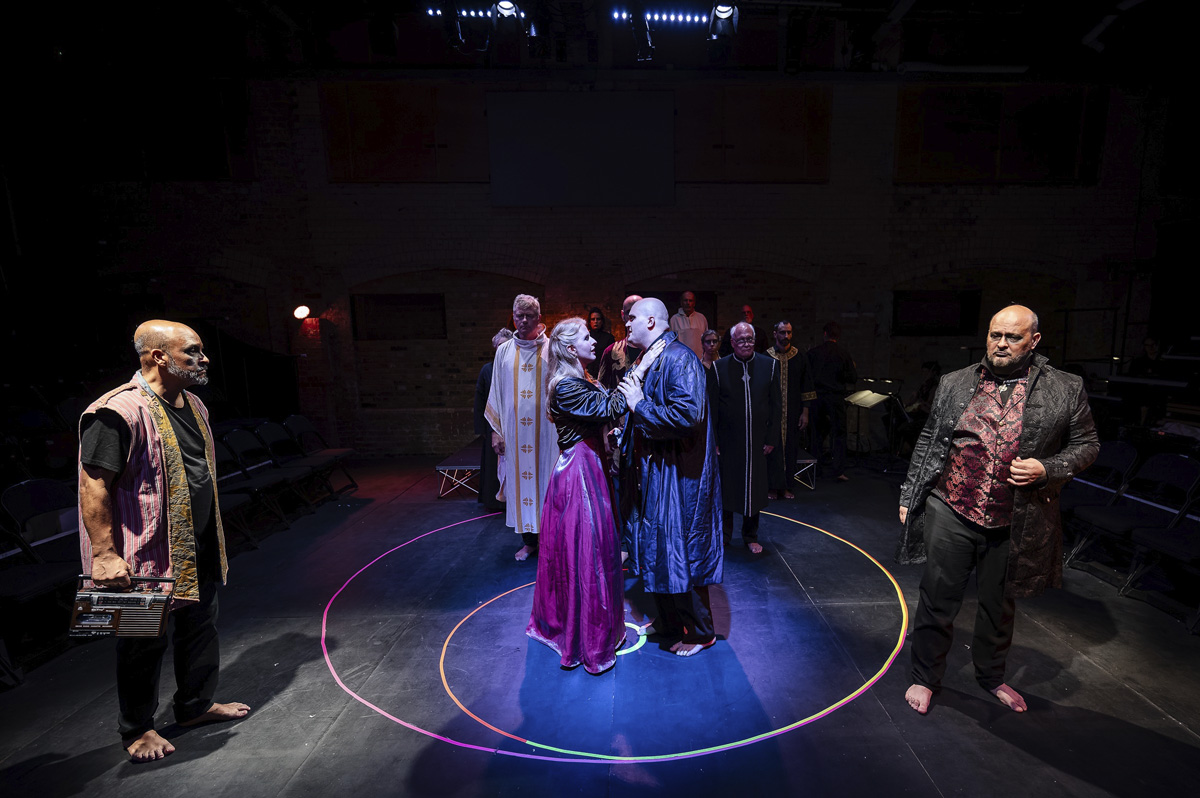
As stage director, he employs his trademark minimalist style: simple costumes, little or no scenery, and cleverly choreographed movement. Much of it works extremely well. Papageno’s magic bells, for example, become a small transistor radio. Yet at times I found myself missing some of the old clichés. I would have liked to see how Da Silva might tackle the trials by fire and water, and the triumph of Sarastro’s sun over the Queen’s moon, in a more expansive setting.
I was also less comfortable with the production’s treatment of Pamina. The image of Tamino leading her through the cavern, guided by the Magic Flute made by her own father, underlines some of the opera’s innate sexism in a way I found difficult to embrace.
But these reservations are outweighed by the production’s many strengths. The six young performers managing the white puppets while singing the parts of the Three Spirits is a wonderful piece of theatre, and musically more impressive than I recall hearing in many larger opera-house productions.
To assemble such a fine international group of singers and bring them to the Arcola for a Grimeborn season, where they can breathe life into one of Mozart’s great operas, is a considerable achievement. This Magic Flute may have its imperfections, but its musical vitality, theatrical imagination and sheer enjoyment make it a triumph.
Arcola Theatre, Dalston
Composer: Wolfgang Amadeus Mozart
Libretto: Emanuel Schikaneder
Music Director & Stage Director: Marcio da Silva
Performers include: Helen May, John Twitchen, Flavio Lauria, Juliet Petrus
Running time: 2 hours 45 minutes
Dates: Until 29 August
Photos: Julian Guidera