


Though running for little over an hour, this programme of three Biblical cantatas by Elisabeth Jacquet de la Guerre was a musical and dramatic revelation. In its London outing it formed the opening concert at the Spitalfields Festival. Everyone was grateful for the efficient air conditioning at Metronome the absence of which had led to the cancellation of the official opening event the previous evening. Moreover, the presence of a wider range of state-of-the art facilities also played a broader role in the rounded success of the production.
The three sonatas for female voice and continuo are all the products of the composer’s maturity, and you sense that immediately. There is a strong musical personality in play that plunges straight into the narrative with no hesitations and focusing only on those events and aspects on which she wishes to comment. There is little conventional piety, and more a desire to use these stories as a basis for moral reflection on the dilemmas and disappointments of human life and how to endure suffering and transcend despair. Despite the seriousness of intent, there is great variety and liveliness of musical form and a determination to deomonstrate that life should be lived to the full. This is clearly internalised by all the performers and creative team.
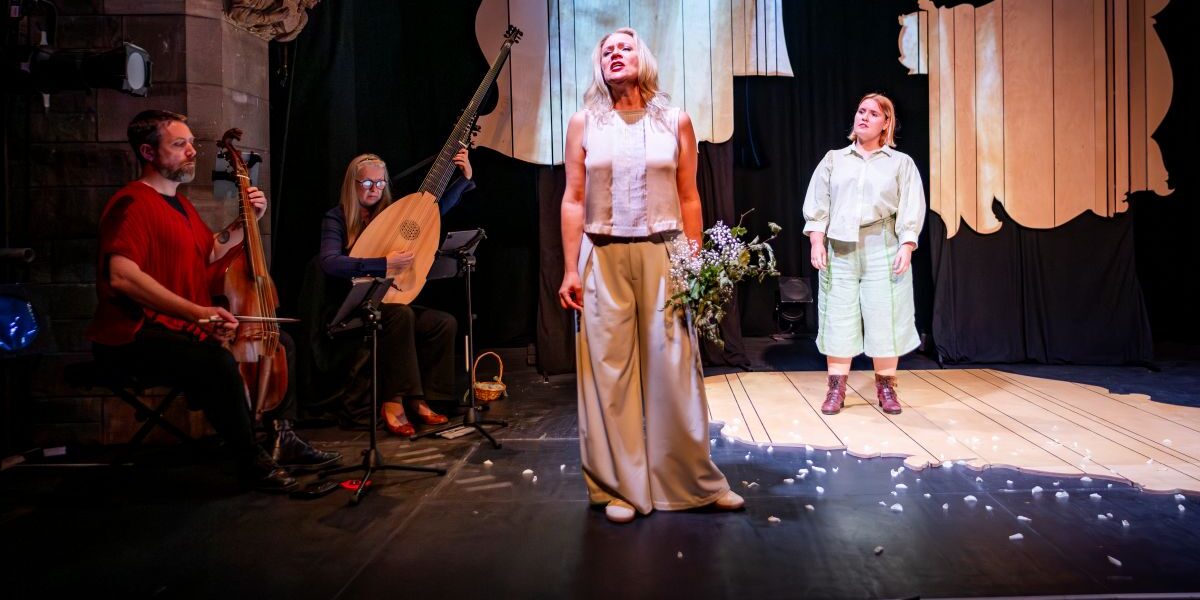
This is not their first venture into this territory. Three years ago this team performed three of the cantatas in a series that focused on the travails and oppression of Biblical women; and this time the focus is on three men who create their own problems – Adam, Jonah and Jephthah – and how they are commemorated, viewed and grieved by women. Each cantata lasts around twenty minutes and consists of a series of contrasted movements where terse exposition in recitative gives way to more elaborate commentary in arias with elements of musical repetition. The combinations of singers and instruments vary, but each cantata has a text translated into English by Toria Banks which is projected onto the backdrop as surtitles within video projections designed to underscore the mood of each section. An abstract set of wooden panelling and a few props complete the minimalist but concisely effective framing.
Adam sets the Creation story, but limited to interactions between Adam and God, with both roles interpreted by Carolyn Sampson. The settings suggest with brisk economy Adam’s hubris, his degradation and despair and the bleak ‘dust to dust’ narrative. But it is a set of messages made immediately accessible through the punchy contemporary language of the translation, and the mood shifts of video from the green of verdant creation through to a green of despair and isolation.
In Jonah Mariana Rodriques told the familiar tale of the storm and the whale but the main focus again here was on the symbolic value of the story rather than its narrative power, with the focus more on human endurance and the empowerment of struggle. In this case the translation of the text was perhaps less successful, with too many distracting colloquialisms and cliches (eg. ‘downturns & cuts’), when the story was already quite accessible enough in itself.
The final cantata Jephthah is perhaps the most remarkable of the three and certainly it received the most thoroughly curated performance. Written for two singers, it tells the familiar story of the sacrifice of Jepthah’s daughter in the wake of battle, but seen through the eyes of the women involved. The opening duet, ‘With garlands crowned’ has a catchy inevitability to it that resembles Purcell’s ‘Sound the trumpet’, and as the work progresses each section adds a different kind of grave underscore of the anguish at the heart of the human condition. This is music that deserves to be much better known. There could be no better advocates for it than Rodrigues and Sampson, whose pearly tone and command of complex ornamentation covered the full gamut of necessary emotions.
Given the composer’s virtuosity at the keyboard and violin, the continuo parts demanded a great deal from the three instrumentalists, set to one side of the stage. Musical director Liam Byrne, on viola da gamba, had to negotiate parts of great complexity in each cantata and his lines were ably augmented by Lynda Sayce and Alice Earll on theorbo and violin.
Careful but unintrusive direction by Jennifer Fletcher, and finely calibrated lighting from Ben Moon compliment the music-making and video elements to ensure that there is always movement and visual elements of interest to take us away from any lingering sense of a static, starchy churchy feel.
This is very fine music presented in a considered and considerate production that does full justice to its considerable quality.
Elisabeth Jacquet de la Guerre
Liretto: Toria Banks after Antoine Houdar de la Motte
Dunedin Consort, Mahogany Opera and Hera
Director: Jennifer Fletcher
Singers: Carolyn Sampson and Mariana Rodrigues
Instrumentalists: Liam Byrne, Alice Earll & Lynda Sayce
27 June 2026 and touring
1 hour, no interval
Photo Credit: Andy Catlin