

Arriving at the Grange estate for Giulio Cesare, one feels that the setting is a sprawling, verdant prologue to the opera. Enjoying the Hampshire nature (an unseasonably damp, grey evening notwithstanding) is a half-day event to remember. The neoclassical grandeur of the estate primed the audience for a tale of ancient empires and eventually makes the descent into director David Alden’s modern, often absurd vision. Handel’s Giulio Cesare in Egitto follows the titular Roman conqueror as his pursuit of a political rival leads him into a sexually charged, labyrinthine power struggle between Egypt’s co-rulers Cleopatra and Tolomeo. Driven by the period-instrument pulse of the Early Opera Company under Christian Curnyn, the Grange Festival’s Giulio Cesare is a playful, tactile, entertaining staging that fully exploits the cultural collision between its two central powers.
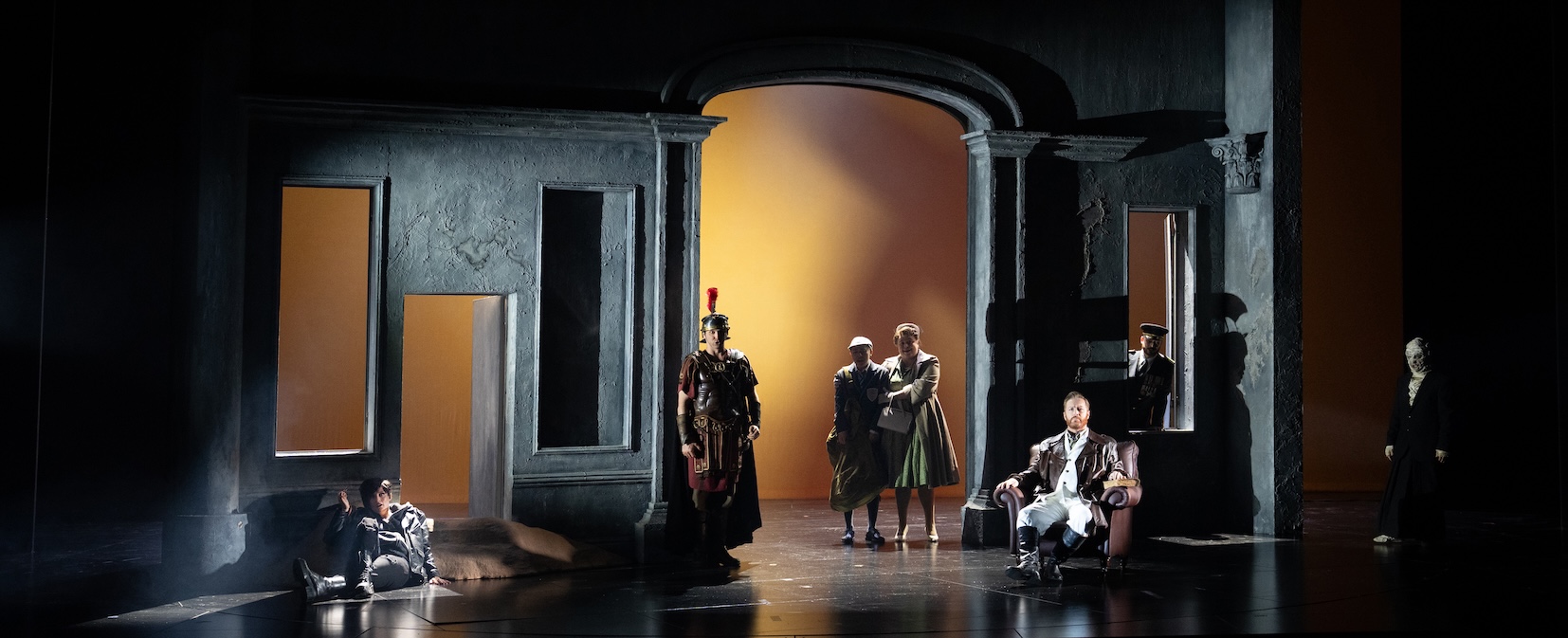
Alden and designer Jon Morrell lean heavily into the traditional binary between the two empires: Rome is framed through a lens of strict sobriety (stone columns, flagpoles, little colour aside from flashes of shiny metal), standing as a rigid foil to an Egypt defined by looseness and excess (silky fabrics, loud patterns, bathtubs). The costumery is wildly anachronistic and under-realised, as though it is being funny simply for the sake of being funny. The audience takes in the bereaved Cornelia in dutiful 1950s housewife dress, Tolomeo in silky robes one could grab in a Rituals store, Achilla in modern military uniform, Curio in Roman gear. Sometimes, this relentless visual noise actively takes away from the singing. There is the valid critique that the production caricaturises Eastern decadence by making it an exotic playground and does little to question the simple conclusion of a battle of good vs. evil, but one may argue that its tongue-in-cheek approach evenly flattens Rome and Egypt for the sake of focusing the opera’s psychological storytelling on individual heroisms and passions.
Despite the thematic messiness, the absurd slapstick does prove this cast is comprised of not just phenomenal vocalists, but multidimensional entertainers. Such comedy in opera can be overlooked in favour of reverence, and one must remember that this event is part of a festival. The sets are surprisingly inviting, avoiding the trap of sterile minimalism that is symptomatic of so many modern operatic updates. Tolomeo’s harem is ingeniously represented by a deep blue curtain closing off the stage, with concubines unceremoniously pulled in and out from beneath the hem by unseen hands; it is brilliantly vaudevillian in highlighting Tolomeo’s lecherous tyranny. Cleopatra, pretending to be her maid Lidia, parades around Cesare in what is essentially a glowing disco ball of a gown and performs “V’adoro pupille” while rolling across the stage on huge silver spheres. The cherry on top is Nireno, the Egyptian siblings’ servant: Owen Willets performs for the entirety of the opera wrapped up as a mummy who ends “Ritorni omai nel nostro cor” by leaning back gleefully into his coffin. It is a camp spectacle of weaponised seduction sold almost entirely by the performers’ unwavering commitment. Handel’s operas live or die by the agility and emotional depth of their singers, and the musicality on display here is largely exceptional.
A grieving widow and her vengeful son steal an opera: contralto Jess Dandy (Cornelia) and countertenor Zheng Jiang (Sesto) are the absolute standouts. Dandy’s contralto is a cavernous marvel, grounding Cornelia’s profound grief in absolute reality. Beside her, Jiang captures the volatile transition of a boy pushed to the brink with a countertenor of striking purity. His “revenge uniform”, which is a literal football jersey adorned with the number 6 (what else could it be for Sesto?) complete with oversized shoulder pads and face paint, is one of the few costume choices that perfectly physicalises the character’s internal arc — a youth’s clumsy, sincere rage.
The score is explicitly written to show off Cleopatra’s range more than anyone else’s, and soprano Sarah Brady navigates the sparkling coloratura well. Her costume changes represent the different archetypes she channels: starting as an “emo tomboy,” morphing into the glowing disco ball femme fatale, shrinking in extravagance as her power diminishes, and finally emerging in a sleek “girl boss” power suit. Crucially, Alden knows when to pull back. For Cleopatra’s two great arias of despair (“Se pietà di me non senti” and “Piangerò la sorte mia”), he places her in elaborately cavernous settings where she is entirely alone on stage. Her shimmering phrasing then completely commands the auditorium.
Countertenor Hugh Cutting is excellent as Tolomeo, utilising his biting, incisive tone to carve out a petulant villain, while James Atkinson (Achilla) and Owen Willetts (Nireno) provide robust, lower register performances to support the high ambitions of the central characters. As for the eponymous Roman conqueror, veteran countertenor Tim Mead takes a little longer to warm to. Vocally, his tone is mellifluous, but dramatically, his Cesare lacks a certain visceral thrust — he simply isn’t very powerful or seductive, which makes Cleopatra’s intense infatuation feel unbalanced. However, Mead sounds better every time he appears. By the time he reaches his final aria during the battle, he is quite masterful, delivering rapid-fire runs with a technical pedigree that reminds you exactly why he holds the title role.
Aside from various criticisms, the Grange Festival is a experience that is as bountiful as its opera (food, drink, and greenery). One has to simply lean back and take in both the scenery and the performance as the opera’s characters learn to do by its conclusion: with fervour, joy, and triumph.
Composer: George Frideric Handel
Librettist: Nicola Francesco Haym
Orchestra: Early Opera Company
Director: David Alden
Choreographer: Tim Claydon
Lighting Designer: Matthew Richardson
Cast includes: Tim Mead, Sarah Brady, Hugh Cutting, Jess Dandy. Zheng Jiang, James Atkinson
Photo credit: Richard Hubert Smith
Running time: 4 hr 30 mins including an extended interval of 1 hr 30 mins
Until: 25th June 2026