


The Return of Ulysses to His Homeland
Garsington reunites the creative team behind its highly successful 2022 L’Orfeo for Il Ritorno d’Ulisse in Patria, the second opera in Monteverdi’s trilogy, composed for Venice’s 1639/40 carnival season. L’Incoronazione di Poppea follows in 2028.
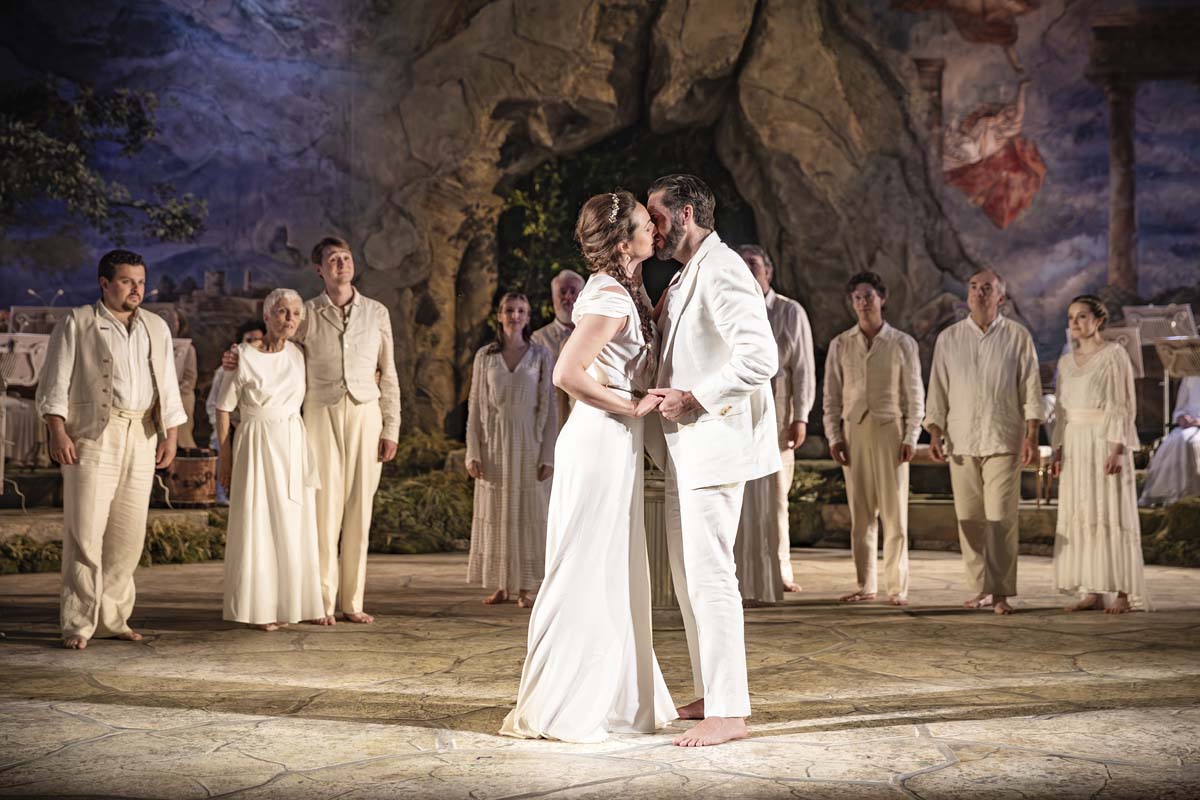
The story is simple. Ulisse leaves Ithaca for the Trojan War, abandoning Penelope and their infant son, Telemaco. After helping the Greeks to victory with the famous wooden horse, his return is delayed by the vengeful Neptune. Eventually, sea nymphs calm the waters and guide him home. Penelope remains faithful despite relentless suitors. With the help of Minerva, Neptune forgives Ulisse, who returns to Ithaca, defeats his rivals with his bow and is finally reunited with his wife.
Monteverdi’s music requires a very different singing style from later opera. Meaning and emotion are communicated through clarity of text, speech-like rhythms, varied tone and finely judged dynamics rather than sheer vocal power. A lighter, more flexible sound is required than the larger, highly vibrated voices associated with 19th-century repertoire. Ornamentation is refined rather than showy, making this a world particularly suited to early-music specialists.
As in L’Orfeo, the covered orchestra pit allows singers, instrumentalists and performers to share a single space beneath an illuminated ring that changes colour throughout the evening—blue for the sea, gold for the gods and cream for the countryside. The audience is invited to participate by wearing white or cream, reinforcing themes of purity, endurance and loyalty. Penelope’s vast blue cloak becomes a striking visual image, suggesting sea, river and shore. Imaginative touches abound: performers appear as sheep, Ulisse is swallowed by the earth, and gods arrive through mist in golden chariots.
Laurence Cummings ensures Monteverdi’s score never loses dramatic momentum, drawing a remarkable range of colours from the continuo group. Vocal lines breathe naturally, allowing the singers to deliver the Italian text with clarity and freedom. With only 12 singers covering more than 30 roles, the result is an impressively integrated ensemble.
Ulisse’s first solo, “Dormo ancora o son desto?” (“Am I asleep or awake?”), immediately establishes the opera’s psychological depth. Monteverdi’s fragmented, speech-like writing conveys the bewilderment and anguish of a man broken by years of wandering. British tenor and early-music specialist Ed Lyon (Garsington’s Orfeo in 2022) handles the demanding roulades with ease, bringing warmth, dignity and vocal variety to the battle-scarred hero. He is mesmerising throughout.
British soprano Claire Lees brings brightness and charm to the dual role of Amore and Minerva, lighting up the stage with radiance and sparkle.
American mezzo-soprano Cecelia Hall’s warm voice captures Penelope’s sadness, but crucial tonal variety is missing. Her opening lament, “Di misera regina” (“Unhappy queen”), is one of opera’s earliest great dramatic monologues. The repeated cry of “Torna Ulisse” (“Return, Ulysses”) should become increasingly desperate and hopeless, yet the vocal colouring remains largely unchanged. Similarly, the final aria, “Illustratevi, o cieli”(Shine forth, O heavens!”), and the recognition duet, “Rinnovata mia luce” (“My renewed light”), lack the emotional release and chemistry the music demands.
Veteran British mezzo Fiona Kimm, now in her seventies, brings warmth and authority to Ericlea, while tenor James Gilchrist is a sympathetic and expressive Eumete.
Welsh tenor Dafydd Jones (Telemaco), British tenor Benjamin Hulett (Giove/Anfinomo) and Welsh soprano Jessica Cale (Fortuna/Juno), winner of the Kathleen Ferrier Award, all make strong contributions with clear, attractive singing.
American bass James Cresswell is luxury casting as Nettuno and Antinoo. His powerful voice dominates the stage, yet remains stylistically controlled.
Iro, a gluttonous parasite, is opera’s first great tragi-comic character. His final aria, “O dolor” (“What pain”), begins with eight bars of sobbing despair as he contemplates suicide after losing access to free meals. British tenor Stuart Jackson turns the scene into one of the evening’s highlights.
South African tenor Innocent Masuku, whose light voice finds a more natural home here than in Almaviva at ENO, charms as Eurimaco.
Rowan Pierce (Melanto) and Alberto Miguélez Rouco (L’Umana Fragilità/Pisandro) are engaging in their supporting roles.
As a magical conclusion, the company reprises the a cappella epilogue used in L’Orfeo—”Che dar più vi poss’io” (“What more can I give you?”) from Monteverdi’s Fifth Book of Madrigals.
An enchanting evening and a rare opportunity to experience one of opera’s early masterpieces.
Music by Claudio Monteverdi (1567-1643)
Libretto Giacomo Badoaro after Homer
Conducted by Laurence Cummings
Directed by John Caird
First performance Teatro Santi Giovanni e Paolo Venice, February 1640
Cast includes Ed Lyon, Cecelia Hall, Alberto Miguélez Rouco, Thomas D Hopkinson,
Jessica Cale, Claire Lees, Fiona Kim, Rowan Pierce, Innocent Masuku, James
Cresswell, Benjamin Hulett, James Gilchrist, Stuart Jackson, Dafydd Jones, Jessica
Cale
Running time 4 hours 40 minutes with one interval of 90 minutes
Dates to see this production: 18, 21, 23 June and 4, 17, 19, 25 July 2026
Photo Credit Craig Fuller, Alastair Muir, Julian Guidera