

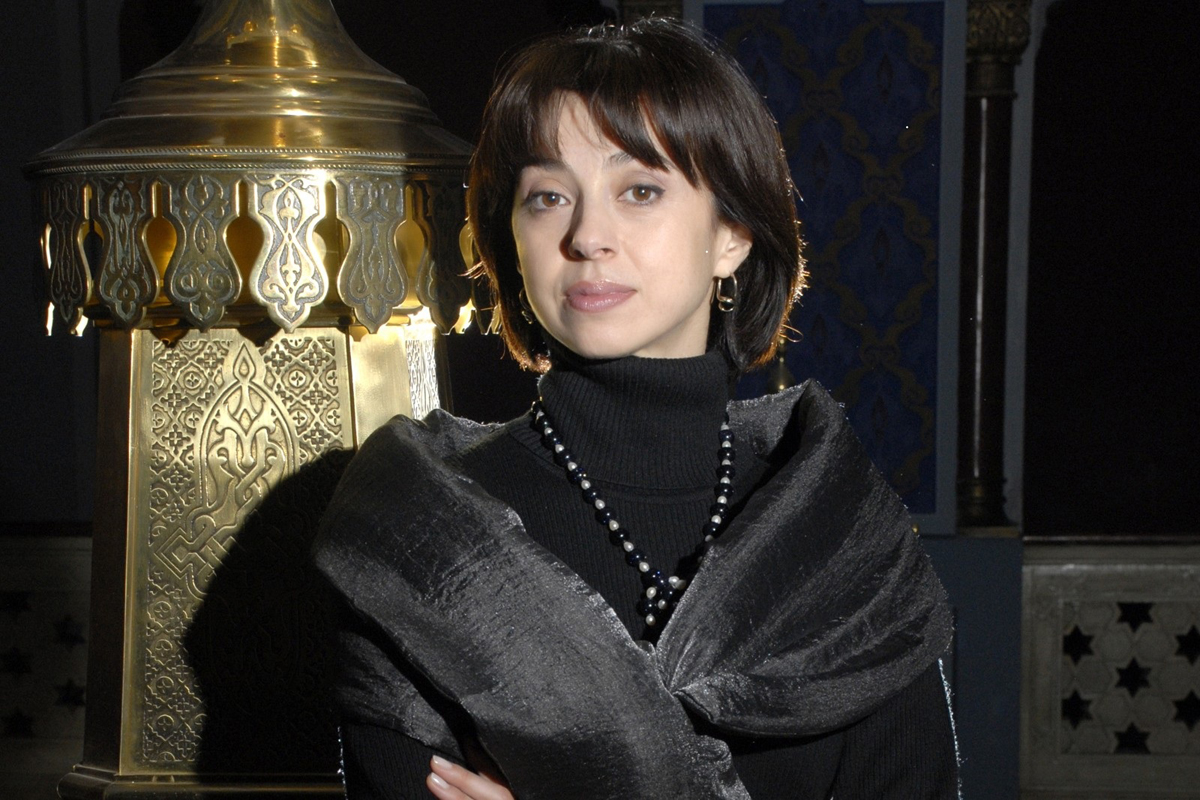

Nina Ananiashvili in Conversation with Rivka Jacobson
Home, heritage and the soul of Swan Lake
Ahead of the State Ballet of Georgia’s return to the London Coliseum, its artistic director and former Bolshoi prima ballerina answers questions on belonging, leadership, and the enduring power of ballet’s greatest tragedy.
This summer, the London Coliseum opens its doors once again to one of the world’s most compelling ballet companies, as the State Ballet of Georgia returns with a brand-new production of Swan Lake (17–26 July 2026). From the first shimmering bars of Tchaikovsky’s score, audiences are promised a journey into pure enchantment: Prince Siegfried’s fateful encounter with the Swan Queen Odette, the shadow of the sorcerer Rothbart, and the sweeping emotional power of ballet’s greatest love story.
Renowned for its exceptional dancing, sumptuous sets and glorious costumes, the company has become one steeped in tradition yet unmistakably alive with Georgian fire. Under the artistic direction of Nina Ananiashvili—the former Bolshoi prima ballerina whose international career made her one of the most beloved dancers of her generation—the ensemble has earned acclaim for its versatility, precision and emotional depth. As The New York Times has noted, its dancers are “versatile and accomplished,” and in Swan Lake they bring those qualities to the fore with striking clarity.
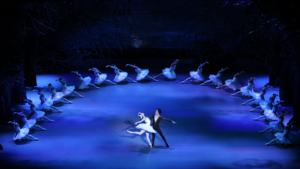
This new staging arrives in London fresh from its world premiere in Tbilisi, accompanied by the Royal Ballet Sinfonia, and promises a visually lavish, dramatically cohesive interpretation shaped by Ananiashvili’s own legendary experience in the role of Odette-Odile.
Ahead of the company’s return to the Coliseum, Rivka Jacobson put a series of questions to Ananiashvili, on home, heritage, leadership and the enduring power of ballet’s greatest tragedy.
Background and Career
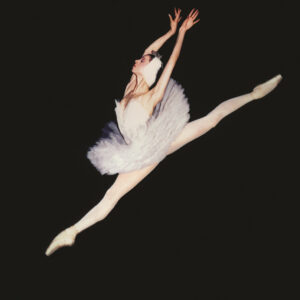
Having been born in Georgia and danced on stages across the globe, how do you define ‘home’ now?
“For me, home has always been the feeling of freedom rather than just geographical coordinates. For a long time I lived in Moscow, London, New York, elsewhere—but Georgia is where I belong, where I am absolutely happy. Understandably, when I was onstage at the Bolshoi, American Ballet Theatre, the Royal Ballet, the Royal Danish Ballet, or say in Oslo and Tokyo, the moment the lights went up, I felt I belonged there too. Today, ‘home’ is Georgia, Tbilisi, the State Ballet of Georgia. In that order.”
How would you describe your journey from Tbilisi to leading the State Ballet of Georgia?
“Unexpected, I would say. I never thought that one day I would be in charge of a ballet company—let alone one with 174 years of history. I rather planned to dance until I could sustain the necessary technical level, and then retire happily. But I always felt a responsibility to my country. Hence, when in 2004 I was urged to return and lead the company, it wasn’t just a career move; it was an obligation, a duty. I thought: ‘Let me try to do something for my fatherland—take the Georgian ballet tradition, which is so rich, and infuse it with the international standards and repertoire I had learned. If in a couple of years I discover that nothing good comes of my efforts, I would bow out.’ Luckily, all turned out well.”
Ballet is often described as ‘a language’—what helps an audience truly understand and connect with it?
“Sincerity and glorious theatre! One can’t lie—there are no words to hide behind, no way to imitate an emotion you do not have, no way to convey something different from what the music is speaking about, and no help from scenery or costumes.
The whole thing is about you and the audience. If a dancer is just doing gymnastics, the audience feels nothing. Audiences do not need to know the technical name of a pas de chat to understand heartbreak, desperation or joy. When the dancer ‘speaks’ with their whole body—not just their legs, but their eyes and their breath—the audience understands that language immediately.”
In ballet the words are muted—how do you think the movements can convey the drama?
“In many ways, the lack of words makes ballet more potent. In drama or opera, the play or libretto tells you what to feel; in ballet, the music and the body show you. Not that ballet is superior to drama or opera—it’s simply different, more laconic, closer to music than any other theatre form.”
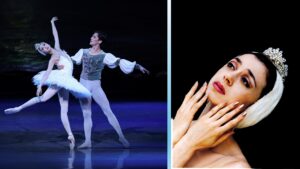
From Performer to Director
How would you describe the transition from performer to director?
“Painful. It is the commotion of going from ‘I’ to ‘them.’ Being a dancer, you are responsible for yourself, your partner and your personal performance. As a director, one suddenly is a parent, a psychotherapist, a ballet master, a coach, an accountant, a travel agent… And above all, you are responsible for these incredible young people, who are desperately in love with dance without much material gain, to be as happy and healthy as possible!”
How has your perspective on ballet changed since moving from the stage to directing a company?
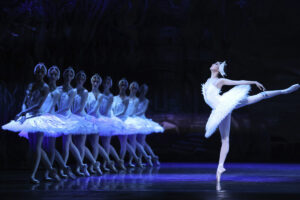
“For me, a ballet performance never was, and even more so is not today, only about the leading roles—it is the entire organism: the corps de ballet, the light, the scenery, the costumes, the atmosphere, and all of the dancers themselves. I could not influence the whole production, or a particular performance, when I was a ballerina—but today, everything is my responsibility.”
Working with Dancers
When you work with dancers in rehearsal, how do you communicate qualities such as musicality, phrasing and expression?
“I often find myself acting, dancing or singing the phrasing to them, because the rhythm of the breath is so important. I tell them: ‘Don’t just hit the count; breathe the music.’ You know, that very last breath of a musical note until it becomes the following one… I try to explain the ‘why’ behind a movement. If they understand the emotion, the phrasing, musicality usually follows naturally.”
How do you pass these qualities on to dancers with different physical instincts?
“Everyone is built differently, physically and emotionally. I never dare to turn a dancer into a clone of my teachers—or, God forbid, of myself. I’m trying to help them discover themselves, their unique strength, their ability to live through those magic minutes onstage with full dedication, because all of this might end quite abruptly, and might never be repeated.”
The Company
How would you describe the identity of the State Ballet of Georgia today?
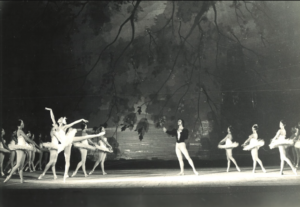
“We have the strength and discipline of the classical Russian school, but we have a very explosive Georgian temperament. We think of the choreography of Petipa, Bournonville, Balanchine, Ashton, Fokine, Chabukiani as our prime responsibility, but we are not afraid of contemporary works—Kylián, Ratmansky, Possokhov, Elo, Valersky, to name a few of the masters on our repertoire.”
What do your dancers bring that feels distinct or recognisably Georgian?
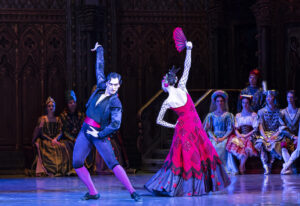
“There is the Georgian temperament—a natural nobility and the inner ‘spark.’ We Georgians have an incredible folk dance tradition, and even in classical ballet you can see that passion. There is a pride in the way they carry themselves on stage.”
Swan Lake
What drew you to stage your own version of Swan Lake at this moment?
“The first version we created with my dear friend and partner Alexey Fadeetchev, in 2004, was a success, and had been performed everywhere from the USA to Japan. Swan Lake is the ultimate test for any company, and the ‘Bible’ of ballet. I wanted to create a version that felt dramatically cohesive for our dancers, using my own experience of dancing the leading role hundreds of times, across more than twenty different versions. But no production can live longer than two decades. So, here came the urgency of having a new production.”
In revisiting Swan Lake, what aspects of the choreographic language do you refine?
“It would be preposterous to declare, ‘I’m refining the choreographic language of Swan Lake’—wouldn’t it? I am just trying to retain, with exactitude, what is Petipa, Ivanov and Gorsky—or at least what is believed to be theirs—and what Raissa Struchkova, Marina Semeyonova, Irina Kolpakova, Rimma Karelskaya, Nikolai Fadeetchev and Ben Stevenson taught me. We are trying to make the acting more natural. Odette-Odile is not just about flapping the arms; it’s about a woman kept prisoner—still something very common, isn’t it? The Prince isn’t just a cardboard cutout; he is a human being searching for an ideal.
I’m desperately sorry that the original fourth act was lost in constant revisions… and I absolutely adore Ashton’s fourth act, but we can’t use this masterpiece apart from the master’s other acts.”
What is the emotional core of your interpretation?
“Sacrifice and the longing for freedom. Odette is a woman imprisoned in her own uniqueness, and Siegfried is a prisoner of his birthright. It’s a tragedy, but it’s a beautiful one, because it shows that love can transcend even the most terrible divides and curses.”
What do you look for in a dancer taking on the roles of Odette and Odile?
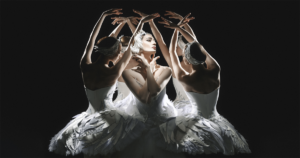
“Similarity and contrast. Odette must be fragile, distant, and strong in her spirit—pure light. Odile must be seductive, present, and technically fearless—dark, but never purely evil. But above all, I look for ‘singing arms,’ for both. If the arms don’t tell the story, it’s not Swan Lake.”
London Performances
What does it mean for the company to perform at the London Coliseum?
“Returning to the Coliseum is like coming back to see a dear friend who welcomed us so warmly. Our fifteen-performance run in 2024 was a historic milestone for us—the first time in our 174-year history that the company had performed in London. To see ‘Full House’ signs, and to be recognised by London audiences and critics, was an emotional victory for all of us. Everyone in Georgia, and beyond, understands what it means to perform in London, where theatre in general—and ballet in particular—is a matter of national importance.”
What do you hope audiences in London will take away from this production?
“This is a totally new production of Swan Lake, which will have its premiere in Tbilisi on 21 May. While there are some choreographic adjustments, we have completely new sets and costumes to share. I won’t say anything more yet—let the audience judge. I hope they take away a sense of the Georgian spirit: our dedication to ballet, and the love we bring to Tchaikovsky’s score. I wish them to leave the theatre feeling that they have witnessed something truly honest.”
What continues to inspire and move you in the theatre today?
“That classical ballet, classical drama, classical opera are as modern as they were centuries ago. A few days ago I went to a wonderful production of King Lear in Tbilisi, and I still can’t get rid of the lump in my throat. Every word, every sentence, every monologue was about today. And the sacred silence of the audience was proof that Shakespeare belongs as much to today as he will to the kingdom come.”
The State Ballet of Georgia’s Swan Lake runs at the London Coliseum from 17 to 26 July 2026, accompanied by the Royal Ballet Sinfonia. For Ananiashvili, the production carries the weight of a company’s history and the freedom of a single, fleeting performance—proof that the oldest stories still have something new to tell.
My thanks to Clair Chamberlain and the team at Bread and Butter PR for facilitating this interview with Nina Ananiashvili, and for providing an extensive selection of photographs by Zuka Pirtskhalaishvili, Besik Mchedlishvili and Anton Senko, together with archive images that will form part of a special exhibition at the English National Opera during the run of Swan Lake.