


Many writers take their cue from historical events, but Rajiv Joseph’s spin on history is a consistently interesting one. In Archduke, just as in Guards at the Taj, his focus is not on the traditional lead players, but on the perspective of observers or those traditionally seen as lacking real agency. When you add to the mix his continuing interest in the theme of male friendship, one not often covered by other writers, this sets up an unusual combination that does not disappoint. Here the focus is not on Austrian Archduke Franz Ferdinand and high politics, but on the young Serbian men recruited to assassinate him and his wife in Sarajevo in June 1914.
A bright ring of light frames the stage when we enter Jerwood Downstairs, and as the house lights dim this is revealed to be the outline of an underground tunnel or warehouse interior. A scrawny young man comes into view uneasily awaiting a rendez-vous with ‘some guy’ about a job. He is soon followed by another, equally down on his luck, and both of them – as is soon revealed – tubercular with only a short time to live. They fence with each other and eventually achieve an uneasy understanding. Then the whole process has to start again as a third man arrives who is to take them off to meet a ‘Captain’ with the promise of food.
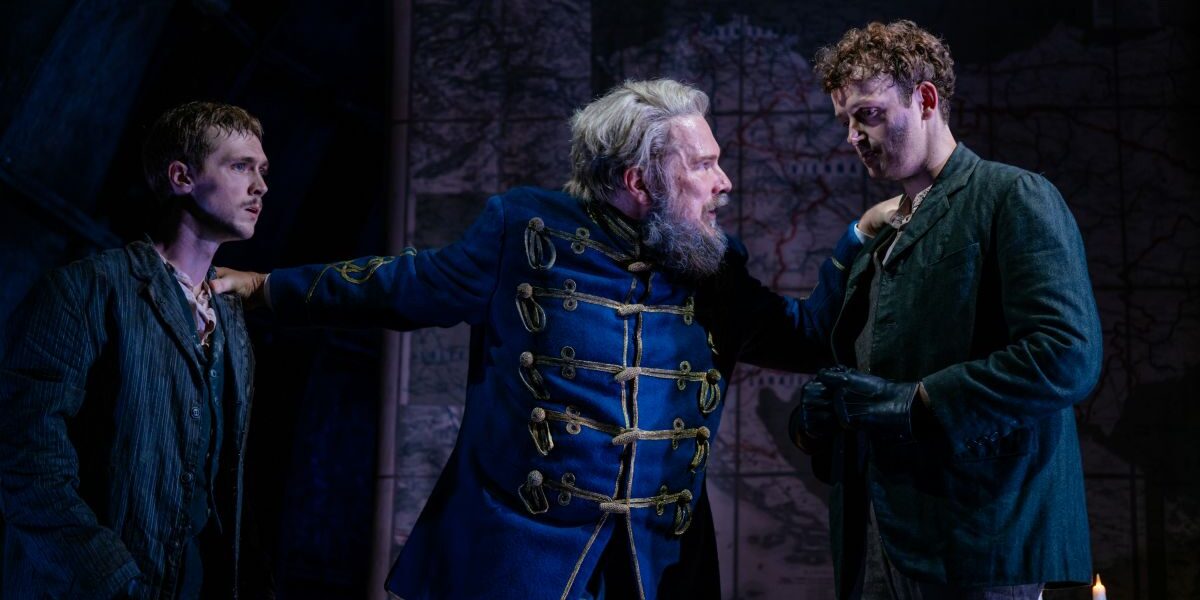
These scenes are compelling and convincing: the febrile suggestibility of the young men comes over vividly, their fears and desperation and readiness to lash out reflexively; but also their desire for reassurance and meaning in life amid so much confusion and uncertainty. This sets things up for a second scene which is more uneven. This is the episode of their radicalisation at the hands of the ‘Captain’, a renegade Serb soldier already responsible for one gruesome royal murder, and now trying to recruit assassins to disrupt Habsburg control of the Balkans. This section does not really convince. Marc Wootton is too relentlessly shouty and exaggerated in manner to be persuasive, and the arguments used are far from plausible even for these very naive young men. Here the author would have done better to stick closer to the facts and to the politics, dry as it might be, that motivated the original assassins.
The play regains its poise, however, ahead of the break, through the interventions of Janice Connolly as Sladjana, the Captain’s elderly cook. She humanises the action, introduces a welcome feminine perspective, and is responsible for a lot of the humour, though, as we find out later, she has a sinister side as well. The scene immediately before the interval is very well done too, in which the actual asassination is rehearsed to both comic and tragic effect, a very deft piece of writing.
At the outset of the second half plaudits go to designer Es Devlin, firstly for adapting the original set into a plausible chapel interior but then for a further set change that is one of the most surprising and effective I have seen in recent years, which wrenches the play into new territory for its final scene with brilliant success. Here the full characters of the young men are allowed to blossom as the structure of the play opens up into more speculative territory. There is a stand-out performance from Stanley Morgan as Gavrilo, initially fearful, edgy and put-upon, but visibly growing in authority with his sharp intelligence turned outwards onto the world around him. Chris Walley is also very persuasive as Nedeljko, much more limited in his grasp of things, but played with excellent comic timing and empathy. Abraham Popoola has less to do in the early scenes but also fills out his characterisation before the end.
This play began life in America, and has gone through a number of productions there. It has clearly changed over time in reaction to how some of the themes have evolved in our own recent times. These are very important issues – whether the nature of the manosphere or how to respond to the causes and consequences of radicalisation. At present, I would say the middle sections of the play still need some work to be fully convincing, but there is no doubting the ambition and reach of the play and that deserves full credit.
Writer: Rajiv Joseph
Director: Lyndsey Turner
Cast: Janice Connolly, Stanley Morgan, Abraham Popoola, Chris Walley, Marc Wootton
Until 25 July 2026
2 hrs with interval
Photo Credit: Helen Murray