

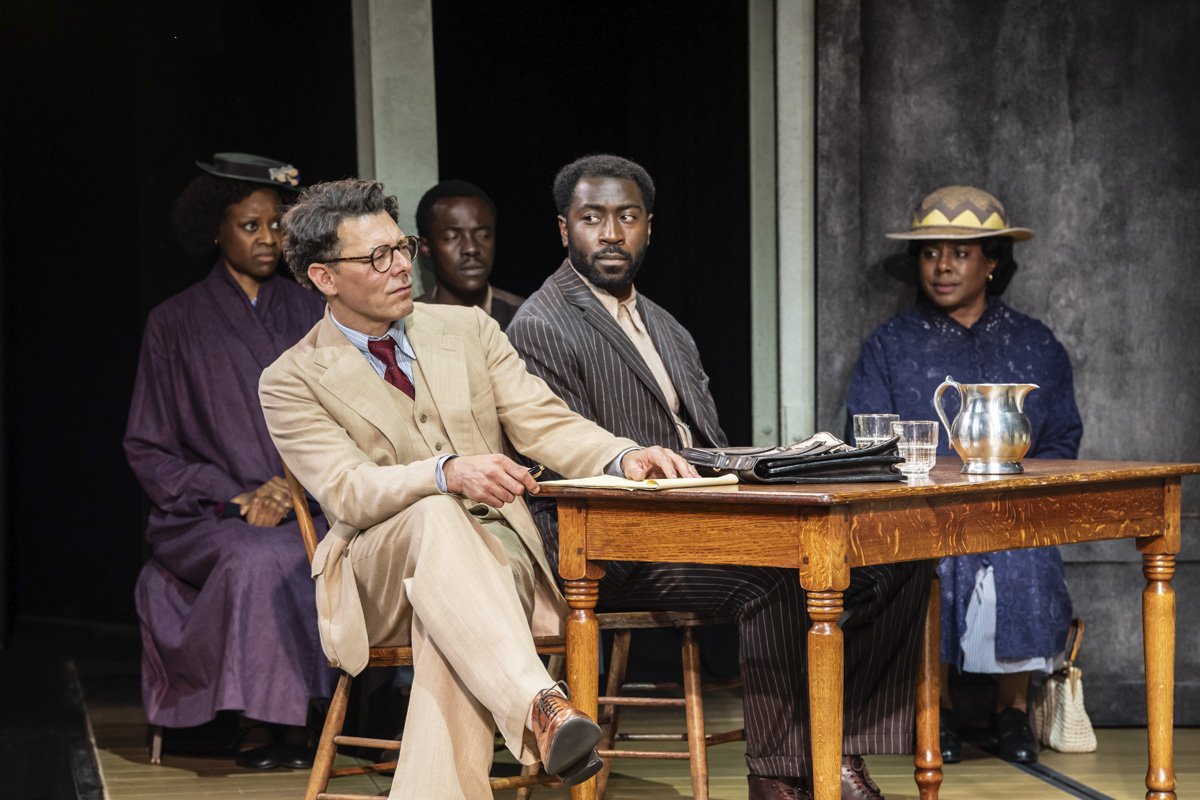

Few novels carry the cultural weight of To Kill a Mockingbird, making any stage adaptation a formidable challenge. Harper Lee’s 1960 Southern Gothic novel won the Pulitzer Prize a year after its release and has since become a cornerstone of modern American literature. That legacy, however, also creates enormous expectations, and this adaptation never quite lives up to them.
The story follows Atticus Finch’s attempts to prove the innocence of Tom Robinson, a Black man wrongly accused of raping a white woman in 1930s Alabama. Beyond its courtroom drama, the novel is remembered for its exploration of racial injustice and the loss of childhood innocence. Aaron Sorkin’s adaptation aims to preserve both themes, but it is Bartlett Sher’s direction that ultimately lets the play down.
From the opening moments, we meet Scout (Anna Munden), Jem Finch (Gabriel Scott) and Dill Harris (Dylan Malyn), with Scout acting as the narrator. These three characters sit at the emotional centre of the story, making the production’s biggest flaw all the more surprising: they are played by adults.
In a play rooted in childhood innocence, the decision proves fatally distracting. Although the detailed set, Southern accents and naturalistic staging strive for realism, watching grown actors mimic children’s behaviour never convinces. Their games, arguments and moments of vulnerability feel studied rather than spontaneous, making it difficult to invest emotionally in their journey.
Atticus Finch (Richard Coyle), meanwhile, commands the stage from his first appearance. Coyle brings warmth, authority and quiet confidence to the role, delivering a compelling and deeply human Atticus throughout.
Sorkin’s decision to weave the courtroom scenes throughout the play, rather than building steadily towards the trial, is an interesting one. While the structure keeps the pace moving, it also weakens the dramatic tension. Just as the courtroom drama begins to gather momentum, the audience is pulled away again, preventing the case from reaching its full emotional impact.
There are several standout performances. Judge Taylor (Stephen Boxer) brings understated authority to the courtroom, despite the occasional wavering Southern accent. Bob Ewell (Oscar Pearce) is particularly impressive, commanding the stage whenever he appears. His time on the witness stand is especially powerful, and Pearce gradually unravels the character, revealing the bitterness and volatility that drive him.
Mayella Ewell (Evie Hargreaves) is equally compelling. Hargreaves’ physicality is exceptional, conveying shame, fear and self-loathing as much through body language as dialogue. Her testimony creates some of the production’s most uncomfortable and emotionally charged moments.
Tom Robinson (Aaron Shosanya) provides the evening with its emotional weight. His testimony is the only point where I genuinely feel the injustice at the heart of Harper Lee’s story, and Shosanya brings a dignity and quiet humanity that make his performance the production’s finest.
Despite those strong individual performances, the production never truly comes together. To Kill a Mockingbird is ultimately a story about the loss of innocence, yet Sher’s direction never allows that theme to resonate. By the time the final revelations arrive, including Bob Ewell’s death, they feel rushed, and the ending lands with surprisingly little emotional weight.
Sorkin and Sher clearly attempt to modernise the novel. Calpurnia is given a stronger voice, while Bob Ewell is shaped in ways that echo contemporary political rhetoric, giving his prejudice a more recognisably modern edge. The intention is understandable, but the result ultimately dilutes some of the novel’s power. Rather than leaving the theatre reflecting on injustice, I leave feeling oddly detached.
The set and lighting are consistently effective. The courtroom transitions smoothly between scenes, and its design allows the action to flow naturally. Yet despite several excellent performances, this remains an unremarkable adaptation. I left almost feeling angry that a story with so much emotional depth could feel so emotionally flat. For me, the best theatre leaves you carrying something with you long after the curtain falls. This production mostly leaves me wanting to know the time of the next Tube home.
By Aaron Sorkin
Based on Harper Lee’s novel.
Music By: Scott Lehrer
Director Bartlett Sher
Photo Credit Johan Persson
Cast Includes: Richard Coyle, Stephen Boxer, Colin Campbell, Mayelle Ewell, Dylan Harris, Anna Munden, Oscar Pearce
Until 12th September 2026
Running Time: Two hours and 50 minutes, including one interval