

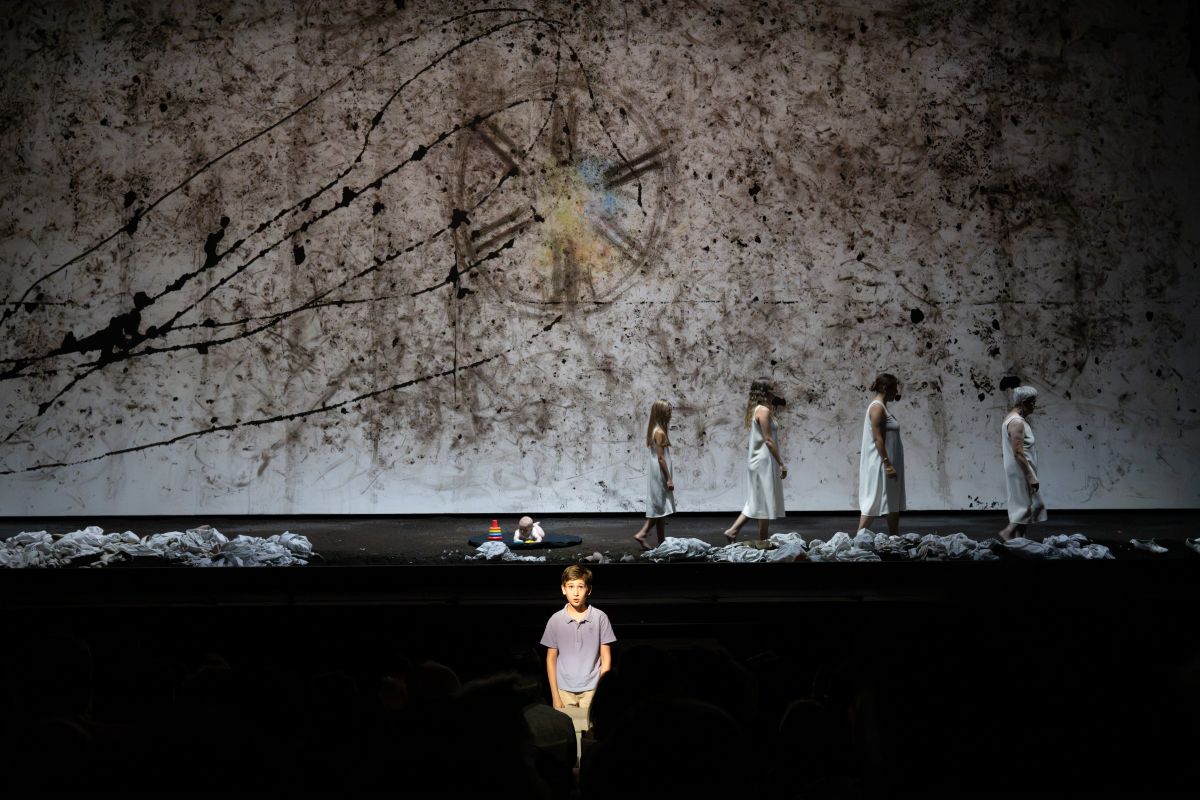

Mozart’s Requiem is inseparable from the mythology of its own making. Composed in the shadow of the composer’s death in December 1791, left unfinished and completed by his pupil Franz Xaver Süssmayr, it has accumulated more than two centuries of legend, speculation and projection. For this revival of the staged production first created at the Festival d’Aix-en-Provence in 2019, conductor Raphaël Pichon reshapes the familiar score by interpolating nine earlier sacred works by Mozart. Far from interrupting the dramatic flow, these interpolated works create islands of contemplation that deepen the spiritual architecture of the Requiem.
Romeo Castellucci, meanwhile, approaches the work not as a funeral rite but as a meditation on extinction at every conceivable scale, from the individual body to entire civilisations and geological eras. Throughout the performance, an Atlas of Great Extinctions scrolls across the rear wall, listing vanished species, lost cities, forgotten languages and destroyed monuments. Catastrophe here is not an isolated event but an ongoing condition of history itself.
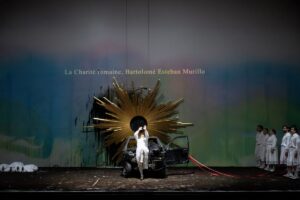
The production opens with an elderly woman slowly swallowed by her own bed. Her life then unfolds in reverse, moving backwards from adulthood to childhood. As a child she becomes the sacrificial centre of the Dies irae: painted in colours, briefly suspended against the wall, and, during the Recordare, cast out and offered up as the community’s scapegoat. Black earth and trees engulf the stage during the Lacrimosa, while the Offertorium introduces folk dances from the Balkans and Southern Italy. Their circular patterns metabolise death into communal rituals rather than attempting to deny it. One of Castellucci’s most devastating images arrives with the Sanctus, where a crashed car is surrounded by bodies arranged as a mass grave. In the closing pages of the Requiem, the choir, stripped of clothes, presses together naked and shivering. The image reads as the final warmth of human solidarity after every cultural structure has disappeared.
Finally, the stage floor rises vertically and, as the accumulated residues of the evening slide away, it reveals an immense white surface stained with black earth and paint. At its centre, the outline of Leonardo’s Vitruvian Man, still inscribed within its circle, remains faintly visible beneath the chaos. The production does not argue that life triumphs over death. What survives is the human trace itself: fragile, almost erased, yet still legible.
Pichon’s musical direction mirrors this vision through an interpretation built on extraordinary intensity. The tempi are urgent without becoming mechanical, and drama never comes at the expense of stylistic refinement. The contrast between breathtaking pianissimi and sudden orchestral eruptions recalls the violence of Caravaggio’s paintings, where light and darkness become moral forces rather than visual effects. The Introitus possesses genuine mystery, the Dies irae unleashes elemental destructive energy, the Confutatis evokes almost physical terror, while the Lacrimosa becomes a supplication offered without any certainty of being heard.
The choristers of the Ensemble Pygmalion are the evening’s true protagonists. They sing, dance, act and, ultimately, bare themselves with a commitment that transcends technical accomplishment and approaches something closer to collective self-sacrifice. The four soloists serve the ensemble rather than seeking individual prominence. Alex Rosen brings richness of tone and complete technical assurance to the bass line, with an especially distinguished Ne pulvis et cinis; Mélissa Petit’s luminous soprano voice conveys extraordinary vulnerability; Beth Taylor grounds the quartet with warmth and earthy solidity; and Duke Kim contributes vocal clarity and brightness to the ensemble numbers. The initial and final motet In paradisum, entrusted to a lone treble voice, provides perhaps the evening’s most haunting sound: a voice without history, singing after history itself has fallen silent.
This is the rarest kind of operatic achievement: a production that uses the stage not to explain music but to reveal emotional and philosophical dimensions that Mozart leaves suspended. Castellucci and Pichon have created a Requiem that is neither consoling nor despairing. It recalls Schopenhauer’s idea that great art briefly lifts the veil of appearances, allowing us to confront reality without illusion or commentary.
At the very end, four women representing different stages of a single life carry a newborn child to the front of the stage before quietly leaving it alone. The gesture offers no solution to the questions the evening has raised. It is simply the final image of biological resilience in the face of extinction.
Festival d’Aix-en-Provence, Théâtre de l’Archevêché, France
Requiem in D minor, K. 626 – Sacred work in staged version
Music by Wolfgang Amadeus Mozart
Anonymous Latin text from the Catholic Mass for the Dead
Version completed by Franz Xaver Süssmayr (1792) and edited by Raphaël Pichon
Conductor Raphaël Pichon
Director, set design, costumes and lighting Romeo Castellucci
Cast includes: Mélissa Petit, Beth Taylor, Duke Kim, Alex Rosen
Orchestra and Choir Pygmalion
Production by the Festival d’Aix-en-Provence 2019 in co-production with Adelaide Festival, Theater Basel, Wiener Festwochen, Palau de les Arts Reina Sofía, La Monnaie / De Munt
Running time: 1 hour 35 minutes without intermission
Until 12th July 2026
Photo credit Monika Rittershaus