

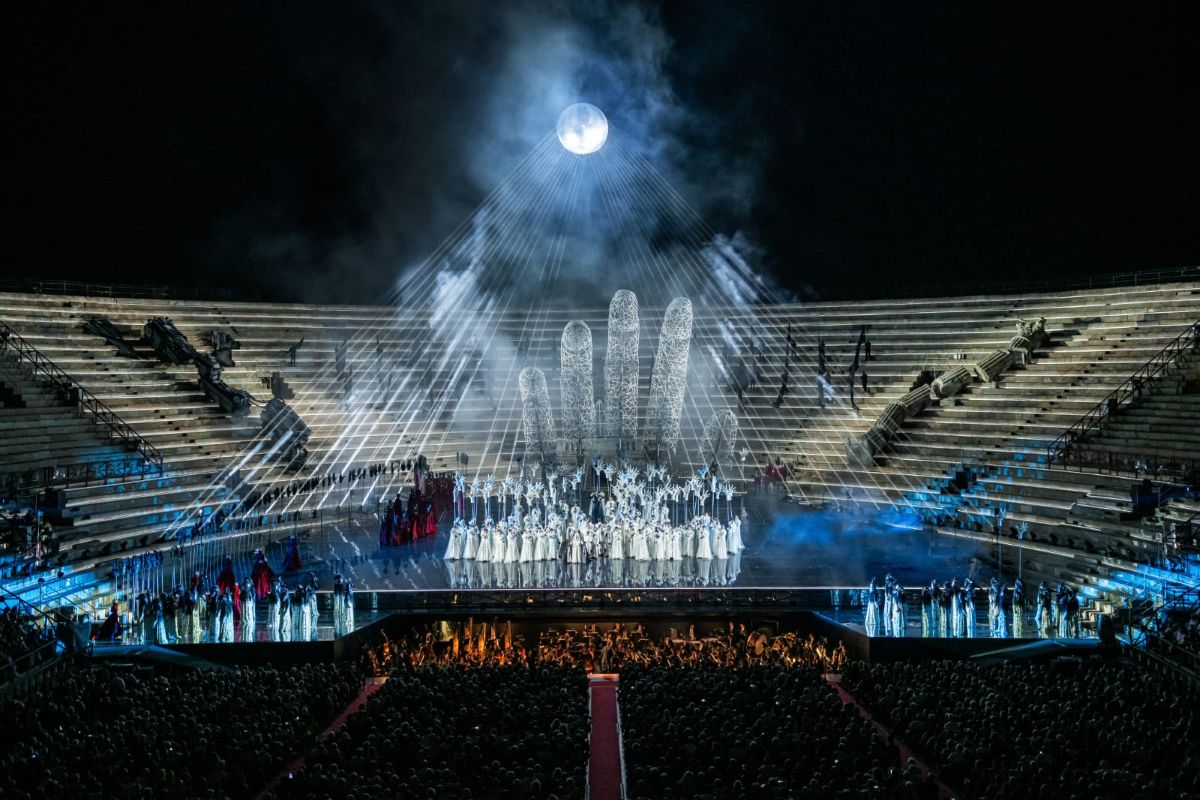

Aida, Arena di Verona: A dazzling crystal vision
Verdi’s Aida was commissioned for Egypt in connection with the opening of the Suez Canal, but delays caused by the Franco-Prussian War meant that the opera premiered in Cairo only in 1871. The Arena di Verona, where grandeur is almost part of the architecture, is perhaps its ideal home.
Stefano Poda’s production, already known as the ‘crystal Aida’, could hardly be more different from Franco Zeffirelli’s monumental staging, which has been a fixture at the Arena since 2002. Poda replaces monumental realism with stylised sets, extravagant costumes, light and symbolism, particularly the recurring images of the hand and the eye.
At the centre of the stage stands a gigantic golden wire hand. Its symbolism gradually becomes clearer: in ancient Egyptian iconography, the hand could represent royal and divine power, authority and protection. During the scene at Vulcan’s temple, its fingers move and a huge ball rolls into its palm, becoming an ominous image of destiny. At the end, the ball flies over the lovers’ grave while the illuminated hand opens above them, suggesting both absolution and protection in the afterlife.
The Eye of Horus is another recurring motif. It appears on the priests’ cloaks, on the chests of worshippers and even in the palms of the white hands carried on staves. Its association with protection, restoration and the afterlife makes it particularly apt for the final scene, where the luminous ball rising above the Arena may itself become a divine eye watching over the dead lovers.
Poda’s visual imagination is relentless. The sloping stage floor is made of Perspex panels that open and combine to form transparent, crystal-like pyramids. During Radamès’s trial, the pyramid suggests authority and judgement; in the final scene, it becomes a haunting image of death. Sophisticated laser beams replace much of the traditional scenery, changing colour according to the atmosphere: white for prayer and purification, red for passion and violence, blue for the restoration of order after war. The costumes combine Egyptian references with glitter, rhinestones, sequins, hieroglyphic patterns and elaborate masks. Some are evocatively Egyptian; others look closer to Venetian carnival than to ancient deities.
Not everything is equally successful. The silver motorcycle-style helmets worn by Amneris’s companions are impossible to decipher, while the dark-red gloves and shoes worn by Egyptians and Ethiopians perhaps suggest that both sides are equally implicated in the bloody business of war, deceit and treason.
Poda is credited with direction, sets, costumes, lighting and choreography, but if anything is missing from this spectacular production it is genuine choreography. The mass movement is often striking, particularly in the chamber scene, where the dancers form a huge domino-like structure before collapsing one after another. Yet professional ballet would have added considerably to the scenes at Vulcan’s temple and during the Triumphal March.
More seriously, the production is strangely detached from the emotional relationships at the heart of Aida. When Aida recognises her father, Amonasro, among the prisoners — ‘Mio padre!… Tu! Prigionier!’ — she does not even look at him. In ‘Ritorna vincitor!’, her stepping in time with the musical cadence makes the scene feel artificial rather than spontaneous. Her confrontation with Amneris, during which she rolls on the ground, conveys little of their underlying rivalry. Radamès’s momentous decision to flee Egypt passes almost unnoticed, and in the final scene the dying lovers do not even touch. For an opera whose emotional power depends so heavily on love, jealousy, betrayal and sacrifice, this is a significant weakness.
Fortunately, the musical performance is considerably more compelling.
Uruguayan soprano María José Siri was an outstanding Aida. Her voice soared effortlessly above the enormous Arena in the dramatic ensembles, yet her lyrical passages were characterised by exquisite pianissimos. Her high C in the Nile scene was a moment of wonder.
Yusif Eyvazov was a splendid Radamès, combining heroic power with an impressive ability to convey guilt, remorse and passionate love. His cry of ‘Sacerdote, io resto a te!’ was particularly powerful, while the conclusion of the final duet, sung with Siri, was memorable for its emotional intensity and technical mastery.
Clémentine Margaine was a forceful Amneris and a convincing counterpart to Siri. She brought both authority to the ensembles and sensuality to Amneris’s private scenes. Her mellow middle register was particularly attractive, although some of the higher notes were strained.
Youngjun Park made a strong Amonasro — no easy task after singing Nabucco on the previous evening — while Alexander Vinogradov was a vibrant and convincing Ramfis. Simon Lim, Francesca Maionchi and Matteo Macchioni completed the principal cast effectively, and the chorus was excellent.
Daniel Oren conducted with great authority. His fiery tempos gave the major dramatic scenes considerable momentum, while he was attentive to the singers’ quieter passages, no small achievement on the vast Arena stage. The considerable desynchronisation between the trumpets during the Triumphal March, however, resulted from the decision to place them at opposite sides of the enormous stage. This was a risky directorial choice that should have been avoided.
Poda’s Aida is undeniably spectacular. Its crystal surfaces, lasers, luminous imagery and vast deployment of performers create an experience of extraordinary visual ambition, while the superb cast and Oren’s conducting provide a strong musical foundation. Yet the production’s obsession with visual symbolism comes at a price: its lovers, rivals and family members too often remain emotionally remote.
It dazzles the eye and excites the ear; it does not always touch the heart.
Arena di Verona
Aida
Music: Giuseppe Verdi (1813–1901).
Libretto: Antonio Ghislanzoni
Director, set, costumes, lighting and choreography: Stefano Poda
Conductor: Daniel Oren
Principal cast: María José Siri, Yusif Eyvazov, Clémentine Margaine, Youngjun Park, Alexander Vinogradov, Simon Lim
Running time: 187 minutes, including a 25-minute interval
Closing date of the 2026 Festival: 24 July
Photo credit: HEADSCollective