


Auschwitz, Dachau, Treblinka. The names of these Nazi extermination camps conjure devastation that remains woundingly fresh. They are ever-present reminders of humanity’s ability to inflict and experience unconscionable violence. Not every shed tear is caught by history, however. This is true of the story of Camp Gurs, a long-forgotten internment centre inhabited by ‘enemy alien’ German-Jewish women in the Pyrenes and managed by the French Government. After much academic research and rummaging through archives, it serves as the subject of a new play by Julia Pascal, The Banality of Evil: Hannah Arendt, France, 1940, inspired in part by a relative of the playwright who endured its dehumanising conditions.
First, it is important to establish that the title of the play is not a faithful representation of the content. There is little exploration of Arendt’s timely concept of the ‘banality of evil’, which was coined to describe the psychology of Adolf Eichmann, a Nazi war criminal who displayed an ingrained unwillingness to empathise with those he persecuted or confront moral reckoning, as evidenced in his trial in 1961. The play instead chooses to focus on an earlier period of Arendt’s life, in 1940, when along with many other women she was rounded up at the Velodrome in Paris and carted off to Camp Gurs. There up to 60 women were placed in a single windowless hut with no access to water or food. The poor conditions meant they readily caught dysentery and the corrupt guards subjected them to sexual violence – often in return for meagre victuals.
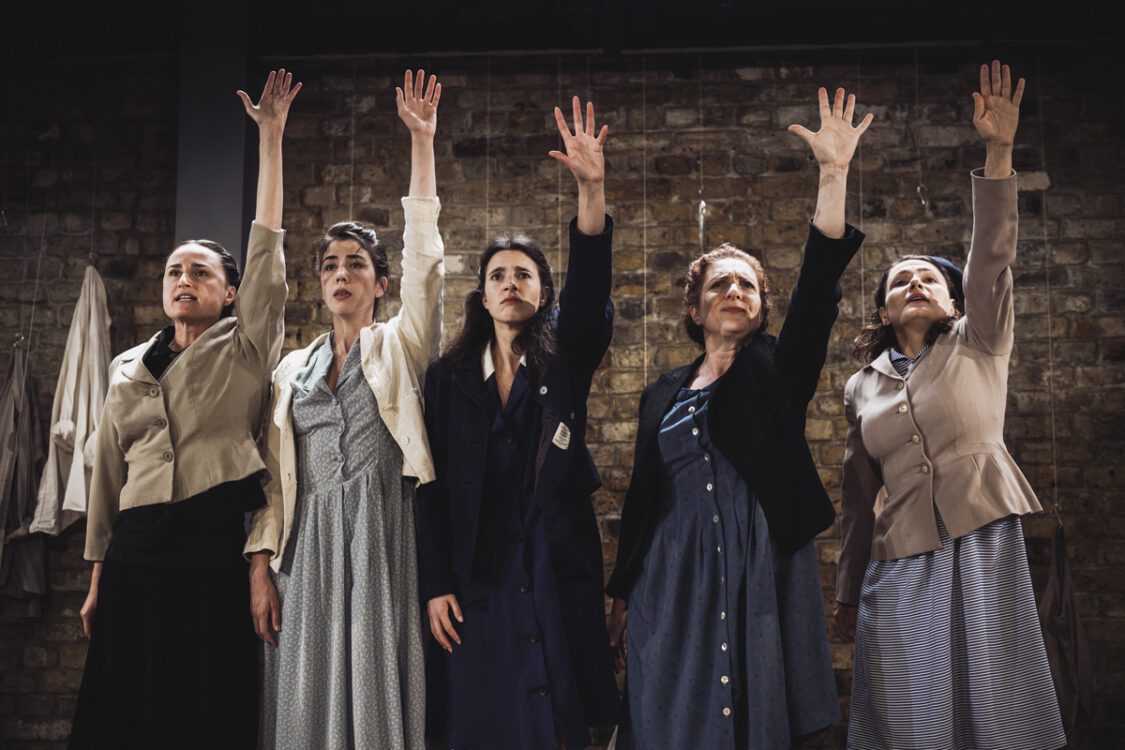
Where performance is concerned, defiantly each member of the ensemble displays a different energy and perspective in an environment constructed to eradicate selfhood. Mai Weisz is Hannah Arendt, the cool rationalist who commandeers her fellow prisoners, providing them with comfort through her sense of self-assurance and gaining respect through her intellectuality. Bringing a schoolgirlish exuberance to the play is Ariella Barnett’s Eva Daube, whose bright-eyed hopefulness glimmers through even in dark, brutalising moments as she clings to communist beliefs. The triad is completed by artist Charlotte Saloman played by Anna Eckhard who exudes an air of contained melancholy – understandably so, her grandfather has been detained in the same camp. By the end of the show, Charlotte has vanished into a spectral presence, perhaps gesturing to personal (female) histories which are lost within the grander narratives of war.
In an interview Pascal said it was hard to find a venue that would programme her play, an indication of the increasingly hostile climate faced by artists in times of political foment. Theatres should, of course, be hothouses of political inquiry. There could be no better stage then than the Arcola’s Studio 2. Its dark, intimate shell atmospherically intensifies the claustrophobia of the piece so the audience feel as if they are inhabiting the grimy, mired sheds of Gurs with the female prisoners. Carmen Neat’s set design is minimal, bringing together a few tin buckets, coats and hangers, ensuring the desolation is foregrounded. In such a harsh space all these women really have is each other, and yet their relationships are continually tested by the Camp’s male authoritarians who try to divide them.
Unfortunately, the moral clarity of the narrative is not matched by a cogent structure. Pascal leans heavily on Brecht to produce alienation but ends up throwing superfluous features at material that is emotionally impactful in its own right. Seemingly sporadically, the production makes free use of different languages, breaks the fourth wall, and draws on the theatrical arsenal of singing and dancing. That said, the musical moments, beautifully sung by the cast, are generally successful because they underscore the shared condition of the women and their fleeting unity. The use of the other flourishes, however, detract from the emotions generated by the captivating performances of the actors.
In The Banality of Evil Pascal successfully breathes life into a neglected chapter of history. Her play ensures that theatregoers depart with a renewed understanding of how German-Jewish women’s lives were impacted in the precarious period before the French-German armistice, and through her art makes a plea for social tolerance to prevent such histories repeating themselves. If you go to the play expecting a piece brimming with an in-depth exploration of Hannah Arendt’s political thought, however, you will not find it. Immerse yourself instead in one of her numerous books, where, because of the expansiveness of the essay form, they are able to be fully articulated.
Written and directed by Julia Pascal
Cast includes:Mai Weisz, Ariella Barnett, Pat Dynowska, Helen Goldwyn and Anja Fahlenkamp.
Until: Saturday 7th November 2025
Running Time: 1 hour and 30 minutes with no interval
Photo credit: Max Brenner