

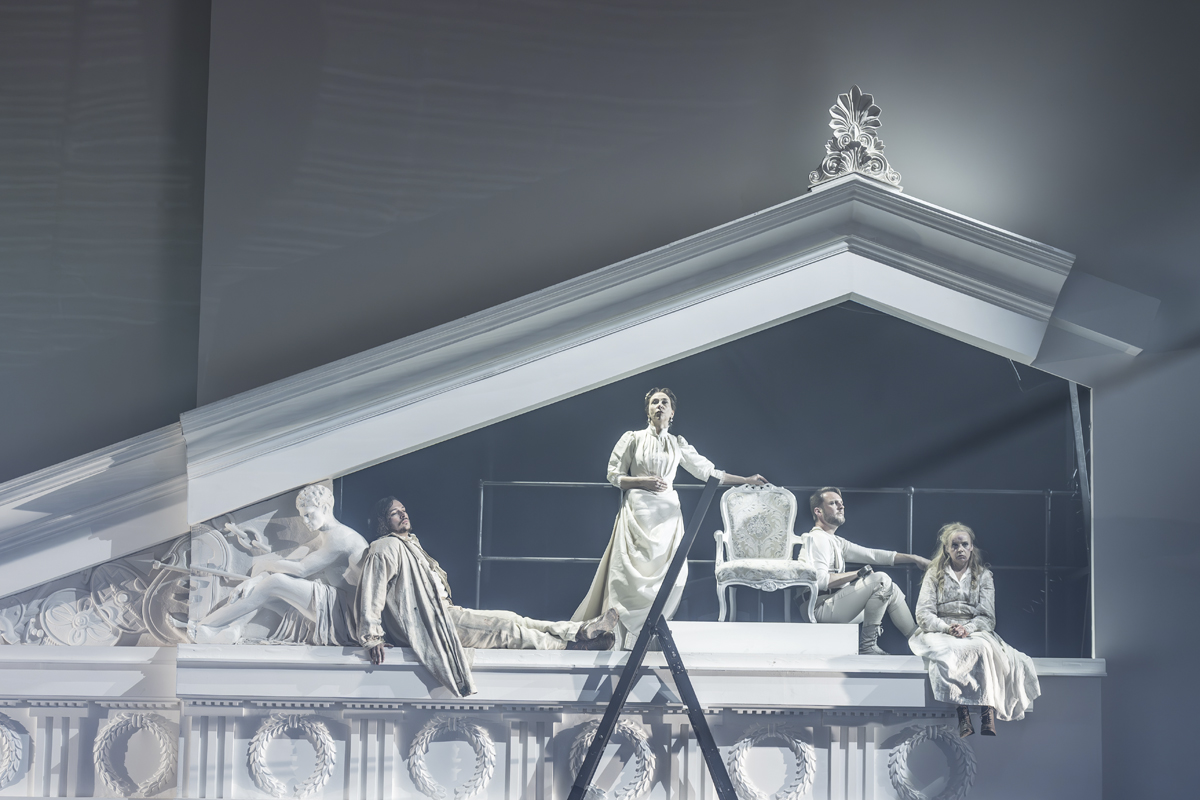

This splendid production of Das Rheingold marks the beginning of Grange Park Opera’s new cycle of Wagner’s Ring of the Nibelung. With a fine cast and the seasoned musicians of the Orchestra of the English National Opera under the baton of Harry Sever, this version of the scene-setting opera is an ideal introduction to the mythic world Wagner creates to tell the story of the doomed gods and the cursed ring forged from gold stolen from the Rhinemaidens.
Alberich, the dwarf lord, strays from his realm of Nibelheim to the Rhine and meets the Rhinemaidens. They trick and torment him. He renounces love and steals their gold to forge a ring of power. Meanwhile, in the heavens, Wotan, ruler of the gods, has persuaded the giants Fafner and Fasolt to build him a new palace, but he has no means of paying them. When they realise they have been deceived, the giants take Freia hostage – her golden apples keep the gods young. Wotan decides to seize Alberich’s stolen gold to pay the debt and regain Freia. With the help of Loge, the god of fire, he tricks Alberich and steals his gold, including the magic ring. In his despair, Alberich curses the ring and all those who desire it. Loge urges a reluctant Wotan to return the ring to the Rhinemaidens. He refuses, but is eventually forced to surrender it as part of the payment to the giants, who immediately fight over it. Freia returns to her family and they triumphantly cross into the newly built palace of Valhalla but, as they do so, we hear the Rhinemaidens’ song of lament from far below in the river.
The singing of all the principals – all home-grown British talent – was of the highest standard, but the outstanding performance of the night came from David Stout as Alberich. It is all too easy to turn the character into a grotesque, but this Alberich was so much more. When he is at the mercy of the duplicitous Wotan, his despair and his curse carry immense dramatic force. His sonorous baritone seems to have developed to another level since I last heard him, in Mozart, and it was perfectly suited to this Wagnerian tour de force.
I was also hugely impressed by Mark Le Brocq’s Loge. There is hardly enough room in the Grange Park programme to do full justice to his long and distinguished career, but his singing and acting here were mesmerising. The constant sense that he could foresee, yet not prevent, Wotan’s folly was spot on.
There is no space here to mention every singer, but we heard fine performances from James Rutherford as an arrogant Wotan, Christine Rice as a Fricka fearing the worst, and Matthew Rose as a lovelorn Fasolt. As an ensemble piece – without the dominant roles that emerge in the later parts of the cycle – Rheingold depends for its impact on quality in every role and on a sense of musical interdependence. This performance delivered that prize and was brilliantly exemplified in the all-on-stage curtain call.
Harry Sever, as conductor, is by Wagnerian standards a newcomer, but his Longborough credentials are impressive, and his pacing of the score – in a first-night performance without an interval, as Wagner intended – was well judged. The ENO orchestra was in fine form, with the brass section particularly outstanding.
There were moments of brilliance and moments of bathos in Charlie Edwards’s production. This was a singer-friendly staging, and the use of video projections onto a front gauze screen was inventive. The descent into Nibelheim, with flashing geometric shapes and an almost silent-film aesthetic, was gripping. The solution to the problem of conjuring Alberich’s invisibility was also very smart. However, the procession of the gods into an impressive Valhalla, resembling the tympanum of a Greek temple, was inexplicably achieved via a stepladder brought on by the Rhinemaidens. Still, no Wagner opera is complete without moments of controversy and, to rival Bayreuth, risks must be taken.
We are extremely fortunate to have smaller companies in the UK with the vision and determination to take on Wagner’s masterpieces, and this Rheingold is a worthy addition to that distinguished list. It is only right to add that Grange Park Opera is a wonderful venue to visit, with grounds and gardens that are a joy, and an auditorium where both sightlines and acoustics are superb.
A great night for all opera lovers, not just the Wagnerians.
Venue: Grange Park Opera, Surrey
Music and Words: Richard Wagner
Conductor: Harry Sever
Director: Charlie Edwards
Performers incl: David Stout, Mark Le Brocq, Christine Rice, James Rutherford
Running time: 2 hours 40 minutes (without interval)
Dates: until 10 July
Photos: Marc Brenner