

Handel’s Orlando, inspired by Ariosto’s Orlando Furioso, centres on a heroic knight driven to destructive jealousy. Orlando loves Angelica, Queen of Cathay, but Angelica loves the African prince Medoro. Dorinda, a shepherdess, is also in love with Medoro, while the magician Zoroastro observes and guides events from the sidelines. In the final act, Orlando descends into madness and kills Angelica and Medoro, only for Zoroastro to restore them to life and return Orlando to sanity.
Handel introduced Italian opera to London with Rinaldo in 1711. Its success sparked a craze for opera seria, a form built around solo arias and star singers.
Handel wrote the title role for the celebrated castrato Senesino. Although Orlando contains one of the greatest mad scenes in opera, Senesino was given only three da capo arias—fewer than Dorinda—and left the company disgruntled at the end of the season. After its original run, Orlando disappeared for more than 200 years until Janet Baker revived the role in London in 1966.
Longborough Opera House, a converted barn, has 500 plush red seats recycled from the Royal Opera House. The setting creates an intimate atmosphere, and the acoustics are excellent.
Orlando is a relatively static opera that depends heavily on the strength of its five singers. There is no weak link in the cast; all five principals are outstanding.
The Act I set feels cramped, gradually opening out as the drama unfolds. By the final act, little remains—a visual expression of Orlando’s release from jealous confusion and his return to clarity.
Zoroastro is accompanied by three silent spirits in crinolines who help propel the action. At times they distract attention from the singers, but generally they reinforce the production’s underlying message.
Although the soloists are given many arias, Orlando also includes an unusually large number of duets and trios, bringing added variety and interest to the score. Given the quality of the cast, these ensemble numbers are among the evening’s highlights.
British bass-baritone Andrew Foster-Williams, as the magician Zoroastro, appears with beard, powdered wig and crinoline as a kind of master of ceremonies, steering the action towards its proper resolution. His sonorous, warm voice displays not only a rich vocal palette but also impressive coloratura technique—unusual for a bass-baritone—bringing both charm and humour to the opera’s only male role.
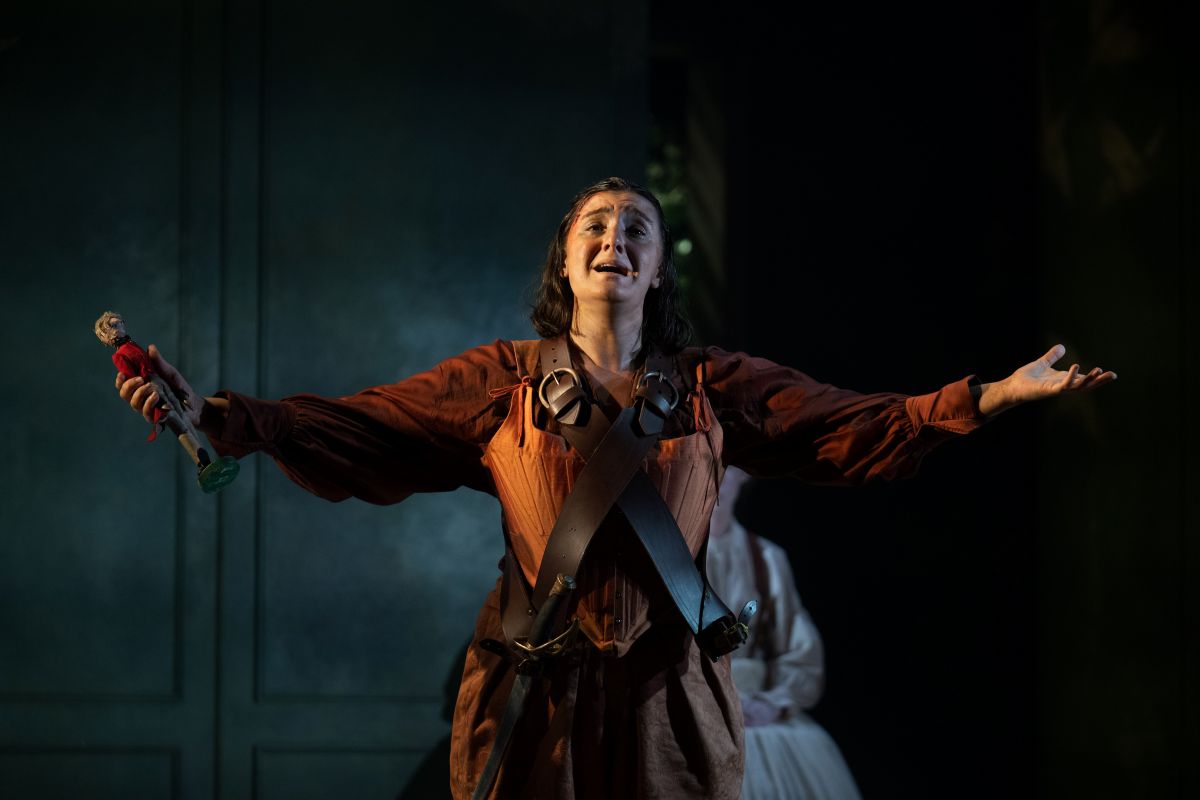
Since reaching the final of Cardiff Singer of the World in 2023, 32-year-old Scottish mezzo-soprano Beth Taylor has risen rapidly. She fully inhabits Orlando, delivering an outstanding performance and commanding the stage from first entrance to last. Her expressive voice moves effortlessly across the range, conveying fury, jealousy and desperation with striking immediacy. In Longborough’s intimate theatre, that emotional intensity registers at close quarters.
Her first aria, Lascia amor e segui Marte (‘Forget love and follow Mars’), reveals a rich lower register, immaculate roulades and an added top note that crowns the aria with panache. She is entirely convincing as the male hero, both vocally and dramatically, and her da capo variations are consistently imaginative, drawing on the full range and colour of the voice. Fammi combattere (‘Let me fight’) showcases an exciting chest register and long, finely sustained coloratura lines. Best of all is Orlando’s descent into madness, pursued by the Furies in Ah! scelerati spettri (‘Ah, evil phantoms’): a true tour de force. Taylor is unquestionably a future star. She will appear in Alcina at the Royal Ballet and Opera in September.
Irish soprano Anna Devin shines as Angelica, her silvery tone perfectly suited to the role and its vocal fireworks.
British mezzo-soprano Katie Bray, winner of the Dame Joan Sutherland Audience Prize at Cardiff Singer of the World in 2019, brings a gorgeous warm tone to Medoro. Her superb breath control and beautifully sustained legato are particularly evident in Verdi allori (‘Green laurels’), as Medoro recalls where he and Angelica first fell in love.
Irish soprano Kelli-Ann Masterson sparkles as Dorinda. In Act II, after losing Medoro, Dorinda is inconsolable, echoing the sad song of a puppet nightingale in Quando spieghi tuoi tormenti (‘When you express your torment’). Masterson negotiates the fiendishly difficult music with apparent ease.
One hopes that a surge of Orlando revivals will follow Longborough’s example.
This is a rare opportunity to experience one of Handel’s least-performed masterpieces, brought vividly to life by five exceptional principals.
Music by Georg Frideric Handel (1685–1759)
Libretto adapted from Carlo Sigismondo Capece’s L’Orlando, based on Ariosto’s Orlando Furioso
Conducted by Christopher Moulds
Directed by Sinéad O’Neill
First performed on 27 January 1733 at the King’s Theatre, London
Cast includes Beth Taylor, Anna Devin, Katie Bray, Kelli-Ann Masterson, Andrew Foster-Williams
Running time: 5 hours, including intervals of 30 and 90 minutes
Performances: 4, 6 and 7 June 2026
Photo Credit: Matthew Williams-Ellis