


As Verdi asserted, his 1841 opera Nabucco was born under a lucky star. It was a huge success at its premiere and has never left the world’s operatic repertoire. It tells the moving story of the Hebrews’ enslavement and exile in Babylon in 587 BC, and their subsequent liberation. The title character is a fictional construct that blends features of the historical Nebuchadnezzar II, Nabonidus and Cyrus.
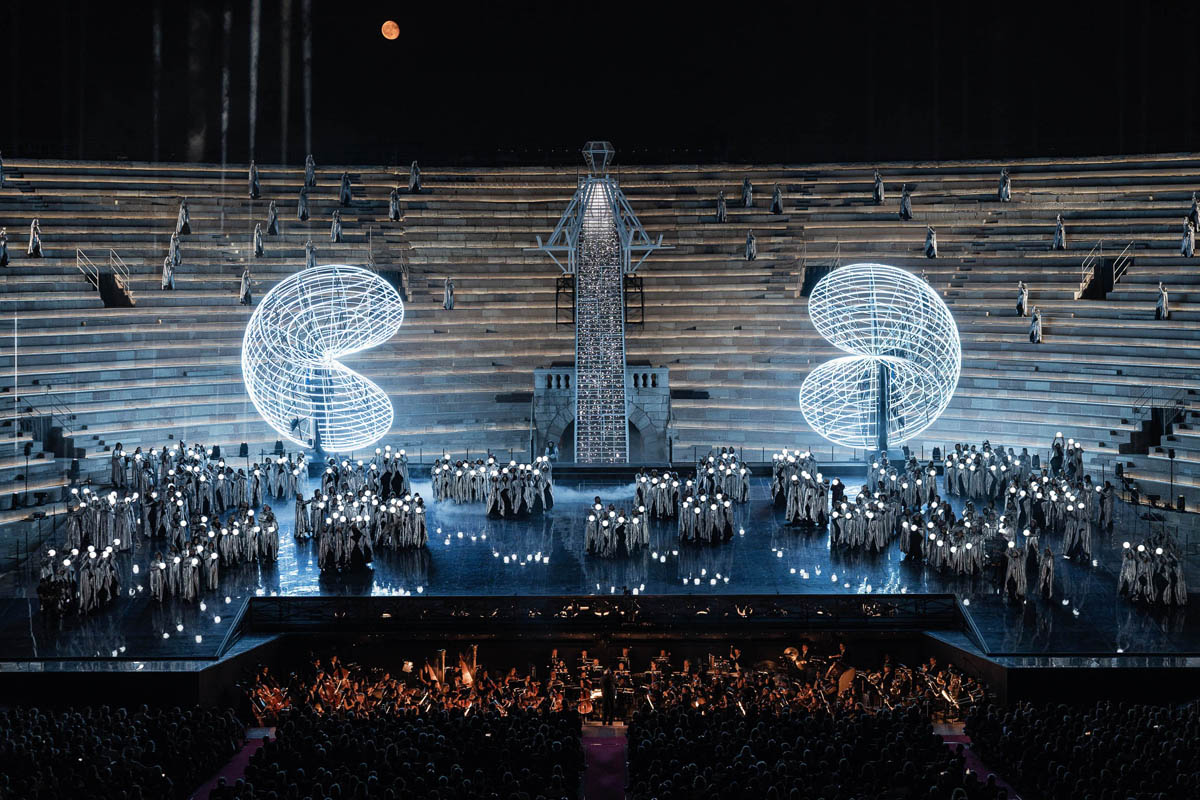
Stefano Poda’s productions for the Arena di Verona are spectacular, making full use of the stage’s spatial dimensions, light, smoke and surprise, all heightened by the sloping Perspex floor. The cultural and symbolic substratum, however, is comparatively thin. The complex conflict between Hebrews and Babylonians is largely reduced to an extended fencing match, a metaphor Poda develops throughout the production. His vision is unmistakably personal, as he is responsible not only for the direction, but also the sets, costumes, lighting and choreography.
The costumes are colour-coded, creating an effective symbolic language, though one that sometimes makes it difficult to distinguish the principals on the constantly crowded stage. The Hebrews wear khaki: the colour of persecution, but also of military uniforms, suggesting they are soldiers of God. Babylonian commoners appear in electric blue and red, producing an overall purple hue, while burgundy signifies legitimate royal authority. Abigaille’s initial purple costume subtly foreshadows her illegitimate birth, while the document revealing her slave origins is cleverly rendered on anachronistic blue paper. Only Nabucco and Fenena wear burgundy. When Abigaille usurps the crown, she adds a burgundy cloak, yet beneath it remains the purple that betrays her true identity. Fenena adopts khaki after her conversion to Judaism and later white, the colour of martyrdom, as she prepares for sacrifice. The fencing metaphor culminates in Nabucco’s cabaletta “O, prodi miei”, when khaki- and purple-clad pairs mimic rapier duels to unintentionally comic effect.
Among the production’s recurring symbols of oppression, the whip is especially prominent, wielded by Abigaille and her female followers, who evoke dominatrices while simultaneously wearing disquieting saint-like halos. The Hebrews are confined within panelled cages, an image later echoed when the disgraced Nabucco is similarly imprisoned.
Poda’s symbolism revolves around time and light. The stage is dominated by a monumental staircase crowned with a giant hourglass bearing the inscription VANITAS, representing the pride of Baal’s followers in contrast with the humility of those who worship Jehovah. The staircase occasionally displays scrolling texts, including Virgil’s Haec olim meminisse iuvabit (“Perhaps one day we’ll enjoy reminiscing about this”), spoken by Aeneas to encourage his companions in exile. Its appearance here, with its Roman rather than Biblical context, is unexpected. Throughout the opera, the Hebrews carry hourglasses as they sing, most poignantly during “Va, pensiero”, suggesting that the time of justice and redemption will eventually arrive. When Nabucco invokes Jehovah to destroy Baal’s idol and save Fenena (“Divin prodigio!”), the giant hourglass opens, the VANITAS inscription disassembles, and a radiant diamond of faith reflects divine light across the stage.
The lighting effects are among the production’s greatest strengths. An artesian burst of fireworks symbolises God’s righteous lightning strike after Nabucco proclaims himself a god rather than a king. Flanking the central staircase, two revolving LED structures illuminate the stage in constantly changing patterns. During the final chorus, “Immenso Jehova!”, every performer carries a glowing orb while wearing a silver cloak symbolising enlightenment. Only the poisoned Abigaille carries an unlit globe. As she repents and implores the forgiveness of the true God, her orb is finally illuminated before shattering in death. In the closing moments, the revolving structures unite to form a sphere, symbolising the perfection of faith.
The star of the evening was Russian soprano Olga Maslova as Abigaille, combining fiendish dramatic power with exquisitely controlled pianissimos to reveal the tragedy of the opera’s most complex character. Possessing a splendid timbre, a vibrant chest voice and unwavering high notes, she is also a compelling actress whose magnetic stage presence dominates every scene.
Making her Arena debut, Italian mezzo-soprano Irene Savignano gave an excellent Fenena, bringing both vocal warmth and dramatic presence to a role that often disappears beneath Abigaille’s brilliance. Francesco Meli was a superb Ismaele, negotiating this demanding role with effortless technique and expressive elegance.
The first half of the opera seemed oddly to lack its title character. South Korean baritone Youngjun Park initially gave a disappointing performance, lacking both stamina and brilliance, with uncertain intonation. Yet after the interval his voice blossomed, and his growing expressive sensitivity culminated in a deeply moving “Dio di Giuda”. A similar transformation occurred with South Korean bass Simon Lim as Zaccaria, whose performance likewise gained authority and emotional depth as the evening progressed.
The cast might have achieved greater cohesion under a firmer baton. Unfortunately, Michele Spotti frequently favoured tempos that were too slow, depriving Verdi’s electrifying score of its momentum and at times leaving the singers sounding constrained rather than supported.
Nevertheless, this was a memorable performance, leaving the audience with the lasting visual impression of Poda’s grand theatrical vision and the enduring memory of Olga Maslova’s dazzling vocal performance.
Nabucco – an Italian-language opera in four acts.
World premiere: Milan, Teatro alla Scala, 1842.
Music: Giuseppe Verdi (1813 – 1901)
Libretto: Temistocle Solera
Based on the Biblical books of 2 Kings, Jeremiah, Lamentations, and Daniel, and on the 1836 play Nabuchodonosor by Auguste Anicet-Bourgeois and Francis Cornu
Director: Stefano Poda
Conductor: Michele Spotti
Principal cast: Youngjun Park, Olga Maslova, Irene Savignano, Simon Lim, Francesco Meli
Duration: 186 minutes (including a 25-minute interval)
Until: 9 September 2026
Photo credit: EnneviFoto