


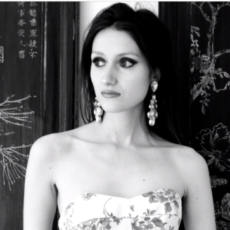
Louis Davison, best known for his roles in BBC’s Poldark series and Tim Burton’s Miss Peregrine’s Home for Peculiar Children (2016), is returning to the stage in a revival of Philip Ridley’s haunting, psychological character study, The Poltergeist.
Directed by frequent Philip Ridley collaborator Wiebke Green, this electrically charged one-man show is an exploration of memory, art, and storytelling. Catch it at the Arcola Theatre from 11 September to 11 October 2025.
OH: Louis, you are performing Philip Ridley’s The Poltergeist at the Arcola until 11th October. Can you tell us what the play is about and what resonated with you upon first reading?
LD: The Poltergeist is a one-man show about Sasha, a young artist wrestling with his past, his relationships, and his inner thoughts. It’s incredibly fast-paced, funny, but also really moving. For me, it examines family, ambition, and the lingering weight of childhood experiences. What struck me when I first read it was how immediate and alive the writing felt. Like all of Ridley’s work, it has this way of making language fizz with energy, but beneath that there’s always a raw honesty about our shared humanity. I knew instantly it was a story I’d love to help tell.
OH: You have collaborated with director Wiebke Green on The Poltergeist, who has a longstanding interest in Philip Ridley’s work and directed the original staging of the play in 2020 at the Southwark Playhouse. Can you tell us about what it was like working together and what you took away from the rehearsal process?
LD: It’s been amazing. Because Wiebke knows Ridley’s work inside out – and having also directed the original production – she’s able to bring a huge amount of insight into the rhythms of Ridley’s text and the world of the play. At the same time, she’s incredibly open to exploration, so the rehearsal room felt very collaborative. Wiebke and Ben Woodhall (our fantastic assistant director) are both extremely precise in their approach to direction – both in Sasha’s language and in the physicality of the characters. With a play like this, where you’re switching between characters so rapidly, clarity is everything, and that precision went a long way in making it work.
OH: The Poltergeist is a deft psychological exploration of anxiety, depression, and social alienation. What have been the most challenging and rewarding parts of tackling these hard-hitting themes?
LD: The biggest challenge is honouring the reality of those themes without slipping into caricature or sentimentality. Sasha’s experiences with anxiety and depression are very real, and as an actor you want to treat that truthfully. At the same time, the play is heightened and almost surreal in places, so balancing those two aspects was a delicate process. The reward comes when you feel the audience connecting – when people tell you afterwards that it resonated with their own experiences, or that it made them feel something.
OH: Since The Poltergeist is a one-man show, you play an eclectic array of characters, often switching between them at lightning pace, but, nevertheless, they always feel fully realised. What is this experience like for you as an actor? And do you have a character you most enjoy playing?
LD: It’s both exhilarating and exhausting – a bit like running a marathon while juggling. You never get a moment to drop focus. But it’s also a rare privilege as an actor to inhabit so many different voices and perspectives in a single evening. I love the challenge of making each one distinct while still keeping the story flowing as a whole. As for a favourite character aside from Sasha – I’d say either Dougie, an overly excited party guest, or Chet, Sasha’s level-headed boyfriend. There are too many to choose from!
OH: You’ve had great success on film and television but the stage contains its own magic and ways of working. What makes theatre special for you?
LD: What excites me about theatre – especially with a play like The Poltergeist – is that once you begin the very first line, there’s no pause button or retake. The only way out is through to the very last line. It’s relentless, but that’s what makes it so thrilling. You have to completely throw yourself into the characters and the story with no breaks or safety nets, and the audience comes with you on that journey in real time. That level of intensity and story commitment doesn’t exist in quite the same way on TV or film. On stage, it’s alive, it’s immediate, and it demands everything from you – which is exactly why I love it.
Book tickets now on the Arcola Theatre website.