


End of the World and Hard-Boiled Wonderland
The English interview is followed by a French-language summary highlighting Philippe Decouflé’s reflections on the production.
Haruki Murakami’s Hard-Boiled Wonderland and the End of the World is hardly an obvious candidate for theatrical adaptation. Its parallel realities, interior landscapes, mysterious creatures and shifting relationship between consciousness, memory and identity present challenges that are difficult enough on the page, let alone within the physical confines of a stage.
For French director and choreographer Philippe Decouflé, however, that apparent impossibility was part of the attraction.
When producer Miyako Kanamori first suggested adapting Murakami’s novel, Decouflé read it thinking that it would be extraordinarily complicated, “perhaps even impossible”, to stage. Yet that was precisely what began to excite him.
“I felt there had to be a theatrical way to make these worlds coexist,” he explains, “to have the entire adventure unfold within the confines of the stage.”
From the outset, the idea was not to create conventional theatre. Kanamori envisaged something between dance and drama, in which movement itself would carry part of the narrative. And Murakami’s extraordinary creatures – particularly the unicorns and the subterranean beings – immediately appealed to Decouflé.
“I love working with the bizarre,” he says.
Finding a theatrical language for Murakami
Was there a particular image or idea in the novel that unlocked the production, or did Decouflé have to invent an entirely new theatrical language?
The brief from HoriPro was ambitious: to create a new form somewhere between theatre and dance – highly visual, accessible to a broad audience, respectful of Murakami’s novel and capable of bringing different artistic disciplines together.
Decouflé describes the result as something resembling “a musical, or an opera without songs”: a theatrical and musical experience in which different art forms continually intersect.
The aim, he says, was “to create something genuinely new”.
That hybridity seems particularly appropriate to a novel which, although published in 1985, now carries some unexpectedly contemporary resonances. Murakami imagined information being encrypted within the human brain decades before our present preoccupation with artificial intelligence, surveillance and algorithmic control.
Decouflé did not attempt to update the world of the novel. Instead, he enjoyed embracing its period technology.
People still speak on corded telephones; if they need to contact someone while away from home, they must find a telephone box. The production therefore belongs simultaneously to the present and to the technological world of 1985.
Yet Decouflé acknowledges that the parallels with our own age can be unsettling.
“There is indeed something troubling when compared to our current world,” he says, “and I believe that is also what makes the show interesting.”
Two worlds on one stage
At the heart of Murakami’s story are two apparently separate worlds: a futuristic Tokyo shaped by information and technology, and a mysterious walled town in which people are separated from their shadows and memories.
How can those worlds be made immediately perceptible in a theatre without explaining away their mysteries?
Decouflé’s solution begins with colour.
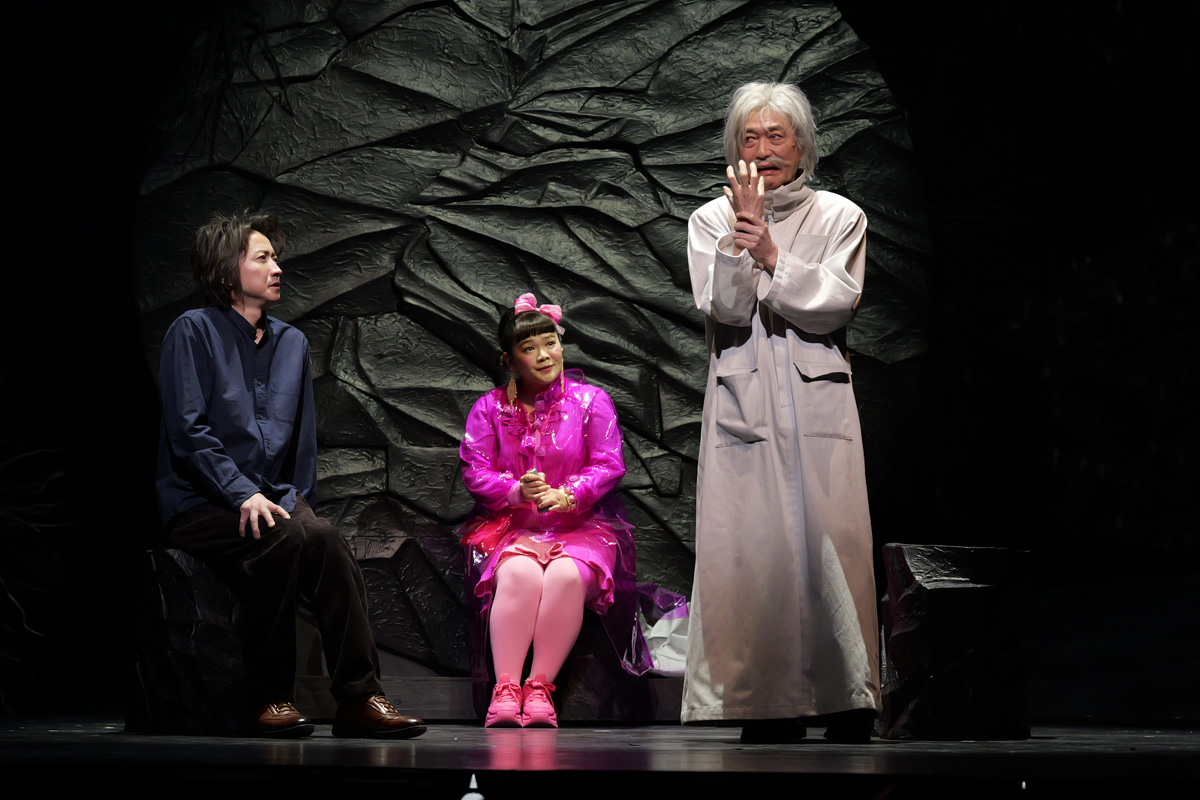
The ostensibly “real” world is treated largely in black and white, while the fantasy world is rendered in colour. But, like almost everything in Murakami’s universe, the distinction is not absolute. Fantastical elements continually infiltrate the supposedly realistic world.
The two realities gradually interpenetrate, just as they do in the novel. Decouflé sought to reproduce that experience by initially presenting what appear to be hermetic fragments of different stories, allowing their relationship and meaning to emerge progressively.
“I hope it works,” he admits, conscious that the story remains complex even when its theatrical architecture rests upon the confrontation of two universes.
The distinction between black and white and colour is partly practical. The “real” world is predominantly urban: Tokyo, underground spaces and subterranean settings naturally lend themselves to a more monochromatic visual language. The fantasy world offers much greater freedom with colour.
Even here, however, Decouflé deliberately breaks his own rules. Pink belongs to the black-and-white world, yet she is dressed in pink from head to toe.
Such contradictions are important to him. He has no desire to dictate precisely how an audience should respond to every visual decision.
“For me, a show is like a flea market,” he says. “There are many stalls, and plenty of things to see, taste and choose from.”
Each spectator, depending on his or her own sensibility, will be drawn towards something different.
Bodies, shadows and the unconscious
Does the human body itself behave differently within these two worlds?
Decouflé describes his approach as an attempt to create a physical, body-based theatre. Actors and dancers worked extensively with movement in both realities, but Murakami’s dream world offered one particularly fertile theatrical possibility: the separation of a character from his shadow.
That idea allowed Decouflé to explore the relationship between a performer and a shadow that has acquired an independent existence – and, more broadly, to experiment with different ways of creating shadows, both genuine and artificial.
“The dream world opened up a vast surrealist landscape,” he says.
That physical and visual vocabulary also offered a solution to one of the most difficult problems in adapting Murakami: so much of the novelist’s work takes place inside the mind.
In the novel, even the protagonist has no conventional name. Characters become “I”, “me”, “my shadow”, “myself”. For Decouflé, this creates a central figure who is simultaneously everyone and no one: someone with whom the audience can identify as he wanders through an unstable world, struggling between dream and reality.
Rather than literalising his thoughts, Decouflé draws upon virtually every theatrical language available to him – music, video, optical effects, dance, movement, changing scenery and, crucially, light.
“I play with all these elements,” he says, “to try to evoke emotion.”
Being faithful without being imprisoned by the novel
The adaptation itself was developed with Ako Takahashi, who faced the formidable task of reducing Murakami’s novel to something that could live on stage.
There were several versions. Decouflé repeatedly returned to the novel, noting passages, dialogue and moments that he regarded as essential. He and Takahashi then worked from those notes, reshaping the text before rehearsals and continuing to alter it once the actors entered the process.
Scenes that proved too long were shortened; others required greater clarity or rhythm. Takahashi, Decouflé says, oversaw that continuing process to ensure that the production remained gripping.
But how does one remain faithful to Murakami while allowing the theatrical work to develop an independent existence?
“Is it faithful to Murakami’s work? I hope so,” Decouflé says.
What mattered was respect – for both the author and his work. Murakami had entrusted Kanamori with the stage adaptation, and she in turn asked Decouflé to direct it. For him, that chain of trust also meant that his own visual imagination was expected to play a part.
He allowed the images generated by his reading to emerge freely and drew extensively, producing sketches through which the production’s strongest visual ideas could begin to take shape.
A musical without songs
Music is another essential part of this theatrical world.
Murakami’s writing is itself saturated with music, and the creative team began with pieces explicitly mentioned in the novel before developing the production’s different worlds through music, scenery, costume and movement.
For a choreographer, the relationship is instinctive.
“Music and dance are closely related art forms,” Decouflé says, “permeable to one another.”
The same freedom extends to Murakami’s non-human creatures. Asked how he choreographs beings without recognisably human physicality, Decouflé points out that this territory is hardly unfamiliar to him.
“For a long time, I have enjoyed creating choreographies featuring imaginary microbes, plants or animals.”
The beautiful, fragile unicorns and the monstrous subterranean creatures consequently became a source of pleasure rather than intimidation.
Costume, too, contributes to the creation of these distinctive beings and personalities. Decouflé designed some of the costumes himself, while others were created by costume designer Ayako Maeda. Rather than simply dressing the performers, costume becomes another element in constructing the visual identity of the characters.
At the centre of the production is Tatsuya Fujiwara as Watashi. Decouflé describes him simply as “a remarkable actor” who immediately understands direction and works with exceptional efficiency and professionalism.
A moment of escape
For all the conceptual complexity of Murakami’s novel – its questions of consciousness, memory, technology and identity – Decouflé ultimately resists telling an audience what it ought to understand.
His ambition is at once simpler and, perhaps, more theatrical.
What would he most like spectators to carry with them when they leave – not an explanation of the story, but a feeling, an image or a question?
He wants audiences, whether they have read Murakami’s novel or not, to experience “a moment of escape and freedom”.
This hybrid creation, he says, ultimately has no greater purpose than to offer “a moment of happiness, a suspended bubble that transports you somewhere else, far away.”
Perhaps that is the key to Decouflé’s approach to Murakami. Faced with a novel that initially seemed almost impossible to put on stage, he has not attempted to explain away its strangeness. Instead, he has embraced it – through bodies and shadows, black and white and colour, music and movement, reality and dream – and invited the audience to enter it.
End of the World and Hard-Boiled Wonderland
Haruki Murakami / Philippe Decouflé
Thu 8—Sun 11 Oct 2026
Philippe Decouflé : entre rêve, mouvement et théâtre
Adapter La fin du monde et Hard-Boiled Wonderland de Haruki Murakami à la scène relevait presque de l’impossible. C’est précisément ce défi qui a séduit Philippe Decouflé.
Lorsque Miyako Kanamori lui propose le projet, le metteur en scène et chorégraphe commence par lire le roman en se disant qu’il sera « très compliqué, voire impossible, à monter ». Mais cette difficulté devient rapidement une source d’excitation : il doit exister, pense-t-il, un moyen théâtral de faire coexister ces différents univers dans l’espace d’une scène.
Dès le départ, le projet est conçu comme une forme hybride, à mi-chemin entre danse et théâtre, dans laquelle une partie du récit passe par le mouvement. Decouflé évoque « une sorte de comédie musicale, ou d’opéra sans chansons » : un spectacle où musique, théâtre, danse et arts visuels se rencontrent pour inventer un langage nouveau.
Cette liberté lui permet d’aborder les deux univers parallèles imaginés par Murakami. Le monde dit « réel », largement urbain et souterrain, est principalement traité en noir et blanc, tandis que le monde fantastique se déploie davantage en couleurs. Mais Decouflé se garde d’établir des règles trop rigides. Pink, par exemple, appartient au monde en noir et blanc tout en étant vêtue de rose des pieds à la tête.
Les deux univers ne sont d’ailleurs jamais totalement séparés. Comme dans le roman, ils s’interpénètrent progressivement. Le spectacle assemble d’abord des fragments d’histoires qui peuvent sembler hermétiques avant que leurs liens ne deviennent peu à peu perceptibles.
Decouflé refuse cependant d’imposer au spectateur une interprétation unique. Il compare volontiers le spectacle à « un marché aux puces » : de nombreux étals, une multitude de choses à voir, à goûter et à choisir. Chacun peut ainsi être touché par un élément différent selon sa propre sensibilité.
Le corps occupe naturellement une place centrale dans cette transposition. Decouflé explique avoir cherché à créer « un théâtre corporel, physique », en travaillant le mouvement des acteurs et des danseurs dans les deux mondes. La séparation des personnages et de leurs ombres, dans l’univers onirique, lui offre notamment un vaste terrain d’expérimentation : l’ombre peut devenir indépendante du danseur, réelle ou artificielle, et participer pleinement au récit.
« Le monde onirique a ouvert un vaste champ surréaliste », explique-t-il.
Cette approche permet également de rendre visible l’intériorité si présente chez Murakami. Les personnages du roman n’ont pas véritablement de noms : ils sont « je », « moi », « mon ombre », « moi-même ». Le personnage principal devient ainsi, aux yeux de Decouflé, à la fois tout le monde et personne – un homme qui erre entre rêve et réalité.
Pour traduire cette vie intérieure, il mobilise toutes les ressources du théâtre : musique, vidéo, effets d’optique, danse, mouvement, changements de décor et surtout lumière. Tous ces éléments sont mis au service d’un même objectif : créer des émotions plutôt qu’expliquer.
La fidélité à Murakami reste néanmoins essentielle. Ako Takahashi a effectué un important travail d’adaptation, tandis que Decouflé a relu le roman plusieurs fois, relevant les passages, dialogues et moments qui lui paraissaient indispensables. Le texte a ensuite continué d’évoluer au cours des répétitions, selon les besoins des scènes et des interprètes.
« Est-ce fidèle à l’œuvre de Murakami ? Je l’espère », confie-t-il. Ce qui compte avant tout pour lui est le profond respect porté à l’écrivain et à son univers, tout en laissant surgir les images que sa propre lecture du roman lui inspirait. Decouflé a d’ailleurs beaucoup dessiné, utilisant ses croquis pour donner forme aux images fortes du spectacle.
La musique joue elle aussi un rôle fondamental. Omniprésente chez Murakami, elle constitue l’un des points de départ de la création. Les morceaux évoqués dans le roman ont nourri le développement des différents univers, conjointement avec les décors, les costumes et le mouvement. Pour Decouflé, « la musique et la danse sont des arts proches, poreux l’un à l’autre ».
Même les créatures les plus étranges de Murakami trouvent naturellement leur place dans son imaginaire chorégraphique. Habitué depuis longtemps à inventer des mouvements pour des microbes, des plantes ou des animaux imaginaires, Decouflé dit avoir pris beaucoup de plaisir à travailler sur les licornes, « belles et fragiles », ainsi que sur les inquiétantes créatures souterraines.
Au centre de cette construction visuelle et physique, Tatsuya Fujiwara incarne Watashi. Decouflé le décrit comme « un acteur remarquable », capable d’intégrer immédiatement les indications qui lui sont données et faisant preuve d’une grande efficacité et d’un profond professionnalisme.
Mais derrière toute la complexité de l’univers de Murakami, Decouflé poursuit finalement un objectif d’une grande simplicité. Il ne cherche pas à ce que le spectateur quitte la salle muni d’une explication définitive du récit.
Il souhaite plutôt lui faire partager, qu’il ait lu le roman ou non, « un moment d’évasion et de liberté ».
Le spectacle hybride n’aurait, au fond, pas d’autre ambition que d’offrir « un moment de bonheur, une bulle suspendue qui vous emmène ailleurs, loin ».