



We met after I saw her magnificent production of Verdi’s Un Ballo in Maschera (A Masked Ball) at Opera Holland Park. This marked her third collaboration with the company, following Tchaikovsky’s The Queen of Spades (2016) and Verdi’s La Traviata (2018).
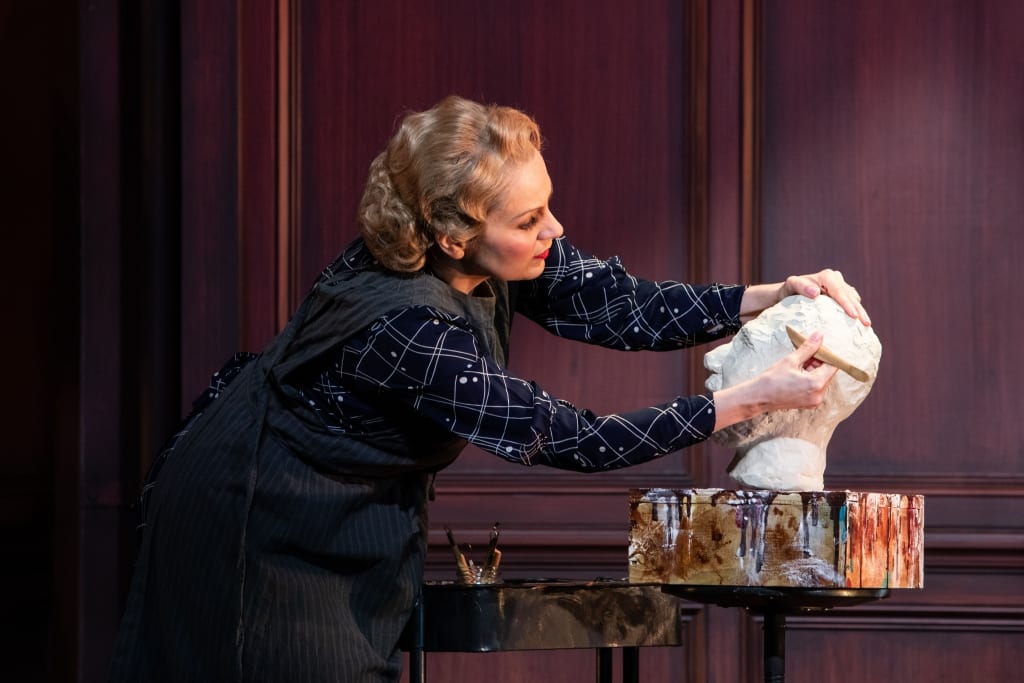
Her 2016 Queen of Spades earned glowing reviews, with critics calling it “compelling.” Two years later, her Traviata was described by David Mellor as “one of the most moving Traviatas I have seen.” The Guardian’s Tim Ashley praised its opening: “Rodula Gaitanou’s new production opens not with Verdi’s prelude but with the alarming sound of laboured breathing… a provocative start to a thoughtful, troubling interpretation.”
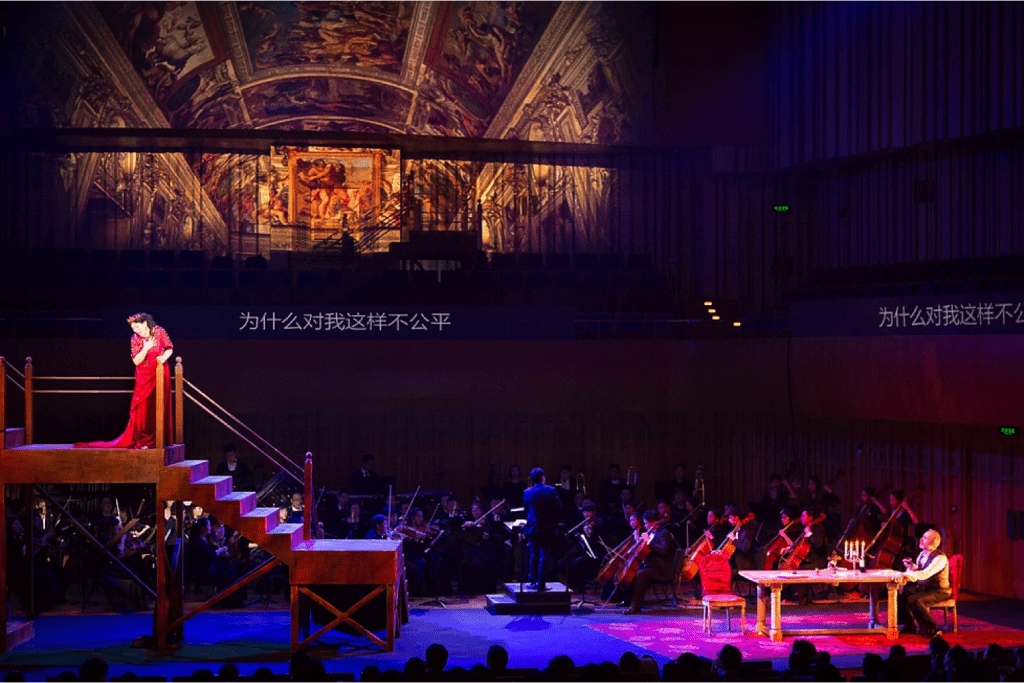
Rodula was born in Greece, studied in France, and now lives in the UK. Her work spans continents—from Europe to the U.S., Australia, and East Asia. In 2015, she staged the first-ever Western opera in Xi’an, China—an ancient city with 8,000 years of history. “It was mind-blowing,” she recalls. She speaks fondly of directing Tosca there and is inspired by the scale and ambition of China’s new opera houses.
Her young son, she jokes, “has the score of Pagliacci in his DNA,” having heard it before and after birth during her multiple productions of the opera.
Rodula’s musical roots run deep: her father was Artistic Director of the Greek National Opera, her mother a piano teacher, and her sisters are both professional musicians. “From the age of six, we went to the opera every night,” she remembers.
Her passion lies in the fusion of music and drama. “An opera director must be able to read music,” she insists. “You can’t truly grasp the work otherwise.” That belief shaped her early career: at 21, she directed Monteverdi’s Orfeo in its full, uncut form while still at university. “We had to create something from nothing—it taught me everything.”
She has a particular affection for East Asia, especially China, where she directed Tosca. In 2015, she staged the first-ever Western opera performance in Xi’an—an 8,000-year-old city and former Chinese capital. “It was mind-blowing,” she recalls. The new opera houses sprouting in Chinese cities reflect a serious governmental commitment to this art form.
When asked how she begins working on a new opera, Rodula is clear: “I always start from the score. The music gives me a full sense of the drama, while the libretto gives me maybe 70%. Even before reading the words, I listen. I don’t speak Russian, for example, but I instinctively react to the music. Then comes the marriage of words and sound. The third layer is visual imagining the world the music evokes. Music doesn’t always express drama in the obvious way. Sometimes, a powerful moment is written not as a crescendo, but as something small and restrained. That’s what fascinates me—the unspoken lines, the subtext. That’s where the juice is. What’s underneath the musical layers is often what matters most”.
Locating the Drama
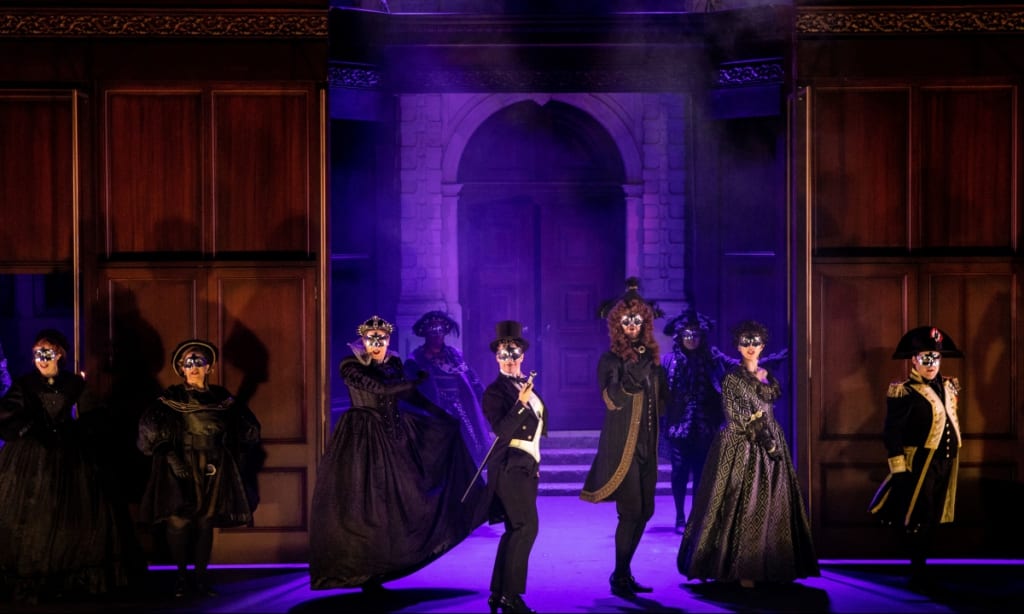
“For me, opera is all about storytelling. The drama comes from the characters. You can place the story anywhere in time or geography—that freedom is essential. Once I narrow down the possibilities, a world starts to form. In Un Ballo in Maschera, for example, we set the story in a 1930s fencing school. The opening chorus is full of soft, lyrical lines—but there’s danger running underneath. That tension is always present, even when people seem at ease. I wanted to show a society at peace, yet quietly preparing for violence. You hear these sweeping legato lines, and then—suddenly—the conspirators enter with sharp, staccato music. It’s a brilliant contrast from Verdi, and I wanted to reflect that musically and visually. The idea of the masque was key: fencing masks hide faces. You don’t know who your opponent is until the end, just like in the story. It became a central metaphor for identity, deception, and betrayal.”
Character, Gender and Emotion
Rodula assumes audiences often know the plot. Her challenge is to make the familiar feel real. “It’s not just about what happens—it’s about making it believable. For example, when Ankarstrom finds his wife with the king in Un Ballo, it’s like walking in and finding your best friend in bed with your partner. It has to feel like a bomb going off—but it also has to be grounded” She explains. “Characters don’t come to me fully formed. They grow. The king, for instance, became someone impulsive, emotional—not a born leader. The conspirators exploit his vulnerability. Yet he’s not weak. He’s bold. When Ulrica predicts his death, he welcomes it. That contradiction makes him human” she adds.
Female Vs Male characters
“Opera has long served women well. Despite being written by men, many operas put strong female characters at the centre. I don’t direct them as victims—unless the story demands it. In Un Ballo, Amelia doesn’t appear for the first 45 minutes. But when she does, I give her depth. I ground her emotionally. That gives her strength. I often find that tenors—the lovers or heroes—are more one-dimensional. You have to dig to make them human. Baritones, who often play the villains, have more juice. And voice type matters. A mezzo-soprano brings different vocal colours than a soprano, and that shapes the character’s emotional world. Sometimes a character says one thing, but the music reveals what they really mean” she explains.
To my question about the female characters assigned to mezzos singers Rodula replies “That’s an interesting question, I think the choice for the vocal type always comes with a choice for the colours that you want to have, and the different colours are always linked to intentions. So I think, undoubtedly, you do think of a character by putting a lot of things in the mix, one of them is exactly what sort of colours they bring, and what their music suggests. But a lot of the time, you have one thing said and another thing meant. Not always do they mean what they say, and the music is there to show you what they truly believe. I think the voice-type is undoubtedly an element that dictates where you’re going to take the character“.
There is a ‘comic’ character that defuses tension and adds humour in the unfolding dark narrative of this opera. It is the King’s page, Oscar, superbly performed in this production by Alison Langer. Rodula explains that ‘Verdi throughout the piece, has a foot in comedy and a foot in tragedy. So it’s a very fine balancing act. We go from extremely tense dramatic moments into things that suddenly lighten up the whole thing. Oscar is the only one we encounter – a woman portraying a man. The intention originally, I think, is to follow the idea of the masque and disguise the voice into a character that, for me, is very ambiguous. Is Oscar a woman or a man? It’s not a question I want to answer. It’s a character with many facets and has to be strong enough to hold the comic element.’
What’s Next
Rodula’s upcoming season is full of variety. She will direct Don Quichotte at Wexford Festival Opera, a new Un Ballo in Maschera in Germany, La Clemenza di Tito in Norway, and Carmen in St. Louis, USA.
You’re staging Un Ballo again. Will it feel different? I asked.
“Completely. The music and libretto are the same, but the world and storytelling will be new. My appreciation of the piece hasn’t changed, but my approach has. That’s the beauty of opera—you can keep rediscovering it” she says with a smile.
Rodula Gaitanou’s production of Lucia di Lammermoor was nominated for Best Opera Production in the CPH Awards (Denmark 2019). Her production of Barber’s Vanessa was nominated in the Irish Times Theatre Awards in the “Best Opera” category (Ireland 2017). She was nominated for two Helpmann Awards (Australia 2013) in the “Best Opera Director” and “Best Opera Production” categories for her production of L’isola disabitata presented at the Hobart Baroque Festival.
This conversation with Rodula Gaitanou opens a window into the creative heart of opera. For young people especially, it shows that opera isn’t frozen in time—it’s alive, evolving, and open to new interpretations. At its best, it’s a living art form that grows with those who shape it.