

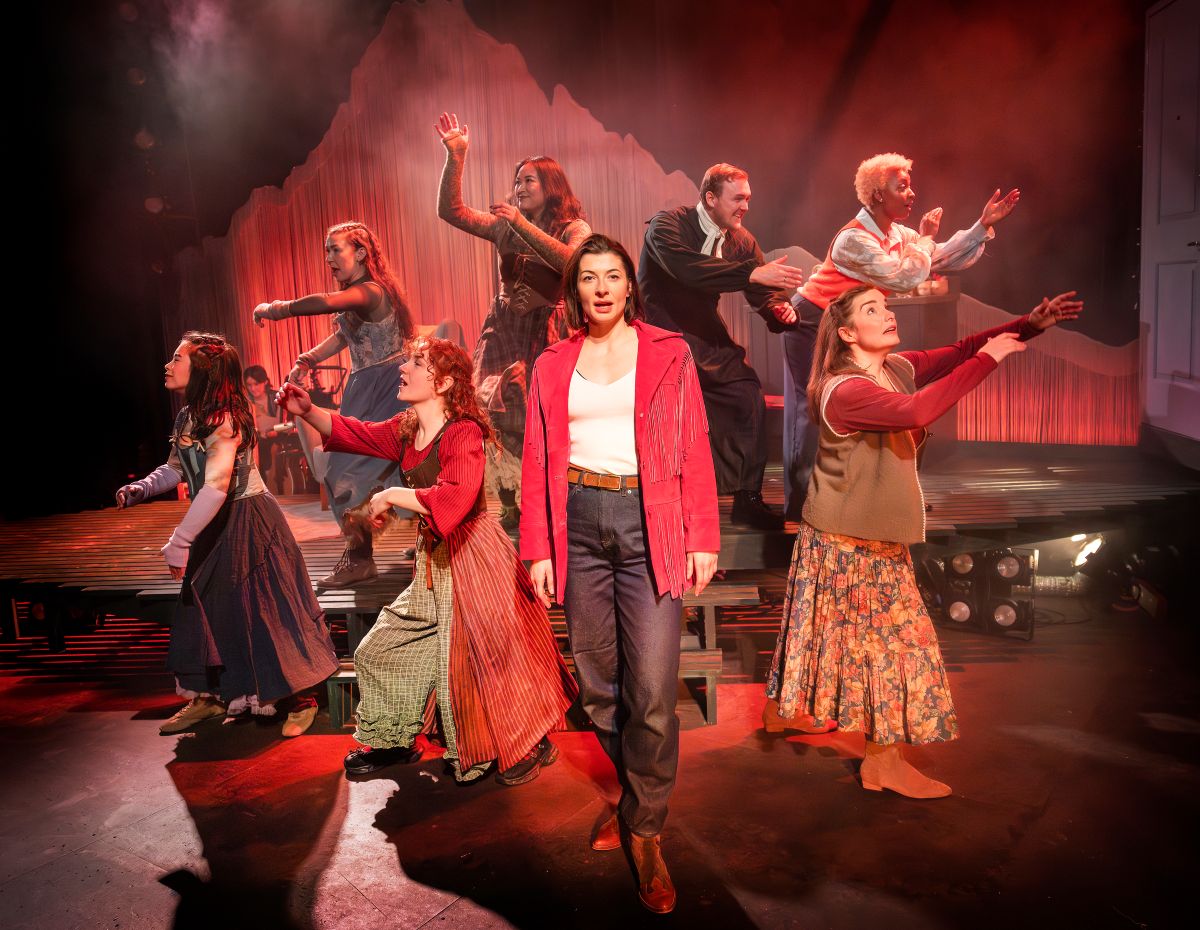

This glorious show is labelled “a folk musical”, and the description fits beautifully. It tells the stories of a line of women who link Scotland, Ireland and America, using folk songs and ballads that have crossed seas and oceans, changing and evolving as songs inevitably do when passed from one generation to another through oral tradition. At its core is a portrayal, across different eras, of women facing the struggles of conceiving – or not conceiving – children. Through both its interwoven narratives and its ancient and modern songs, the work is moving and deeply inspiring.
Sarah and Alix are young women in love, setting up an apartment together in New York. Sarah brings with her a large box left by the aunt who brought her up, and from whom she had become estranged. Persuaded by Alix not simply to throw it away, she begins to explore its contents. The box turns out to contain a set of audio tapes, telling in song and speech the stories of a series of women who struggled to assert control over their choices: who to love, and whether to have children. Among them are Kait, the wife of a minister in sixteenth-century Scotland; Jean, a young woman in eighteenth-century Ireland who chooses to have a baby out of wedlock; and Betty, raising children who are not her own in twentieth-century West Virginia. Listening to these tapes awakens in Sarah a compelling desire to have a child herself, and to test what she truly wants from her relationship.
The stories are told by a group of eight actor-singers, all of whom have their moment in the spotlight while working together brilliantly, particularly in the ensemble singing. The relationship between Sarah and Alix is the central focus, and both France McNamee as Sarah and Sydney Sainte as Alix are consistently convincing. McNamee perhaps has the most fully drawn character in the piece, and she is utterly compelling as she charts the shifts in Sarah’s sense of self as she learns about the women who came before her and the struggles they faced. As a singer, she is outstanding.
Kirsty Findlay, playing Kait, is a singer of enormous power and passion; her solo is the moment when the folk roots of the music feel most vividly present. Her conflict with a pious, though not unloving, husband is deeply moving. Yna Tresvalles and Sian Louise Dowdalls, as sisters Jean and Shona, are tremendous, bringing to life the penalties faced by free-spirited women across the ages — penalties that still resonate today. Ally Kennard is versatile and convincing across a range of male roles. I would have welcomed more insight into the life of ‘redneck’ Betty, played by the impressive Rebecca Trehearn, whose box of tapes sets Sarah on the road to self-awareness; Betty’s country-music ballad was one of the evening’s highlights.
Although there are many sharp and telling individual performances, it is the ensemble work — both the harmony singing and the frenetic dancing — that lifts the piece to its highest moments. Director Tania Azevedo keeps the action buzzing and manages the complex shifts in time with real finesse. At times I wondered whether the tight spaces of the new Southwark Playhouse Elephant Theatre might limit her evident enthusiasm for choreography that reinforces the life and power of the music and story. Yet the abiding memory is of a musical theatre piece of real impact, with a moving story to tell.
The ways in which songs and stories travel back and forth between the mountains of Scotland, Ireland and Appalachia might have been given slightly more attention on stage — though this connection is foregrounded in Azevedo’s programme note — but the force of the women’s stories gives the whole show its emotional truth. It is, in every sense, a great night at Southwark Playhouse.
Music, Lyrics and Book: Finn Anderson and Tania Azavedo
Director: Tania Azavedo
Musical Director: Shonagh Murray
Performers incl: Frances McNamee, Rebecca Trehearn, Kirsty Findlay, Sydney Sainte
Running time: 2 hours 25 Minutes
Dates: until 21 March 2026
Photographs: Pamela Raith