

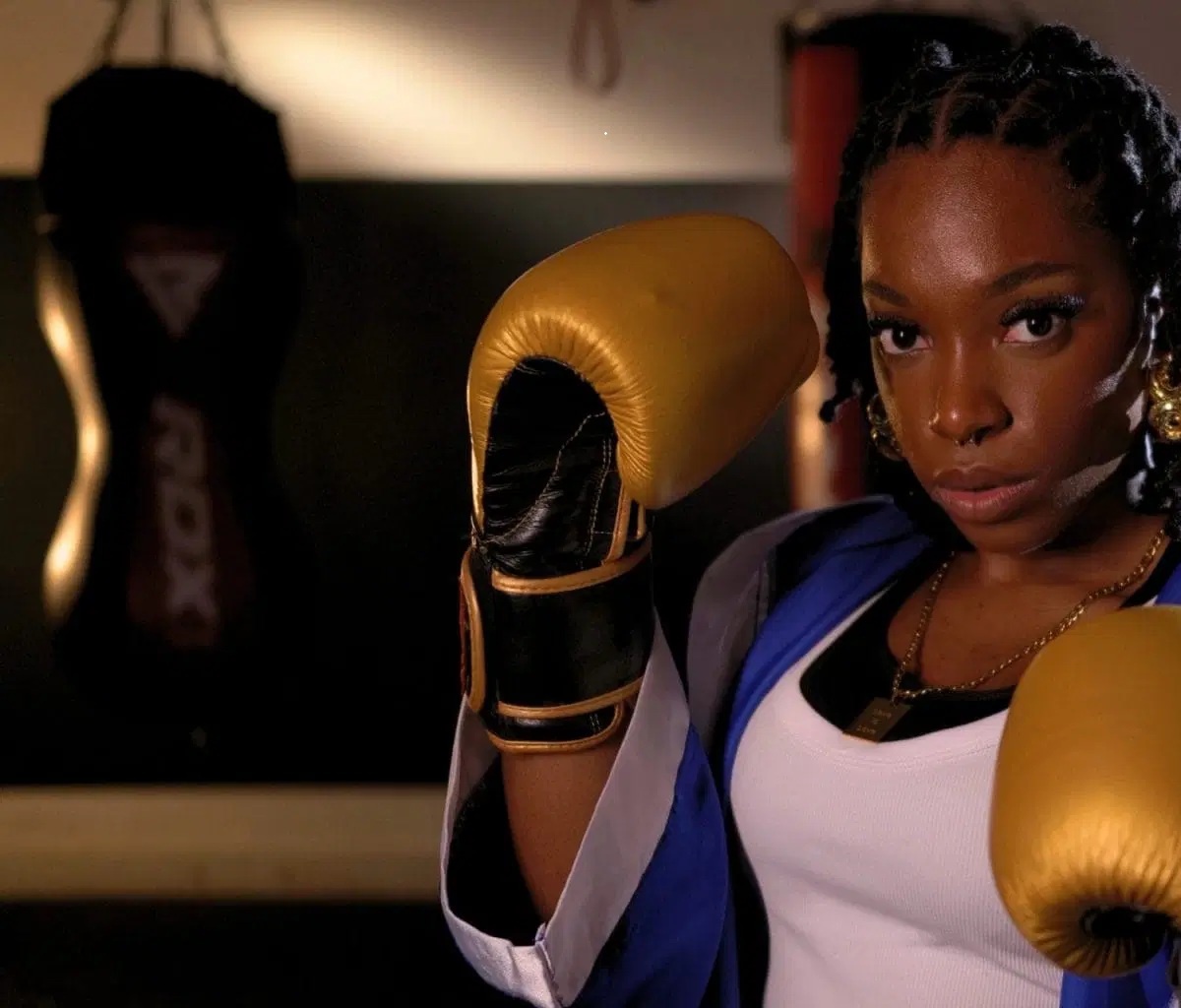

From the name alone, Bitch Boxer immediately intrigues. That intrigue grows when it becomes clear that this is a one-woman production, something that can be difficult to visualise if solo theatre is not usually your preference. Running at the Arcola Theatre from February to March, the play stars Jodie Campbell in a one-woman story about love, family and what the production describes as “smashing society’s expectations.”
The play runs for just under an hour without an interval. At its centre is Chloe (Campbell), a young boxer determined to honour a dream she once shared with her father: attending the Olympics together. After his death, Chloe channels her grief into training, trying to remain strong as she pushes forward alone.
The production opens strikingly. Chloe skips silently in a dimly lit boxing ring placed centre stage, the rest of the theatre in darkness. The moment feels deliberate: the audience observes Chloe in motion before they truly know her. In these opening scenes, written by Charlie Josephine, Chloe emerges as upbeat, determined and quietly resilient. The early moments sketch a young woman whose identity is bound up with boxing and with her relationship with her father.
News of her father’s death arrives quickly, however, and the audience is left largely guessing at the circumstances. Because the play provides limited introduction to him as a character, and only a brief glimpse into Chloe’s relationship with him, the emotional impact feels muted. Campbell’s reaction to the loss remains restrained to the point of feeling somewhat flat, leaving the audience with little emotional grounding in the moment.
As the play progresses, this lack of emotional depth becomes its most noticeable weakness. Grief, resilience and the process of rebuilding one’s life are immense themes, and compressing them into a 60-minute runtime proves challenging. There are moments where the writing shines. Chloe’s irritation at the flowers piled at her father’s funeral, despite the fact that he never liked them, captures something truthful about how rituals of mourning can miss the mark. A later scene in the gym, where Chloe briefly reveals how overwhelmed she feels, offers another glimpse into the emotional landscape the play attempts to explore. Yet these moments are fleeting, and the production rarely pushes much deeper.
Alongside grief, Josephine introduces themes of love and sexuality through Chloe’s relationship with her girlfriend, Jamie. The play moves quickly between moments in their relationship as it develops, with Campbell shifting between characters to recreate conversations and social scenes. One night-out sequence proves particularly ambitious, requiring Campbell to play Chloe, Jamie and several friends in quick succession. Her performance remains technically strong, but scenes like this feel slightly awkward and disjointed, momentarily pulling the audience out of the story.
The play’s final scene, however, is its most compelling. Chloe finally steps into the ring to fight, and Campbell’s physical performance takes centre stage. Through movement alone, she convincingly conjures an opponent who is never actually present. For a solo performer commanding the stage without assistance, it is an impressive display of control and energy, and a reminder of the powerful theatrical possibilities the production hints at throughout.
The staging remains simple throughout, with the boxing ring doubling as a nightclub, a set of fences and, of course, the boxing gym itself. The sound design plays an important role in supporting the solo performance, helping to transform the space and allowing the audience to believe in the shifting locations.
A one-woman production is demanding at the best of times, and here both the writing and performance struggle to sustain the piece. Josephine’s script aims to explore themes of grief, love and identity through the straightforward premise of someone training towards a goal. Yet despite flashes of promise, the execution never fully comes together, leaving the overall production feeling somewhat underwhelming.
Production Information
Arcola Theatre
Drama
Title: Bitch Boxer
Writer: Charlie Josephine
Director: Prime Isaac
Designer: Ross Kernahan
One woman show: Jodie Campbell
Until 14 March
Duration: One hour (no interval)