
Johann Strauss II’s Die Fledermaus has never pretended to be a tightly engineered farce. Champagne is the engine. Liam Steel’s new production for Opera Holland Park seems perfectly content with that arrangement. This production works in the English adaptation with lyrics by Jeremy Sams and dialogue by Douglas Carter Beane. Fledermaus’s game is now set in 1920s London, not 1874 Vienna.
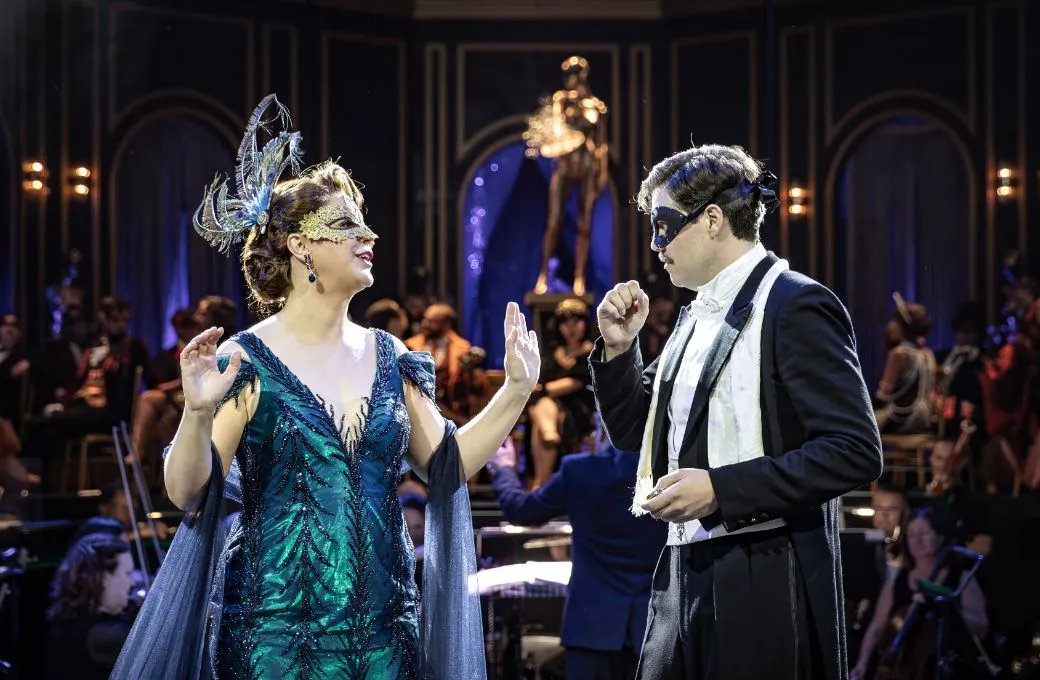
The first thing to catch the eye is Neil Irish’s split-level set. Opera Holland Park’s unusual stage has always rewarded productions willing to embrace its mechanics rather than disguise them. Stagehands weave in and out with furniture, walls unfold in plain sight, and the company races to complete the changeover in time for the overture’s final flourish. Seeing the transformation from the Eisensteins’ drawing room to Orlofsky’s ballroom, then onwards to the prison is part of the entertainment, very in tune with the operetta’s obsession with performance.
The music – the very score which makes Strauss’s operetta fizz – is conducted beautifully with a light touch by George Jackson and the cast pulls it off marvellously.
Act One is especially buoyant. Von Eisenstein, his wife Rosalinde, and their chambermaid Adele circle one another as their synchronised gestures hint at the web of lies they’ve weaved, giving the domestic chaos a whimsical rhythm. Tenor Thomas Atkins takes a little while to settle into Eisenstein’s swagger, though by the final act his comic timing has loosened beautifully. His relationship with Rosalinde becomes oddly endearing simply because both characters embrace the absurdity surrounding them. Elegant as the Hungarian countess, plaintive as the neglected wife, comically outraged as the foiled schemer, Alison Langer’s Rosalinde carries effortless authority with gleaming top notes and a warmly expressive middle register. Rebecca Bottone’s Adele is completely unwilling to be intimidated by her surroundings. Her crystalline soprano dispatches the coloratura in “Mein Herr Marquis” with much relish, reminding the viewer Adele is a most ambitious social climber.
Baritone Julien Van Mellaerts is the production’s musical standout as Dr. Falke (the long-suffering Fledermaus), playing both the gracious host and mischievous architect of the entire evening’s chaos with perfect elegance. Tenor Xavier Hetherington’s Alfred is equally invaluable. His relentless operatic grandstanding provides the evening’s earliest genuine laughs, continuing cheerfully even from his prison cell with a laudable burst of “Nessun dorma”. Robert Burt’s Frosch earns easy goodwill with contemporary jokes and policing the audience as unofficial front-of-house manager.
Prince Orlofsky, sung with cool authority by mezzo-soprano Clare Presland, becomes a woman, a change that settles naturally into the production. What proves more surprising is that Die Fledermaus still treats Orlofsky as an immensely wealthy Russian aristocrat whose money can bend every social rule in the room, an exotic curiosity whose melancholy is amusing rather than troubling. The opera has always traded on this caricature, certainly, but the question is why it still must today. As Russian wealth and influence have increasingly become subjects of serious public debate here in “Londongrad”, it is curious that this is one stereotype it leaves entirely intact while it’s proven capable of rethinking other parts.
More baffling still is the newly introduced dancer in a bat costume, seemingly embodying the Fledermaus as a concept separate from Dr. Falke. The silent bat drifts through the production delivering invitations and apparently nudging events towards disaster – a Cupid for strife. It’s an intriguing image, particularly in the final tableau the company gaze towards the dancer suspended upside down above the prison. Even so, the extended opening devoted to establishing this symbolic presence never quite justifies the time it occupies. The idea remains more intriguing than dramatically useful.
The production also occasionally gets in its own way. The marvellously decorated split-level ballroom in Act Two – the backstage containing the actual ballroom set-up and the frontstage the balcony/garden area – pushes much of the action frustratingly far from the audience, making an act that depends upon fizz feel oddly remote (like the New Year’s Eve party is so exclusive even the audience is not invited). The shenanigans of Act Three are most welcome and manage to gain back the momentum.
Whether Steel deliberately leans into the opera’s disregard for explanation is hard to judge. A great example is how Falke’s explanation for his motive arrives so late and so briefly that newcomers may wonder why this elaborate revenge existed at all. To gain back satisfaction, one must conclude to oneself that this indeed is an operetta fuelled by champagne where everyone repeatedly insists logic is overrated.
Still, Opera Holland Park’s Die Fledermaus is full of gumption, handsome to look at and anchored by an excellent central cast. When it stops fussing and simply lets Strauss, the cast, and the comedy sparkle together, it reminds everyone why this operetta has lasted so long.
Opera Holland Park
Music by Johann Strauss II
Directed by Liam Steel
Conducted by George Jackson
Cast includes Thomas Atkins, Alison Langer, Rebecca Bottone, Clare Presland, Julien Van Mellaerts, Monwabisi Lindi, Xavier Hetherington, Matthew Siveter
Running time: 2 hrs 50 mins including 30-minute interval
Until: 8th August 2026